| |

| Piú viste - The Universe in Super Definition |
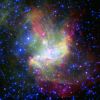
NGC-0346-PIA11227.jpgNGC 346 in the Small Magellanic Cloud64 visiteThis painterly portrait of a star-forming cloud, called NGC 346, is a combination of multiwavelength light from NASA's Spitzer Space Telescope (infrared), the European Southern Observatory's New Technology Telescope (visible), and the European Space Agency's XMM-Newton space telescope (X-ray).
The infrared observations highlight cold dust in red, visible data show glowing gas in green, and X-rays show very warm gas in blue. Ordinary stars appear as blue spots with white centers, while young stars enshrouded in dust appear as red spots with white centers.
The colorful picture demonstrates that stars in this region are being created by two different types of triggered star formation — one involving wind, and the other, radiation.
Triggered star formation occurs when massive stars spur new, smaller stars into existence. The first radiation-based mechanism is demonstrated near the center of the cloud. There, radiation from the massive stars is eating away at the surrounding dust cloud, creating shock waves that compress gas and dust into new stars. This compressed material appears as an arc-shaped orange-red filament, while the new stars within this filament are still blanketed with dust and cannot be seen.
The second wind-based mechanism is at play higher up in the cloud. The isolated, pinkish blob of stars at the upper left was triggered by winds from a massive star located to the left of it. This massive star blew up in a supernova explosion 50,000 years ago, but before it died, its winds pushed gas and dust together into new stars. While this massive star cannot be seen in the image, a bubble created when it exploded can be seen near the large, white spot with a blue halo at the upper left (this white spot is actually a collection of three stars).
NGC 346 is the brightest star-forming region in the Small Magellanic Cloud, an irregular dwarf galaxy that orbits our Milky Way galaxy, 210.000 LY away.MareKromium
|
|

ARP_274-HST-2009-14-a-print.jpgGalaxy Triplet Arp 27464 visiteArp 274, also known as NGC 5679, is a system of 3 galaxies that appear to be partially overlapping in the image, although they may be at somewhat different distances. The spiral shapes of 2 of these galaxies appear mostly intact. The third galaxy (to the far left) is more compact, but shows evidence of star formation.
Two of the three galaxies are forming new stars at a high rate. This is evident in the bright blue knots of star formation that are strung along the arms of the galaxy on the right and along the small galaxy on the left.
The largest component is located in the middle of the triplet. It appears as a Spiral Galaxy, which may be barred. The entire system resides at about 400 Million Light-Years away from Earth in the Virgo constellation.
Hubble's Wide Field Planetary Camera 2 was used to image Arp 274. Blue, visible, and infrared filters were combined with a filter that isolates hydrogen emission. The colors in this image reflect the intrinsic color of the different stellar populations that make up the galaxies. Yellowish older stars can be seen in the central bulge of each galaxy.
A bright central cluster of stars pinpoint each nucleus. Younger blue stars trace the spiral arms, along with pinkish nebulae that are illuminated by new star formation. Interstellar dust is silhouetted against the starry population. A pair of foreground stars inside our own Milky Way are at far right.MareKromium
|
|
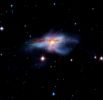
NGC-6240-PIA11828.jpgNGC 6240 - Colliding Galaxies64 visiteThis image of a pair of colliding galaxies called NGC 6240 shows them in a rare, short-lived phase of their evolution just before they merge into a single, larger galaxy. The prolonged, violent collision has drastically altered the appearance of both galaxies and created huge amounts of heat turning NGC 6240 into an "InfraRed Luminous" Active Galaxy.
A rich variety of active galaxies, with different shapes, luminosities and radiation profiles exist. These galaxies may be related astronomers have suspected that they may represent an evolutionary sequence. By catching different galaxies in different stages of merging, a story emerges as one type of active galaxy changes into another. NGC 6240 provides an important "missing link" in this process.
This image was created from combined data from the infrared array camera of NASA's Spitzer Space Telescope at 3.6 and 8.0 microns (red) and Visible Light from NASA's Hubble Space Telescope (green and blue).MareKromium
|
|

Galactic_Center-PIA12074.jpgNewborn Stars found near the Galactic Centre64 visiteThis InfraRed image from NASA's Spitzer Space Telescope shows 3 "baby stars" in the bustling center of our Milky Way galaxy.
The three stars are the first to be discovered in the region — previous attempts to find them were unsuccessful because there is so much dust standing between us and our galaxy's core.
Spitzer was able to find the newborn stars with its sharp InfraRed eyes, which can cut through dust.
The center of our galaxy is a hectic place. It's stuffed with stars, gas and dust. Astronomers have long wondered how stars can form in such chaotic circumstances. While they have known that stars are born there, they weren't able to see the stars forming until now. Astronomers plan to search for more newborn stars in the region, and ultimately learn more about stellar births at the center of the Milky Way.MareKromium
|
|

M-016-PIA09108.jpgThe many colors of the Eagle63 visiteThis set of images from NASA's Spitzer Space Telescope shows the Eagle Nebula in different hues of infrared light. Each view tells a different tale. The left picture shows lots of stars and dusty structures with clarity. Dusty molecules found on Earth called polycyclic aromatic hydrocarbons produce most of the red; gas is green and stars are blue.
The middle view is packed with drama, because it tells astronomers that a star in this region violently erupted, or went supernova, heating surrounding dust (orange). This view also reveals that the hot dust is shell shaped, another indication that a star exploded.
The final picture highlights the contrast between the hot, supernova-heated dust (green) and the cooler dust making up the region's dusty star-forming clouds and towers (red, blue and purple).
The left image is a composite of infrared light with the following wavelengths: 3.6 microns (blue); 4.5 microns (green); 5.8 microns (orange); and 8 microns (red). The right image includes longer infrared wavelengths, and is a composite of light of 4.5 to 8.0 microns (blue); 24 microns (green); and 70 microns (red). The middle image is made up solely of 24-micron light.
|
|

Spectrum-PIA09197.jpgSpectrum of an Alien World63 visiteThis infrared data from NASA's Spitzer Space Telescope - called a spectrum - tells astronomers that a distant gas planet, a so-called "hot Jupiter" called HD 209458b, might be smothered with high clouds. It is one of the first spectra of an alien world.
A spectrum is created when an instrument called a spectrograph cracks light from an object open into a rainbow of different wavelengths. Patterns or ripples within the spectrum indicate the presence, or absence, of molecules making up the object.
Astronomers using Spitzer's spectrograph were able to obtain infrared spectra for two so-called "transiting" hot-Jupiter planets using the "secondary eclipse" technique. In this method, the spectrograph first collects the combined infrared light from the planet plus its star, then, as the planet is eclipsed by the star, the infrared light of just the star. Subtracting the latter from the former reveals the planet's own rainbow of infrared colors.
When astronomers first saw the infrared spectrum above, they were shocked. It doesn't look anything like what theorists had predicted. For example, theorists thought there'd be signatures of water in the wavelength ranges of 8 to 9 microns. The fact that water is not detected might indicate that it is hidden under a thick blanket of high, dry clouds.
In addition, the spectrum shows signs of silicate dust -- tiny grains of sand -- in the wavelength range of 9 to 10 microns. This suggests that the planet's skies could be filled with high clouds of dust unlike anything seen in our own solar system.
There is also an unidentified molecular signature at 7.78 microns. Future observations using Spitzer's spectrograph should be able to determine the nature of the mysterious feature.
This spectrum was produced by Dr. Jeremy Richardson of NASA's Goddard Space Flight Center, Greenbelt, Md. and his colleagues. The data were taken by Spitzer's infrared spectrograph on July 6 and 13, 2005.
|
|

Spectrum-PIA09199.jpgSpectrum of an Alien World63 visiteThis infrared data from NASA's Spitzer Space Telescope - called a spectrum - tells astronomers that a distant gas planet, a so-called "hot Jupiter" called HD 189733b, might be smothered with high clouds. It is one of the first spectra of an alien world.
A spectrum is created when an instrument called a spectrograph cracks light from an object open into a rainbow of different wavelengths. Patterns or ripples within the spectrum indicate the presence, or absence, of molecules making up the object.
Astronomers using Spitzer's spectrograph were able to obtain infrared spectra for two so-called "transiting" hot-Jupiter planets using the "secondary eclipse" technique. In this method, the spectrograph first collects the combined infrared light from the planet plus its star, then, as the planet is eclipsed by the star, the infrared light of just the star. Subtracting the latter from the former reveals the planet's own rainbow of infrared colors.
Astronomers were perplexed when they first saw the infrared spectrum above. It doesn't look anything like what theorists had predicted. Theorists thought the spectra of hot, Jupiter-like planets like this one would be filled with the signatures of molecules in the planets' atmospheres. But the spectrum doesn't show any molecules, and is instead what astronomers call "flat." For example, theorists thought there'd be a strong signature of water in the form of a big drop in the wavelength range between 7 and 10 microns. The fact that water is not detected may indicate that it is hidden underneath a thick blanket of high, dry clouds. The average brightness of the spectrum is also a bit lower than theoretical predictions, suggesting that very high winds are rapidly moving the terrific heat of the noonday sun from the day side of HD 189733b to the night side.
This spectrum was produced by Dr. Carl Grillmair of NASA's Spitzer Science Center at the California Institute of Technology in Pasadena, Calif., and his colleagues. The data were taken by Spitzer's infrared spectrograph on November 22, 2006.
|
|
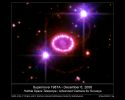
SN-1987A.jpgSupernova 1987A63 visiteTwenty years ago, astronomers witnessed one of the brightest stellar explosions in more than 400 years. The titanic supernova, called SN 1987A, blazed with the power of 100 million suns for several months following its discovery on Feb. 23, 1987.
Observations of SN 1987A, made over the past 20 years by NASA's Hubble Space Telescope and many other major ground- and space-based telescopes, have significantly changed astronomers' views of how massive stars end their lives. Astronomers credit Hubble's sharp vision with yielding important clues about the massive star's demise.
"The sharp pictures from the Hubble telescope help us ask and answer new questions about Supernova 1987A," said Robert Kirshner, of the Harvard-Smithsonian Center for Astrophysics in Cambridge, Mass. "In fact, without Hubble we wouldn't even know what to ask."
Kirshner is the lead investigator of an international collaboration to study the doomed star. Studying supernovae like SN 1987A is important because the exploding stars create elements, such as carbon and iron, that make up new stars, galaxies, and even humans. The iron in a person's blood, for example, was manufactured in supernova explosions. SN 1987A ejected 20,000 Earth masses of radioactive iron. The core of the shredded star is now glowing because of radioactive titanium that was cooked up in the explosion.
The star is 163,000 light-years away in the Large Magellanic Cloud. It actually blew up about 161,000 B.C., but its light arrived here in 1987.
Kirshner has used the Hubble telescope to monitor the supernova. "The Hubble observations have helped us rewrite the textbooks on exploding stars. We found that the actual world is more complicated and interesting than anyone dared to imagine. There are mysterious triple rings of glowing gas and powerful blasts sent out from the explosion that are just having an impact now, 20 years later."
Before SN 1987A, astronomers had a "simplified, idealized model of a supernova," Kirshner explained. "We thought the explosions were spherical and we didn't think much about the gas a star would exhale in the thousands of years before it exploded. The actual shreds of the star in SN 1987A are elongated — more like a jellybean than a gumball, and the fastest-moving debris is slamming into the gas that was already out there from previous millennia. Who would have guessed?"
Hubble wasn't even around when astronomers first spotted the supernova in 1987. When Hubble was launched three years later, astronomers didn't waste any time in using the telescope to study the stellar blast. Its first peek was in 1990, the year the observatory launched. Since then, the telescope has taken hundreds of pictures of the doomed star.
The Hubble studies have revealed the following details about the supernova:
*A glowing ring, about a light-year in diameter, around the supernova. The ring was there at least 20,000 years before the star exploded. X-rays from the explosion energized the gas in the ring, making it glow for two decades.
*Two outer loops of glowing gas, which had been imaged by ground-based telescopes, were seen more clearly by Hubble.
*A dumbbell-shaped central structure that has now grown to one-tenth of a light-year long. The structure consists of two blobs of debris in the center of the supernova racing away from each other at roughly 20 million miles an hour.
*The onrushing stellar shock wave from the stellar explosion is slamming into, heating up, and illuminating the inner regions of the narrow ring surrounding the doomed star.
Hubble continues to watch as the blast debris moves through the ring. The light show makes the glowing ring look like a pearl necklace. Astronomers think the whole ring will be illuminated in a few years.
The glowing ring is expected to become bright enough to illuminate the star's surroundings, which will provide astronomers with new information on how the star ejected material before the explosion.
Astronomers are analyzing images by NASA's Spitzer Space Telescope to try to understand the fate of the dust that surrounds the exploded star and in the neighborhood around the blast.
"We will learn more in the future when the shock wave moves through the inner ring and slams into the outer rings and illuminates them," Kirshner said. "It could lead to clues about the last 20,000 years of the star. But there are many things that are still a mystery. We still do not understand the evolution of the star before the explosion or how the three rings formed. We also think that the star may be part of a binary system."
Astronomers also are still looking for evidence of a black hole or a neutron star left behind by the blast. The fiery death of massive stars usually creates these energetic objects. Most astronomers think a neutron star formed 20 years ago. Kirshner said the object could be obscured by dust or it could have become a black hole.
He plans to use the infrared capabilities of the Wide Field Camera 3 — an instrument scheduled to be installed during the upcoming Hubble servicing mission — to hunt for a stellar remnant. Scientists will use another instrument planned for installment during the mission, the Cosmic Origins Spectrograph, to analyze the supernova's chemical composition and velocities.
The James Webb Space Telescope, scheduled for launch in 2013, will be able to see infrared light from the ring that is 10 times fainter than what astronomers see today. The debris inside the ring will begin to brighten, and astronomers will get another chance to study the interior of an exploded star.
|
|
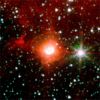
Supernova-PIA09119.jpgBipolar Nebula63 visiteCaption NASA:"A luminous blue variable star in our galaxy, named HD168625, surrounded by a bipolar nebula that is similar to the one around SN1987A.
SN1987A was a supernova that exploded in 1987 in the Large Magellanic Cloud, and was the nearest supernova in about 400 years.
Rings near the equator are sometimes seen around stars that shed mass from their surfaces, but the larger rings above the poles are very rare. Tipped toward Earth and illuminated by the star, the rings look like ellipses in images taken with NASA's Spitzer Space Telescope.
The image was taken in 2004 by the infrared array camera on Spitzer at wavelengths between 3,6 and 8 microns. The massive star at the center, which lies within the constellation Sagittarius, is about 7.200 Light-Years from Earth". MareKromium
|
|
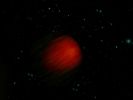
HD149026b_-PIA09378.jpgHot, Black and (relatively) Close...63 visiteThis artist's concept illustrates the hottest planet yet observed in the universe.
The scorching ball of gas, a "Hot Jupiter" called HD 149026b, is a sweltering 3700° Fahrenheit (2040° Celsius) -- about 3 times hotter than the rocky surface of Venus, the hottest planet in our Solar System. The Planet is so hot that astronomers believe it is absorbing almost all of the heat from its star and reflecting very little to no light. Objects that reflect no sunlight are black. Consequently, HD 149026b might be the blackest known planet in the universe, in addition to the hottest.
The temperature of this dark and balmy planet was taken with NASA's SST. While the planet reflects no visible light, its heat causes it to radiate a little visible and a lot of infrared light. Spitzer, an infrared observatory, was able to measure this infrared light through a technique called secondary eclipse. HD 149026b is what is known as a transiting planet, which means that it crosses in front of in front of and passes behind its star -- the secondary eclipse -- when viewed from Earth. By determining the drop in total infrared light that occurs when the planet disappears, astronomers can figure out how much infrared light is coming from the planet alone.
The Spitzer observations of HD 149026b also suggest a hot spot in the middle of the side of the planet that always faces its star. Even though the planet is black, the spot would glow like a black lump of charcoal. HD 149026b is thought to be tidally locked, just as our moon is to Earth, such that one side of the planet is perpetually baked under the heat of its sun.
Astronomers think that HD 149026b is probably blazing hot on its sunlit side, and much cooler on its dark side. A similar phenomenon was observed previously by Spitzer for the planet Upsilon Andromedae b.
In the case of both planets, heat is not being evenly distributed across their surfaces. This is the opposite of what happens on Jupiter, where temperature differences are minimal all around.
HD 149026b is located 256 light-years away in the constellation Hercules. It is the smallest known transiting planet, with a size similar to Saturn's and a suspected dense core 70 to 90 times the mass of Earth. It speeds around its star every 2.9 days.
MareKromium
|
|
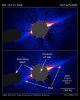
HD-15115.jpgLopsided debris disk around the young star HD 1511563 visiteThe disk, seen edge-on, is the dense blue line extending from the star to the upper right and lower left of the image. As seen from Earth, the edge-on disk resembles a needle sticking out from the star. The disk appears thicker and longer at upper right than at lower left, evidence of the disk's lopsided structure.
Astronomers think the disk's odd imbalanced look is caused by dust particles following a highly elliptical orbit around the star, which is slightly brighter than the Sun. The lopsidedness may have been caused by planets sweeping up debris in the disk or by the gravity of a nearby star.
Astronomers used an occulting mask on Hubble's Advanced Camera for Surveys to block out the bright starlight so they could see the dim disk. The occulting masks can be seen in the image as the dark circle in the center and the dark bar on the left. The star is behind the central mask.
HD 15115 is among nearly 30 stars that belong to the Beta Pictoris Moving Group. Moving groups are expanded clusters of stars believed to have a common birthplace and age, in this case about 12 million years, that are traveling together loosely through space. HD 15115 is 150 light-years from Earth.
Dusty disks are known to exist around at least 100 stars, but because of the difficulty in observing material close to the brightness of a star, less than a dozen have been studied closely.
Astronomers described the disk as one of the most peculiar debris disks that Hubble has ever imaged. They in fact made follow-up observations with the W.M. Keck Observatory in Hawaii to confirm the disk's presence.
Hubble's Advanced Camera for Surveys snapped the image on July 17, 2006.
MareKromium
|
|
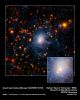
PIA09955_fig2.jpgFearsome Foursome (Figure 2)63 visiteFigure 2 is similar to figure 1 except the color blue represents X-ray light captured by NASA's Chandra X-ray Observatory. The colliding galaxies appear white in this picture because they are in areas where all the colors overlap.
The WIYN telescope, located near Tucson, Ariz., is owned and operated by the WIYN Consortium, which consists of the University of Wisconsin, Indiana University, Yale University, and the National Optical Astronomy Observatory.MareKromium
|
|
| 157 immagini su 14 pagina(e) |
|
|
|
|
|
8 | |
|
|
|
|
|
|





