| |

| Piú viste - The Universe in Super Definition |
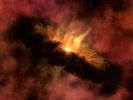
NGC-1333-PIA09967.jpgNGC 133364 visiteNASA's Spitzer Space Telescope observed a fledgling Solar System like the one depicted in this artist's concept, and discovered deep within it enough water vapor to fill the oceans on Earth five times. This water vapor starts out in the form of ice in a cloudy cocoon (not pictured) that surrounds the embryonic star, called NGC 1333-IRAS 4B (buried in center of image).
Material from the cocoon, including ice, falls toward the center of the cloud. The ice then smacks down onto a dusty pre-planetary disk circling the stellar embryo (doughnut-shaped cloud) and vaporizes.
Eventually, this water might make its way into developing planets.MareKromium
|
|
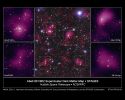
Abell-901_and_902-PM.jpgAbell 901 and 902 Supercluster64 visiteAstronomers are using NASA's Hubble Space Telescope to dissect one of the largest structures in the universe as part of a quest to understand the violent lives of galaxies. Hubble is providing indirect evidence of unseen dark matter tugging on galaxies in the crowded, rough-and-tumble environment of a massive supercluster of hundreds of galaxies.
Dark matter is an invisible form of matter that accounts for most of the universe's mass. Hubble's Advanced Camera for Surveys has mapped the invisible dark matter scaffolding of the supercluster Abell 901/902, as well as the detailed structure of individual galaxies embedded in it.
The images are part of the Space Telescope Abell 901/902 Galaxy Evolution Survey (STAGES), which covers one of the largest patches of sky ever observed by the Hubble telescope. The area surveyed is so wide that it took 80 Hubble images to cover the entire STAGES field. The new work is led by Meghan Gray of the University of Nottingham in the United Kingdom and Catherine Heymans of the University of British Columbia in Vancouver, along with an international team of scientists.
The Hubble study pinpointed four main areas in the supercluster where dark matter has pooled into dense clumps, totaling 100 trillion times the Sun's mass. These areas match the location of hundreds of old galaxies that have experienced a violent history in their passage from the outskirts of the supercluster into these dense regions. These galaxies make up four separate galaxy clusters.
"Thanks to Hubble's Advanced Camera for Surveys, we are detecting for the first time the irregular clumps of dark matter in this supercluster," Heymans said. "We can even see an extension of the dark matter toward a very hot group of galaxies that are emitting X-rays as they fall into the densest cluster core."
The dark matter map was constructed by measuring the distorted shapes of over 60,000 faraway galaxies. To reach Earth, the galaxies' light traveled through the dark matter that surrounds the supercluster galaxies and was bent by the massive gravitational field. Heymans used the observed, subtle distortion of the galaxies' shapes to reconstruct the dark matter distribution in the supercluster using a method called weak gravitational lensing. The dark matter map is 2.5 times sharper than a previous ground-based survey of the supercluster.
"The new map of the underlying dark matter in the supercluster is one key piece of this puzzle," Gray explained. "At the same time we're looking in detail at the galaxies themselves." The survey's broader goal is to understand how galaxies are influenced by the environment in which they live.
On Earth, the pace of quiet country life is vastly different from the hustle of the big city. In the same way, galaxies living lonely isolated lives look very different from those found in the most crowded regions of the universe, like a supercluster. "We've known for a long time that galaxies in crowded environments tend to be older, redder, and rounder than those in the field," Gray said. "Galaxies are continually drawn into larger and larger groups and clusters by the inevitable force of gravity as the universe evolves."
In such busy environments galaxies are subject to a life of violence: high-speed collisions with other galaxies; the stripping away of gas, the fuel supply they use to form new stars; and distortion due to the strong gravitational pull of the underlying invisible dark matter. "Any or all of these effects may play a role in the transformation of galaxies, which is what we're trying to determine," Gray said.
The STAGES survey's simultaneous focus on both the big picture and the details can be likened to studying a big city. "It's as if we're trying to learn everything we can about New York City and New Yorkers," Gray explained. "We're examining large-scale features, like mapping the roads, counting skyscrapers, monitoring traffic. At the same time we're also studying the residents to figure out how the lifestyles of people living downtown differ from those out in the suburbs. But in our case the city is a supercluster, the roads are dark matter, and the people are galaxies."
Further results by other team members support this view. "In the STAGES supercluster we clearly see that transformations are happening in the outskirts of the supercluster, where galaxies are still moving relatively slowly and first feel the influence of the cluster environment," said Christian Wolf, an Advanced Research Fellow at the University of Oxford in the U.K.
Assistant professor Shardha Jogee and graduate student Amanda Heiderman, both of the University of Texas in Austin, concur. "We see more collisions between galaxies in the regions toward which the galaxies are flowing than in the centers of the clusters," Jogee said. "By the time they reach the center, they are moving too fast to collide and merge, but in the outskirts their pace is more leisurely, and they still have time to interact."
The STAGES team also finds that the outer parts of the clusters are where star formation in the galaxies is slowly switching off and where the supermassive black holes at the hearts of the galaxies are most active.
Added Heiderman: "The galaxies at the centers of the clusters may have been there for a long time and have probably finished their transformation. They are now old, round, red, and dead."
The team plans more studies to understand how the supercluster environment is responsible for producing these changes.
Abell 901/902 resides 2.6 billion light-years from Earth and measures more than 16 million light-years across.
MareKromium
|
|

GRB-080319B.jpgSpace "Flash"! GRB-080319B64 visiteCaption NASA:"Peering across 7,5 BLY (Billion Light-Years) and halfway back to the Big Bang, NASA's Hubble Space Telescope has photographed the fading optical counterpart of a powerful Gamma Ray Burst (GRB) that holds the record for being the intrinsically brightest naked-eye object ever seen from Earth. For nearly a minute this single star was as bright as 10 million galaxies.
Hubble Wide Field and Planetary Camera 2 (WFPC2) images of GRB 080319B, taken on Monday, April 7, 2008, show the fading optical counterpart of the titanic blast. The object erupted in a brilliant flash of Gamma Rays and other electromagnetic radiation at 2:12 a.m. EDT on March 19, and was detected by Swift, NASA's Gamma Ray Burst "Watchdog Satellite". Immediately after the explosion, the Gamma Ray Burst glowed as a dim 5th magnitude "star" in the spring constellation Bootes.
Designated GRB 080319B, the intergalactic firework has been fading away ever since then. Hubble astronomers had hoped to see the host galaxy where the burst presumably originated, but were taken aback that the light from the GRB is still drowning out the galaxy's light even three weeks after the explosion.
This is particularly surprising because it was such a bright GRB initially. Previously, bright bursts have tended to fade more rapidly, which fits in to the theory that brighter GRBs emit their energy in a more tightly confined beam. The slow fading leaves astronomers puzzling about just where the energy came from to power this GRB, and makes Hubble's next observations of this object in May 2008 all the more crucial.
Called a Long-Duration GRB, such events are theorized to be caused by the death of a very massive star, perhaps weighing as much as 50 times our Sun. Such explosions, sometimes dubbed "hypernovae", are more powerful than ordinary supernova explosions and are far more luminous, in part because their energy seems to be concentrated into a blowtorch-like beam that, in this case, was aimed directly at Earth. The Hubble exposure also shows field galaxies around the fading optical component of the gamma ray burst, which are probably unrelated to the burst itself".MareKromium
|
|

NGC-3324-HST.jpgNGC 3324 - Star-forming Region64 visiteThe landmark 10th anniversary of the Hubble Space Telescope's Hubble Heritage Project is being celebrated with a 'landscape' image from the cosmos. Cutting across a nearby star-forming region are the "hills and valleys" of gas and dust displayed in intricate detail. Set amid a backdrop of soft, glowing blue light are wispy tendrils of gas as well as dark trunks of dust that are light-years in height.
The Hubble Heritage Project, which began in October 1998, has released nearly 130 images mined from the Hubble data archive as well as a number of observations taken specifically for the project. By releasing a new, previously unseen Hubble image every month, the team's intent was to showcase some of the most attractive images ever taken by the Hubble telescope, and share them with a wide audience. The Heritage team continues to create aesthetic images that present the universe from an artistic perspective.
This month's three-dimensional-looking Hubble image shows the edge of the giant gaseous cavity within the star-forming region called NGC 3324. The glowing nebula has been carved out by intense ultraviolet radiation and stellar winds from several hot, young stars. A cluster of extremely massive stars, located well outside this image in the center of the nebula, is responsible for the ionization of the nebula and excavation of the cavity.
The image also reveals dramatic dark towers of cool gas and dust that rise above the glowing wall of gas. The dense gas at the top resists the blistering ultraviolet radiation from the central stars, and creates a tower that points in the direction of the energy flow. The high-energy radiation blazing out from the hot, young stars in NGC 3324 is sculpting the wall of the nebula by slowly eroding it away.
Located in the Southern Hemisphere, NGC 3324 is at the northwest corner of the Carina Nebula (NGC 3372), home of the Keyhole Nebula and the active, outbursting star Eta Carinae. The entire Carina Nebula complex is located at a distance of roughly 7,200 light-years, and lies in the constellation Carina.
This image is a composite of data taken with two of Hubble's science instruments. Data taken with the Advanced Camera for Surveys (ACS) in 2006 isolated light emitted by hydrogen. More recent data, taken in 2008 with the Wide Field Planetary Camera 2 (WFPC2), isolated light emitted by sulfur and oxygen gas. To create a color composite, the data from the sulfur filter are represented by red, from the oxygen filter by blue, and from the hydrogen filter by green.
The Heritage project has released images using several of Hubble's optical cameras: the Wide Field Planetary Camera (WF/PC), which was installed when the telescope was first deployed in 1990; WFPC2, which replaced WFPC in 1993 and is still in service today; and ACS, which was added in 2002. After the Hubble Servicing Mission in early 2009, the Hubble Heritage team hopes to continue using ACS as well as the newest of the optical cameras, Wide Field Camera 3.
MareKromium
|
|
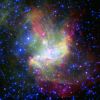
NGC-0346-PIA11227.jpgNGC 346 in the Small Magellanic Cloud64 visiteThis painterly portrait of a star-forming cloud, called NGC 346, is a combination of multiwavelength light from NASA's Spitzer Space Telescope (infrared), the European Southern Observatory's New Technology Telescope (visible), and the European Space Agency's XMM-Newton space telescope (X-ray).
The infrared observations highlight cold dust in red, visible data show glowing gas in green, and X-rays show very warm gas in blue. Ordinary stars appear as blue spots with white centers, while young stars enshrouded in dust appear as red spots with white centers.
The colorful picture demonstrates that stars in this region are being created by two different types of triggered star formation — one involving wind, and the other, radiation.
Triggered star formation occurs when massive stars spur new, smaller stars into existence. The first radiation-based mechanism is demonstrated near the center of the cloud. There, radiation from the massive stars is eating away at the surrounding dust cloud, creating shock waves that compress gas and dust into new stars. This compressed material appears as an arc-shaped orange-red filament, while the new stars within this filament are still blanketed with dust and cannot be seen.
The second wind-based mechanism is at play higher up in the cloud. The isolated, pinkish blob of stars at the upper left was triggered by winds from a massive star located to the left of it. This massive star blew up in a supernova explosion 50,000 years ago, but before it died, its winds pushed gas and dust together into new stars. While this massive star cannot be seen in the image, a bubble created when it exploded can be seen near the large, white spot with a blue halo at the upper left (this white spot is actually a collection of three stars).
NGC 346 is the brightest star-forming region in the Small Magellanic Cloud, an irregular dwarf galaxy that orbits our Milky Way galaxy, 210.000 LY away.MareKromium
|
|

ARP-147.jpgARP 14764 visiteJust a couple of days after the orbiting observatory was brought back online, Hubble aimed its prime working camera, the Wide Field Planetary Camera 2 (WFPC2), at a particularly intriguing target, a pair of Gravitationally Interacting Galaxies called Arp 147.
The image demonstrated that the camera is working exactly as it was before going offline, thereby scoring a "perfect 10" both for performance and beauty.
The two galaxies happen to be oriented so that they appear to mark the number 10. The left-most galaxy, or the "one" in this image, is relatively undisturbed apart from a smooth ring of starlight. It appears nearly on edge to our line of sight. The right-most galaxy, resembling a zero, exhibits a clumpy, blue ring of intense star formation.
The blue ring was most probably formed after the galaxy on the left passed through the galaxy on the right. Just as a pebble thrown into a pond creates an outwardly moving circular wave, a propagating density wave was generated at the point of impact and spread outward. As this density wave collided with material in the target galaxy that was moving inward due to the gravitational pull of the two galaxies, shocks and dense gas were produced, stimulating star formation.
The dusty reddish knot at the lower left of the blue ring probably marks the location of the original nucleus of the galaxy that was hit.
Arp 147 appears in the Arp Atlas of Peculiar Galaxies, compiled by Halton Arp in the 1960s and published in 1966.
This picture was assembled from WFPC2 images taken with three separate filters. The blue, visible-light, and infrared filters are represented by the colors blue, green, and red, respectively.
The galaxy pair was photographed on October 27-28, 2008. Arp 147 lies in the constellation Cetus, and it is more than 400 MLY away from Earth.MareKromium
|
|
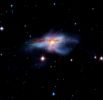
NGC-6240-PIA11828.jpgNGC 6240 - Colliding Galaxies64 visiteThis image of a pair of colliding galaxies called NGC 6240 shows them in a rare, short-lived phase of their evolution just before they merge into a single, larger galaxy. The prolonged, violent collision has drastically altered the appearance of both galaxies and created huge amounts of heat turning NGC 6240 into an "InfraRed Luminous" Active Galaxy.
A rich variety of active galaxies, with different shapes, luminosities and radiation profiles exist. These galaxies may be related astronomers have suspected that they may represent an evolutionary sequence. By catching different galaxies in different stages of merging, a story emerges as one type of active galaxy changes into another. NGC 6240 provides an important "missing link" in this process.
This image was created from combined data from the infrared array camera of NASA's Spitzer Space Telescope at 3.6 and 8.0 microns (red) and Visible Light from NASA's Hubble Space Telescope (green and blue).MareKromium
|
|

Galactic_Center-PIA12074.jpgNewborn Stars found near the Galactic Centre64 visiteThis InfraRed image from NASA's Spitzer Space Telescope shows 3 "baby stars" in the bustling center of our Milky Way galaxy.
The three stars are the first to be discovered in the region — previous attempts to find them were unsuccessful because there is so much dust standing between us and our galaxy's core.
Spitzer was able to find the newborn stars with its sharp InfraRed eyes, which can cut through dust.
The center of our galaxy is a hectic place. It's stuffed with stars, gas and dust. Astronomers have long wondered how stars can form in such chaotic circumstances. While they have known that stars are born there, they weren't able to see the stars forming until now. Astronomers plan to search for more newborn stars in the region, and ultimately learn more about stellar births at the center of the Milky Way.MareKromium
|
|

DR22.jpgCygnus Region (DR22; NGC 4145 and NGC 4361)64 visiteThese images are some of the first to be taken during Spitzer's warm mission -- a new phase that began after the telescope, which operated for more than five-and-a-half years, ran out of liquid coolant. The pictures were snapped with the two InfraRed Channels that still work at Spitzer's still-quite-chilly temperature of 30 Kelvin (about - 406 degrees Fahrenheit). The two InfraRed Channels are part of Spitzer's InfraRed Array Camera: 3.6-micron light is blue and 4.5-micron light is orange.
The main image shows a cloud, known as DR22, bursting with new stars in the Cygnus Region of the sky.
Spitzer's infrared eyes can see dust, and see through dust, giving it a unique view into star-forming nests. The blue areas are dusty clouds, and the orange is mainly hot gas.MareKromium
|
|

30-Doradus.jpg30 Doradus and R-13664 visiteThe massive, young stellar grouping, called R136, is only a few million years old and resides in the 30 Doradus Nebula, a turbulent star-birth region in the Large Magellanic Cloud (LMC), a satellite galaxy of our Milky Way. Many of the stars are among the most massive known. Several of them are over 100 times more massive than our Sun. These hefty stars are destined to become supernovae in a few million years.
The image, taken by Hubble's Wide Field Camera 3, spans about 100 light-years. The nebula is close enough to Earth that Hubble can resolve individual stars, giving astronomers important information about the stars' birth and evolution.
The brilliant stars are carving deep cavities in the surrounding material by unleashing a torrent of ultraviolet light, and hurricane-force stellar winds (streams of charged particles), which are etching away the enveloping hydrogen gas cloud in which the stars were born. The image reveals a fantasy landscape of pillars, ridges, and valleys, as well as a dark region in the center that roughly looks like the outline of a holiday tree. Besides sculpting the gaseous terrain, the brilliant stars can also help create a successive generation of offspring. When the winds hit dense walls of gas, they create shocks, which may be generating a new wave of star birth.
The movement of the LMC around the Milky Way may have triggered the massive cluster's formation in several ways. The gravitational tug of the Milky Way and the companion Small Magellanic Cloud may have compressed gas in the LMC. Also, the pressure resulting from the LMC plowing through the Milky Way's halo may have compressed gas in the satellite. The cluster is a rare, nearby example of the many super star clusters that formed in the distant, early universe, when star birth and galaxy interactions were more frequent. Previous Hubble observations have shown astronomers that super star clusters in faraway galaxies are ubiquitous. The LMC is located 170,000 light-years away and is a member of the Local Group of Galaxies, which also includes the Milky Way.
The Hubble image was taken at infrared wavelengths (1.1 microns and 1.6 microns). Hubble sees through the dusty nebula, revealing many stars that cannot be seen in visible light. The large bright star just above the center of the image is in the 30 Doradus nebula. The Hubble observations of 30 Doradus were made October 20-27, 2009.MareKromium
|
|

M 82-PIA08093.jpgM 82: A "Space Rainbow"63 visiteCaption NASA originale:"NASA's Spitzer, Hubble and Chandra Space Observatories teamed up to create this multi-wavelength, false-colored view of the M82 galaxy.
The lively portrait celebrates Hubble's "sweet sixteen" birthday.
X-ray data recorded by Chandra appears in blue; infrared light recorded by Spitzer appears in red; Hubble's observations of hydrogen emission appear in orange, and the bluest visible light appears in yellow-green".
|
|

Life-PIA03538.jpgLife!63 visiteThis artist's conception symbolically represents complex organic molecules, known as polycyclic aromatic hydrocarbons, seen in the early universe. These large molecules, comprised of carbon and hydrogen, are considered among the building blocks of life.
NASA's Spitzer Space Telescope is the first telescope to see polycyclic aromatic hydrocarbons so early -- 10 billion years further back in time than seen previously. Spitzer detected these molecules in galaxies when our universe was one-fourth of its current age of about 14 billion years.
These complex molecules are very common on Earth. They form any time carbon-based materials are not burned completely. They can be found in sooty exhaust from cars and airplanes, and in charcoal broiled hamburgers and burnt toast.
Polycyclic aromatic hydrocarbons are pervasive in galaxies like our own Milky Way, and play a significant role in star and planet formation.
|
|
| 157 immagini su 14 pagina(e) |
|
|
|
|
|
7 | |
|
|
|
|
|
|





