| |

| Piú viste - The Universe in Super Definition |

Life-PIA03538.jpgLife!68 visiteThis artist's conception symbolically represents complex organic molecules, known as polycyclic aromatic hydrocarbons, seen in the early universe. These large molecules, comprised of carbon and hydrogen, are considered among the building blocks of life.
NASA's Spitzer Space Telescope is the first telescope to see polycyclic aromatic hydrocarbons so early -- 10 billion years further back in time than seen previously. Spitzer detected these molecules in galaxies when our universe was one-fourth of its current age of about 14 billion years.
These complex molecules are very common on Earth. They form any time carbon-based materials are not burned completely. They can be found in sooty exhaust from cars and airplanes, and in charcoal broiled hamburgers and burnt toast.
Polycyclic aromatic hydrocarbons are pervasive in galaxies like our own Milky Way, and play a significant role in star and planet formation.
|
|

M 42-PIA08653.jpgMoments of M-4268 visiteThis infrared image from NASA's Spitzer Space Telescope shows the Orion nebula, our closest massive star-making factory, 1,450 light-years from Earth. The nebula is close enough to appear to the naked eye as a fuzzy star in the sword of the popular hunter constellation.
The nebula itself is located on the lower half of the image, surrounded by a ring of dust. It formed in a cold cloud of gas and dust and contains about 1,000 young stars. These stars illuminate the cloud, creating the beautiful nebulosity, or swirls of material, seen here in infrared.
In the center of the nebula (bottom inset of figure 1) are four monstrously massive stars, up to 100,000 times as luminous as our sun, called the Trapezium (tiny yellow smudge to the lower left of green splotches. Radiation and winds from these stars are blasting gas and dust away, excavating a cavity walled in by the large ring of dust.
Behind the Trapezium, still buried deeply in the cloud, a second generation of massive stars is forming (in the area with green splotches). The speckled green fuzz in this bright region is created when bullets of gas shoot out from the juvenile stars and ram into the surrounding cloud.
Above this region of intense activity are networks of cold material that appear as dark veins against the pinkish nebulosity (upper inset pf figure 1). These dark veins contain embryonic stars. Some of the natal stars illuminate the cloud, creating small, aqua-colored wisps. In addition, jets of gas from the stars ram into the cloud, resulting in the green horseshoe-shaped globs.
Spitzer surveyed a significant swath of the Orion constellation, beyond what is highlighted in this image. Within that region, called the Orion cloud complex, the telescope found 2,300 stars circled by disks of planet-forming dust and 200 stellar embryos too young to have developed disks.
This image shows infrared light captured by Spitzer's infrared array camera. Light with wavelengths of 8 and 5.8 microns (red and orange) comes mainly from dust that has been heated by starlight. Light of 4.5 microns (green) shows hot gas and dust; and light of 3.6 microns (blue) is from starlight.
|
|

HD-209458b-00.jpgExtra-Solar Planet HD-209458b (1)68 visiteThe powerful vision of NASA's HST has allowed astronomers to study for the first time the layer-cake structure of the atmosphere of a planet orbiting another star. HST discovered a dense upper layer of hot Hydrogen gas where the super-hot planet's atmosphere is bleeding off into space.
The planet, designated HD 209458b, is unlike any world in our Solar System. It orbits so close to its star and gets so hot that its gas is streaming into space, making the planet appear to have a comet-like tail. This new research reveals the layer in the planet's upper atmosphere where the gas becomes so heated it escapes, like steam rising from a boiler.
"The layer we studied is actually a transition zone where the temperature skyrockets from about 1340 deg. Fahrenheit (1000 Kelvin) to about 25.540 degrees (15.000 Kelvin), which is hotter than the Sun " said Gilda Ballester of the University of Arizona in Tucson, leader of the research team.
"With this detection we see the details of how a planet loses its atmosphere."
The findings by Ballester, David K. Sing of the University of Arizona and the Institut d'Astrophysique de Paris, and Floyd Herbert of the University of Arizona will appear Feb. 1 in a letter to the journal Nature.
The Hubble data show how intense ultraviolet radiation from the host star heats the gas in the upper atmosphere, inflating the atmosphere like a balloon. The gas is so hot that it moves very fast and escapes the planet's gravitational pull at a rate of 10,000 tons a second, more than three times the rate of water flowing over Niagara Falls. The planet, however, will not wither away any time soon. Astronomers estimate its lifetime is more than 5 billion years.
The scorched planet is a big puffy version of Jupiter. In fact, it is called a "hot Jupiter," a large gaseous planet orbiting very close to its parent star. Jupiter might even look like HD 209458b if it were close to the Sun, Ballester said.
The planet completes an orbit around its star every 3.5 days. It orbits 4.7 million miles from its host, 20 times closer than the Earth is to the Sun. By comparison, Mercury, the closest planet to our Sun, is 10 times farther away from the Sun than HD 209458b is from its star. Unlike HD 209458b, Mercury is a small ball of iron with a rocky crust.
|
|
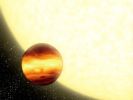
LonelyPlanet-PIA09118.jpgWhat's the weather like over there?68 visiteCaption NASA:"An artist's conception shows a gas-giant planet orbiting very close to its parent star, creating searingly hot conditions on the planet's surface.
New research suggests that for three such planets lying from 50 to 150 light-years from Earth, strong winds thousands of miles per hour mix the atmosphere so that the temperature is relatively uniform from the permanently light side to the permanently dark side.
This illustration represents an infrared view of a planetary system, in which brightness indicates warmer temperatures. For example, the bright band around the equator of the planet denotes warmer temperatures on both the dark and sunlit sides.
The planet's poles, shown in darker colors, would be cooler".MareKromium
|
|

TwoSuns-PIA09229.jpgTwin Suns, Planets and Asteroids68 visiteThis artist's image depicts a faraway Solar System like our own -- except for one big difference: planets and asteroids circle around not one, but two Suns. NASA's Spitzer Space Telescope found evidence that such Solar Systems might be common in the Universe. Spitzer did not see any planets directly, but it detected dust that is kicked up from disks like this one. The disks were spotted circling all the way around several double, or binary, stars, some of which were closer together than Earth is to our sun. In fact, Spitzer found more disks in orbit around close-knit binary stars than single stars. This could mean that planets prefer two parent stars to one, but more research is needed to figure out exactly what's going on.
|
|

Abell-1689.jpgGravitational "Lensing" for Abell 168968 visiteA massive cluster of yellowish galaxies is seemingly caught in a spider web of eerily distorted background galaxies in the left-hand image, taken with the Advanced Camera for Surveys (ACS) aboard NASA's Hubble Space Telescope.
The gravity of the cluster's trillion stars acts as a cosmic "zoom lens," bending and magnifying the light of the galaxies located far behind it, a technique called gravitational lensing. The faraway galaxies appear in the Hubble image as arc-shaped objects around the cluster, named Abell 1689. The increased magnification allows astronomers to study remote galaxies in greater detail.
One galaxy is so far away, however, it does not show up in the visible-light image taken with ACS [top, right], because its light is stretched to invisible infrared wavelengths by the universe's expansion.
Astronomers used Hubble's Near Infrared Camera and Multi-Object Spectrometer (NICMOS) and NASA's Spitzer Space Telescope with its Infrared Array Camera (IRAC)—with help from the gravitational lensing cluster—to see the faraway galaxy.
The distant galaxy, dubbed A1689-zD1, appears as a grayish-white smudge in the close-up view taken with Hubble's NICMOS [center, right], and as a whitish blob in the Spitzer IRAC close-up view [bottom, right]. The galaxy is brimming with star birth. Hubble and Spitzer worked together to show that it is one of the youngest galaxies ever discovered. Astronomers estimate that the galaxy is 12.8 billion light-years away. Abell 1689 is 2.2 billion light-years away.
A1689-zD1 was born during the middle of the "dark ages," a period in the early universe when the first stars and galaxies were just beginning to burst to life. The dark ages lasted from about 400,000 to roughly a billion years after the Big Bang. Astronomers think that A1689-zD1 was one of the galaxies that helped end the dark ages.
The ACS images were taken in 2002, the NICMOS images in 2005 and 2007, and the Spitzer IRAC images in 2006.
MareKromium
|
|
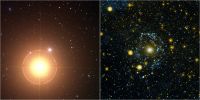
NGC-0404-PIA11393-1.jpgNGC 404 - The 'Ghost of Mirach' rears its Spooky Head68 visiteThe "Ghost of Mirach" Galaxy is shown in visible light on the left, and in UltraViolet as seen by NASA's Galaxy Evolution Explorer on the right. The fields of view are identical in both pictures, with the Ghost of Mirach — a galaxy also known as NGC 404 — seen as the whitish spot in the center of the images.
Mirach is a Red Giant star that looms large in visible light. Because NGC 404 is lost in the glare of this star, it was nicknamed the "Ghost of Mirach".
But when the galaxy is viewed in ultraviolet light, it comes to "life", revealing a never-before-seen ring. This ring, seen in blue in the picture on the right, contains new stars — a surprise considering that the galaxy was previously thought to be, essentially, dead.
The field of view spans 55.000 Light Years across. The Ghost of Mirach is located 11 MLY from Earth. The star Mirach is very close in comparison — since it is only 200 LY away and is visible with the naked eye.
The visible data come from the Digitized Sky Survey of the Space Telescope Science Institute in Baltimore, Md.MareKromium
|
|

Galactic_Center-PIA12074.jpgNewborn Stars found near the Galactic Centre68 visiteThis InfraRed image from NASA's Spitzer Space Telescope shows 3 "baby stars" in the bustling center of our Milky Way galaxy.
The three stars are the first to be discovered in the region — previous attempts to find them were unsuccessful because there is so much dust standing between us and our galaxy's core.
Spitzer was able to find the newborn stars with its sharp InfraRed eyes, which can cut through dust.
The center of our galaxy is a hectic place. It's stuffed with stars, gas and dust. Astronomers have long wondered how stars can form in such chaotic circumstances. While they have known that stars are born there, they weren't able to see the stars forming until now. Astronomers plan to search for more newborn stars in the region, and ultimately learn more about stellar births at the center of the Milky Way.MareKromium
|
|

PIA07854.jpgA beautiful "Asteroid Belt"67 visiteThis artist's animation illustrates a massive asteroid belt in orbit around a star the same age and size as our Sun. Evidence for this possible belt was discovered by NASA's Spitzer Space Telescope when it spotted warm dust around the star, presumably from asteroids smashing together.
The view starts from outside the belt, where planets like the one shown here might possibly reside, then moves into to the dusty belt itself. A collision between two asteroids is depicted near the end of the movie. Collisions like this replenish the dust in the asteroid belt, making it detectable to Spitzer.
The alien belt circles a faint, nearby star called HD 69830 located 41 light-years away in the constellation Puppis. Compared to our own solar system's asteroid belt, this one is larger and closer to its star - it is 25 times as massive, and lies just inside an orbit equivalent to that of Venus. Our asteroid belt circles between the orbits of Mars and Jupiter.
Because Jupiter acts as an outer wall to our asteroid belt, shepherding its debris into a series of bands, it is possible that an unseen planet is likewise marshalling this belt's rubble. Previous observations using the radial velocity technique did not locate any large gas giant planets, indicating that any planets present in this system would have to be the size of Saturn or smaller.
Asteroids are chunks of rock from "failed" planets, which never managed to coalesce into full-sized planets. Asteroid belts can be thought of as construction sites that accompany the building of rocky planets.
|
|
Z-Camelopardalis-PIA09219.jpgZ-Camelopardalis67 visiteThis composite image shows Z Camelopardalis, or Z Cam, a double-star system featuring a collapsed, dead star, called a white dwarf, and a companion star, as well as a ghostly shell around the system. The massive shell provides evidence of lingering material ejected during and swept up by a powerful classical nova explosion that occurred probably a few thousand years ago.
The image combines data gathered from the far-ultraviolet and near-ultraviolet detectors on NASA's Galaxy Evolution Explorer on Jan. 25, 2004. The orbiting observatory first began imaging Z Cam in 2003.
Z Cam is the largest white object in the image, located near the center. Parts of the shell are seen as a lobe-like, wispy, yellowish feature below and to the right of Z Cam, and as two large, whitish, perpendicular lines on the left.
Z Cam was one of the first known recurrent dwarf nova, meaning it erupts in a series of small, "hiccup-like" blasts, unlike classical novae, which undergo a massive explosion. That's why the huge shell around Z Cam caught the eye of astronomer Dr. Mark Seibert of Carnegie Institution of Washington in Pasadena, Calif. - it could only be explained as the remnant of a full-blown classical nova explosion. This finding provides the first evidence that some binary systems undergo both types of explosions. Previously, a link between the two types of novae had been predicted, but there was no evidence to support the theory.
The faint bluish streak in the bottom right corner of the image is ultraviolet light reflected by dust that may or may not be related to Z Cam. Numerous foreground and background stars and galaxies are visible as yellow and white spots. The yellow objects are strong near-ultraviolet emitters; blue features have strong far-ultraviolet emission; and white objects have nearly equal amounts of near-ultraviolet and far-ultraviolet emission.
|
|
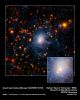
PIA09955_fig2.jpgFearsome Foursome (Figure 2)67 visiteFigure 2 is similar to figure 1 except the color blue represents X-ray light captured by NASA's Chandra X-ray Observatory. The colliding galaxies appear white in this picture because they are in areas where all the colors overlap.
The WIYN telescope, located near Tucson, Ariz., is owned and operated by the WIYN Consortium, which consists of the University of Wisconsin, Indiana University, Yale University, and the National Optical Astronomy Observatory.MareKromium
|
|

GRB-080319B.jpgSpace "Flash"! GRB-080319B67 visiteCaption NASA:"Peering across 7,5 BLY (Billion Light-Years) and halfway back to the Big Bang, NASA's Hubble Space Telescope has photographed the fading optical counterpart of a powerful Gamma Ray Burst (GRB) that holds the record for being the intrinsically brightest naked-eye object ever seen from Earth. For nearly a minute this single star was as bright as 10 million galaxies.
Hubble Wide Field and Planetary Camera 2 (WFPC2) images of GRB 080319B, taken on Monday, April 7, 2008, show the fading optical counterpart of the titanic blast. The object erupted in a brilliant flash of Gamma Rays and other electromagnetic radiation at 2:12 a.m. EDT on March 19, and was detected by Swift, NASA's Gamma Ray Burst "Watchdog Satellite". Immediately after the explosion, the Gamma Ray Burst glowed as a dim 5th magnitude "star" in the spring constellation Bootes.
Designated GRB 080319B, the intergalactic firework has been fading away ever since then. Hubble astronomers had hoped to see the host galaxy where the burst presumably originated, but were taken aback that the light from the GRB is still drowning out the galaxy's light even three weeks after the explosion.
This is particularly surprising because it was such a bright GRB initially. Previously, bright bursts have tended to fade more rapidly, which fits in to the theory that brighter GRBs emit their energy in a more tightly confined beam. The slow fading leaves astronomers puzzling about just where the energy came from to power this GRB, and makes Hubble's next observations of this object in May 2008 all the more crucial.
Called a Long-Duration GRB, such events are theorized to be caused by the death of a very massive star, perhaps weighing as much as 50 times our Sun. Such explosions, sometimes dubbed "hypernovae", are more powerful than ordinary supernova explosions and are far more luminous, in part because their energy seems to be concentrated into a blowtorch-like beam that, in this case, was aimed directly at Earth. The Hubble exposure also shows field galaxies around the fading optical component of the gamma ray burst, which are probably unrelated to the burst itself".MareKromium
|
|
| 157 immagini su 14 pagina(e) |
|
|
|
|
6 | |
|
|
|
|
|
|
|





