| |

| Piú viste - The Universe in Super Definition |
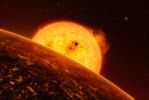
COROT7b-ESO.jpgExo-Planet CoRoT-7b68 visiteHow similar is exoplanet CoRoT-7b to Earth?
The newly discovered Extra-Solar Planet is the closest physical match yet, with a mass about five Earths and a radius of about 1,7 Earths. Also, the home star to CoRoT-7b, although 500 LY distant, is very similar to our Sun.
Unfortunately, the similarities likely end there, as CoRoT-7b orbits its home star well inside the orbit of Mercury, making its year last only 20 hours, and making its peak temperature much hotter than humans might find comfortable. CoRoT-7b was discovered in February by noting a predictable slight decrease in the brightness of its parent star.
Pictured above, an artist's depiction shows how CoRoT-7b might appear in front of its Parent Star. The composition of CoRoT-7b remains unknown, but given its size and mass, it cannot be a gas giant like Jupiter, and is very likely composed predominantly of rock. Future observations will likely narrow the composition of one of the first known rocky planets discovered outside of our Solar System.MareKromium
|
|
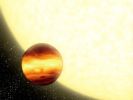
LonelyPlanet-PIA09118.jpgWhat's the weather like over there?67 visiteCaption NASA:"An artist's conception shows a gas-giant planet orbiting very close to its parent star, creating searingly hot conditions on the planet's surface.
New research suggests that for three such planets lying from 50 to 150 light-years from Earth, strong winds thousands of miles per hour mix the atmosphere so that the temperature is relatively uniform from the permanently light side to the permanently dark side.
This illustration represents an infrared view of a planetary system, in which brightness indicates warmer temperatures. For example, the bright band around the equator of the planet denotes warmer temperatures on both the dark and sunlit sides.
The planet's poles, shown in darker colors, would be cooler".MareKromium
|
|

BLG-109.jpgBLG-109: A Distant Version of our own Solar System67 visiteCaption NASA:"How common are planetary systems like our own?
Perhaps quite common, as the first system of planets like our own Solar System has been discovered using a newly adapted technique that, so far, has probed only six planetary systems.
The technique, called "Gravitational Microlensing", looks for telling brightness changes in measured starlight when a foreground star with planets chances almost directly in front of a more distant star. The distant star's light is slightly deflected in predictable ways by the gravity of the closer system.
Recently a detailed analysis of Microlensing System OGLE-2006-BLG-109 has related brightness variations to two planets that are similar to Jupiter and Saturn of our own Solar System. This discovery carries the tantalizing implication that interior planets, possibly including Earth-like planets, might also be common.
Pictured above is an artistic conception of how the BLG-109 planetary system might look".MareKromium
|
|
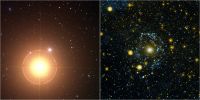
NGC-0404-PIA11393-1.jpgNGC 404 - The 'Ghost of Mirach' rears its Spooky Head67 visiteThe "Ghost of Mirach" Galaxy is shown in visible light on the left, and in UltraViolet as seen by NASA's Galaxy Evolution Explorer on the right. The fields of view are identical in both pictures, with the Ghost of Mirach — a galaxy also known as NGC 404 — seen as the whitish spot in the center of the images.
Mirach is a Red Giant star that looms large in visible light. Because NGC 404 is lost in the glare of this star, it was nicknamed the "Ghost of Mirach".
But when the galaxy is viewed in ultraviolet light, it comes to "life", revealing a never-before-seen ring. This ring, seen in blue in the picture on the right, contains new stars — a surprise considering that the galaxy was previously thought to be, essentially, dead.
The field of view spans 55.000 Light Years across. The Ghost of Mirach is located 11 MLY from Earth. The star Mirach is very close in comparison — since it is only 200 LY away and is visible with the naked eye.
The visible data come from the Digitized Sky Survey of the Space Telescope Science Institute in Baltimore, Md.MareKromium
|
|

GALEX Portrait-PIA03295.jpgPortrait of the Universe66 visiteFrom sparkling blue rings to dazzling golden disks, Galaxy Evolution Explorer (Galex) scientists are handing out a collection of their finest galactic treasures at the January 2006 American Astronomical Society meeting in Washington, D.C.
Mined from the mission's Survey of Nearby Galaxies data, these cosmic gems were collected with the telescope's sensitive ultraviolet instruments. The gallery of galaxies has been made into a poster for meeting attendees visiting the mission's booth. Organized from far-ultraviolet to near-ultraviolet bright galaxies, this poster encapsulates the heart of the mission to study how galaxies and star formation rates have changed over the past 10 billion years.
Events in space take millions or billions of years to unfold, which means that astronomers can't watch individual galaxies and stars age over time. Luckily, because the physics of light travel dictates that the farther away an object is from Earth, the longer it takes for its light to travel to us, the universe can be thought of as a time machine. By building telescopes sensitive enough to capture objects that are 10 billion light-years away, astronomers can essentially see an object the way it looked 10 billion years ago. Galex astronomers are using this phenomenon to their advantage by taking snapshots of different galaxies at various distances in space. By comparing portraits of numerous objects at various times in the universe's history, the team can begin to piece together the life cycle of stars and galaxies.
For the poster, Galex scientists organized 196 different nearby galaxies in bins of increasing ultraviolet color. By placing the various snapshots side by side, astronomers can see how galaxies age differently. When viewed in ultraviolet, active star-forming regions in galaxies can be seen as glittering blue structures, while a soft, golden glow indicates the presence of older stars.
The 196 galaxies represented in the poster were selected from more than 1,000 galaxies in the "Ultraviolet Atlas of Nearby Galaxies." So far, the Galex mission has surveyed more than 100 million galaxies.
|
|

Black Hole-PIA08697_fig1.jpgBlack Holes66 visiteThis diagram illustrates research from NASA's Galaxy Evolution Explorer showing that black holes -- once they reach a critical size -- can put the brakes on new star formation in elliptical galaxies.
In this graph, galaxies and their supermassive black holes are indicated by the drawings (the black circle at the center of each galaxy represents the black hole). The relative masses of the galaxies and their black holes are reflected in the sizes of the drawings. Blue indicates that the galaxy has new stars, while red means the galaxy does not have any detectable new stars.
The Galaxy Evolution Explorer observed the following trend: the biggest galaxies and black holes (shown in upper right corner) are more likely to have no observable star formation (red) than the smaller galaxies with smaller black holes. This is evidence that black holes can create environments unsuitable for stellar birth.
The white line in the diagram illustrates that, for any galaxy no matter what the mass, its black hole must reach a critical size before it can shut down star formation.
|
|

Dark_Matter.jpgBright Universe, Dark Matter66 visiteAn international team of astronomers using NASA's Hubble Space Telescope has created a three-dimensional map that provides the first direct look at the large-scale distribution of dark matter in the universe.
Dark matter is an invisible form of matter that accounts for most of the universe's mass.
The map provides the best evidence yet that normal matter, largely in the form of galaxies, accumulates along the densest concentrations of dark matter. The map reveals a loose network of filaments that grew over time and intersect in massive structures at the locations of clusters of galaxies.
The map stretches halfway back to the beginning of the universe and shows how dark matter has grown increasingly "clumpy" as it collapses under gravity.
This milestone takes astronomers from inference to direct observation of dark matter's influence in the universe. Previous studies of dark matter are based largely on numerical simulations of the expected evolution of large-scale structure. This evolution is driven by the gravitational attraction of dark matter.
Mapping dark matter's distribution in space and time is fundamental to understanding how galaxies grew and clustered over billions of years. Tracing the growth of clustering in the dark matter may eventually also shed light on dark energy, a repulsive form of gravity that influences how dark matter clumps.
The new maps of dark matter and galaxies will provide critical observational underpinnings to future theories for how structure formed in the evolving universe under the relentless pull of gravity. Theories suggest the universe transitioned from a smooth distribution of matter into a sponge-like structure of long filaments.
The research results appeared online today in the journal Nature and were presented at the 209th meeting of the American Astronomical Society in Seattle, Wash., by Richard Massey for the dark matter and Nick Scoville for the galaxies. Both researchers are from the California Institute of Technology, Pasadena, Calif.
"It's reassuring how well our map confirms the standard theories for structure formation." said Massey. He calls dark matter the "scaffolding" inside of which stars and galaxies have been assembled over billions of years.
Researchers created the map using Hubble's largest survey of the universe, the Cosmic Evolution Survey ("COSMOS") with an international team of 70 astronomers led by Scoville. The COSMOS survey covers a sufficiently wide area of sky – nine times the area of the Earth's Moon. This allows for the large-scale filamentary structure of dark matter to be evident. To add 3-D distance information, the Hubble observations were combined with multicolor data from powerful ground-based telescopes. "The 3-D information is vital to studying the evolution of the structures over cosmic time," said Jason Rhodes, a collaborator in the study at the Jet Propulsion Laboratory in Pasadena, Calif.
The dark matter map was constructed by measuring the shapes of half a million faraway galaxies. To reach us, the galaxies' light has traveled through intervening dark matter. The dark matter deflected the light slightly as it traveled through space. Researchers used the observed, subtle distortion of the galaxies' shapes to reconstruct the distribution of intervening mass along Hubble's line of sight — a method called weak gravitational lensing. This effect is analogous to deducing the rippling pattern in a glass shower door by measuring how light from behind it is distorted as it passes through the glass.
"Although this technique has been employed previously, the depth of the COSMOS image and its superior resolution enables a more precise and detailed map, covering a large enough area to see the extended filamentary structures," said co-investigator Richard Ellis of the California Institute of Technology.
For astronomers, the challenge of mapping the universe has been similar to mapping a city from nighttime aerial snapshots showing only streetlights. Dark matter is invisible, so only the luminous galaxies can be seen directly. The new images are equivalent to seeing a city, its suburbs and country roads — in daylight, for the first time. Major arteries and intersections become evident, and a variety of neighborhoods are revealed.
A separate COSMOS team led by Scoville presented images of the large scale galactic structures in the same area with the dark matter. Galaxies appear in visible light seen with Hubble and in ground-based Subaru telescope images by Yoshiaku Taniguchi and colleagues. The hot gas in the densest galaxy clusters was imaged in X-rays by Gunther Hasinger and colleagues using the European Space Agency's XMM-Newton telescope.
Galaxy structures inside the dark matter scaffolding show clusters of galaxies in the process of assembly. These structures can be traced over more than 80 million light-years in the COSMOS survey – approximately five times the extent of the nearby Virgo galaxy cluster. In the densest early universe structures, many galaxies already have old stellar populations, implying that these galaxies formed first and accumulated the greatest masses in a bottom-up assembly process where smaller galaxies merge to make bigger galaxies — like tributaries converging to form a large river.
The COSMOS survey shows that galaxies with on-going star formation, even to the present epoch, dwell in less populated voids and dark matter filaments. "It is remarkable how the environment on the enormous cosmic scales seen in the dark matter structures can influence the properties of individual stars and galaxies — both the maturity of the stellar populations and the progressive 'downsizing' of star formation to smaller galaxies is clearly dependent on the dark matter environment," said Scoville.
"The comparison is of fundamental importance," said Massey. "Almost all current scientific knowledge concerns only baryonic matter. Now that we have begun to map out where dark matter is, the next challenge is to determine what it is, and specifically its relationship to normal matter."
In making the COSMOS survey, Hubble photographed 575 slightly overlapping views of the universe using the Advanced Camera for Surveys' (ACS) Wide Field Camera onboard Hubble. It took nearly 1,000 hours of observations. Thousands of galaxies' spectra were obtained by using the European Southern Observatory's Very Large Telescope in Chile, and the Subaru telescope in Hawaii. The distances to the galaxies were accurately determined through their spectral redshifts. The distribution of the normal matter was partly determined with the European Space Agency's XMM-Newton telescope.
MareKromium
|
|

The_Evaporating_Planet.jpgWater Claimed in Evaporating Planet HD 209458b66 visitePlanet HD 209458b is evaporating. It is so close to its parent star that its heated atmosphere is simply expanding away into space. Some astronomers studying this distant planetary system now believe they have detected water vapor among the gases being liberated. This controversial claim, if true, would mark the first instance of planetary water beyond our Solar System, and indicate anew that life might be sustainable elsewhere in the universe. HD 209458b is known as a hot Jupiter type system because it involves a Jupiter-type planet in a Mercury-type orbit. Although spectroscopic observations from the Hubble Space Telescope are the basis for the water detection claim, the planetary system is too small and faint to image. Therefore, an artist's impression of the HD 209458b system is shown above. Research into the atmospheric composition of HD 209458b and other extrasolar planets is continuing.MareKromium
|
|

Abell-1689.jpgGravitational "Lensing" for Abell 168966 visiteA massive cluster of yellowish galaxies is seemingly caught in a spider web of eerily distorted background galaxies in the left-hand image, taken with the Advanced Camera for Surveys (ACS) aboard NASA's Hubble Space Telescope.
The gravity of the cluster's trillion stars acts as a cosmic "zoom lens," bending and magnifying the light of the galaxies located far behind it, a technique called gravitational lensing. The faraway galaxies appear in the Hubble image as arc-shaped objects around the cluster, named Abell 1689. The increased magnification allows astronomers to study remote galaxies in greater detail.
One galaxy is so far away, however, it does not show up in the visible-light image taken with ACS [top, right], because its light is stretched to invisible infrared wavelengths by the universe's expansion.
Astronomers used Hubble's Near Infrared Camera and Multi-Object Spectrometer (NICMOS) and NASA's Spitzer Space Telescope with its Infrared Array Camera (IRAC)—with help from the gravitational lensing cluster—to see the faraway galaxy.
The distant galaxy, dubbed A1689-zD1, appears as a grayish-white smudge in the close-up view taken with Hubble's NICMOS [center, right], and as a whitish blob in the Spitzer IRAC close-up view [bottom, right]. The galaxy is brimming with star birth. Hubble and Spitzer worked together to show that it is one of the youngest galaxies ever discovered. Astronomers estimate that the galaxy is 12.8 billion light-years away. Abell 1689 is 2.2 billion light-years away.
A1689-zD1 was born during the middle of the "dark ages," a period in the early universe when the first stars and galaxies were just beginning to burst to life. The dark ages lasted from about 400,000 to roughly a billion years after the Big Bang. Astronomers think that A1689-zD1 was one of the galaxies that helped end the dark ages.
The ACS images were taken in 2002, the NICMOS images in 2005 and 2007, and the Spitzer IRAC images in 2006.
MareKromium
|
|

The_Missing_Matter.jpgWhat is "missing" in the Universe?66 visiteIn the May 20, 2008, issue of The Astrophysical Journal, Charles Danforth and Mike Shull (University of Colorado, Boulder) report on NASA's Hubble Space Telescope and NASA's Far Ultraviolet Spectroscopic Explorer (FUSE) observations taken along sight-lines to 28 quasars. Their analysis represents the most detailed observations to date of how the intergalactic medium looks within about 4 Billion Light-Years of Earth.
The astronomers say they have definitively found about half of the missing normal matter, called "Baryons", in the space between the galaxies.
This illustration shows how the Hubble Space Telescope searches for missing Baryons, by looking at the light from quasars several Billion Light-Years away. Imprinted on that light are the spectral fingerprints of the missing ordinary matter that absorbs the light at specific frequencies (shown in the colorful spectra at right).
The missing Baryonic Matter helps trace out the structure of intergalactic space, called the "Cosmic Web".MareKromium
|
|
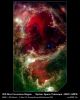
W5-SST.jpgW 5 - Stellar "Nursery"66 visiteGenerations of stars can be seen in this new infrared portrait from NASA's Spitzer Space Telescope. In this wispy star-forming region, called W5, the oldest stars can be seen as blue dots in the centers of the two hollow cavities (other blue dots are background and foreground stars not associated with the region). Younger stars line the rims of the cavities, and some can be seen as pink dots at the tips of the elephant-trunk-like pillars. The white knotty areas are where the youngest stars are forming. Red shows heated dust that pervades the region's cavities, while green highlights dense clouds.
W5 spans an area of sky equivalent to four full moons and is about 6500 Light-Years away in the constellation Cassiopeia. The Spitzer picture was taken over a period of 24 hours.
Like other massive star-forming regions, such as Orion and Carina, W5 contains large cavities that were carved out by radiation and winds from the region's most massive stars. According to the theory of triggered star-formation, the carving out of these cavities pushes gas together, causing it to ignite into successive generations of new stars.
This image contains some of the best evidence yet for the triggered star-formation theory. Scientists analyzing the photo have been able to show that the ages of the stars become progressively and systematically younger with distance from the center of the cavities.
This is a three-color composite showing infrared observations from two Spitzer instruments. Blue represents 3,6-micron light and green shows light of 8 microns, both captured by Spitzer's infrared array camera. Red is 24-micron light detected by Spitzer's multiband imaging photometer.MareKromium
|
|

EpsilonEridani-PIA11375.jpgEpsilon Eridani66 visiteThis artist's conception shows the closest known Planetary System to our own, called Epsilon Eridani. Observations from NASA's Spitzer Space Telescope show that the system hosts two Asteroid Belts, in addition to previously identified candidate planets and an outer Comet Ring.
Epsilon Eridani is located about 10 LY away in the constellation Eridanus. It is visible in the night skies with the naked eye.
The System's Inner Asteroid Belt appears as the yellowish ring around the star, while the Outer Asteroid Belt is in the foreground. The outermost Comet Ring is too far out to be seen in this view, but comets originating from it are shown in the upper right corner.
Astronomers think that each of Epsilon Eridani's Asteroid Belts could have a planet orbiting just outside it, shepherding its rocky debris into a ring in the same way that Jupiter helps keep our asteroid belt confined.
The planet near the inner belt was previously identified in 2000 via the radial velocity, or "star wobble", technique, while the planet near the outer belt was inferred when Spitzer discovered the belt.
The inner belt orbits at a distance of about 3 AU from its star — or about the same position as the Asteroid Belt in our own Solar System (an astronomical unit is the distance between Earth and the Sun). The second Asteroid Belt lies at about 20 AU from the star, or a position comparable to Uranus in our Solar System.
The outer Comet Ring orbits from 35 to 90 AU from the star; our Solar System's analogous Kuiper Belt extends from about 30 to 50 AU from the sun.MareKromium
|
|
| 157 immagini su 14 pagina(e) |
|
|
|
5 | |
|
|
|
|
|
|
|
|





