| |

| Piú viste - The Universe in Super Definition |

M 84.jpgM 84 - Galactic nucleus and... a Black Hole?71 visiteIs this "almost artistic graph" the signature of a supermassive Black Hole in the center of distant galaxy M 84 (based on data recorded by Hubble's new Space Telescope Imaging Spectrograph (STIS)?. The presence of a Black Hole can also be revealed by watching matter fall into it.
In fact, material spiraling into a Black Hole would find its speed increasing at a drastic rate. These extreme velocity increases provide what we call a 'signature' of the Black Hole's presence. The STIS data show that radiation from approaching gas, shifted to blue wavelengths left of the centerline, is suddenly redshifted to the right of center indicating a rapidly rotating disk of material near the galactic nucleus. The resulting sharp S-shape is effectively the signature of a Black Hole estimated to contain at least 300 million solar masses. Now the question is: do all galaxies have central Black Holes? And, if "Yes", then "Why"?
|
|

GasGiant-PIA09117.jpgA "young" Gas-Giant71 visiteCaption NASA:"This is an artist's concept of a hypothetical 10-million-year-old star system. The bright blur at the center is a star much like our Sun. The other orb in the image is a gas-giant planet like Jupiter. Wisps of white throughout the image represent traces of gas.
Astronomers using NASA's Spitzer Space Telescope have found evidence showing that gas-giant planets either form within the first 10 million years of a Sun-like star's life, or not at all. The lifespan for sun-like stars is about 10 billion years.
The scientists came to this conclusion after searching for traces of gas around 15 different Sun-like stars, most with ages ranging from 3 to 30 million years. With the help of Spitzer's Infrared Spectrometer Instrument, they were able to search for relatively warm gas in the inner regions of these star systems, an area comparable to the zone between Earth and Jupiter in our own solar system. They also used ground-based radio telescopes to search for cooler gas in the outer regions of these systems, an area comparable to the zone around Saturn and beyond".MareKromium
|
|

PIA13120.jpgWISE Eyes...71 visiteThis frame shows the progress of the WISE All-Sky Survey at the present time. WISE, or NASA's Wide-field InfraRed Survey Explorer, is perched up in the sky like a wise, old owl, scanning the whole sky one-and-a-half times in IR Light. On July 17, 2010, it will have completed its first scan of the entire sky, delivering more than one million image frames so far.
This map is filled in to show the sky areas that WISE scanned over time. Red indicates regions with the greatest coverage, and blue the least. The Poles received the most coverage because WISE orbits Earth around the Poles, scanning out strips of sky as Earth moves around the Sun. The red lines between the Poles show areas that received extra coverage because of the mission's strategy to avoid the Moon.
When the moon is in WISE's field of view, about twice every month, the space telescope captures the region it blocks, by first moving ahead of the moon and then behind it. This results in overlapped coverage for certain slices of sky. During this first all-sky scan, every point was covered by at least eight image frames.
The Infrared Astronomical Satellite was a joint project of the United States, United Kingdom and the Netherlands.
The Two-Micron All-Sky Survey was a project of NASA; the National Science Foundation; the University of Massachusetts, Amherst, and the California Institute of Technology, Pasadena, California.MareKromium
|
|

30-Doradus_and_R-136.jpg30 Doradus and R-13670 visiteJust in time for the holidays: a Hubble Space Telescope picture postcard of hundreds of brilliant blue stars wreathed by warm, glowing clouds. The festive portrait is the most detailed view of the largest stellar nursery in our local galactic neighborhood. The massive, young stellar grouping, called R136, is only a few million years old and resides in the 30 Doradus Nebula, a turbulent star-birth region in the Large Magellanic Cloud (LMC), a satellite galaxy of our Milky Way. There is no known star-forming region in our galaxy as large or as prolific as 30 Doradus. Many of the diamond-like icy blue stars are among the most massive stars known. Several of them are over 100 times more massive than our Sun. These hefty stars are destined to pop off, like a string of firecrackers, as supernovas in a few million years.
The image, taken in ultraviolet, visible, and red light by Hubble's Wide Field Camera 3, spans about 100 light-years. The nebula is close enough to Earth that Hubble can resolve individual stars, giving astronomers important information about the birth and evolution of stars in the universe. The Hubble observations were taken Oct. 20-27, 2009. The blue color is light from the hottest, most massive stars; the green from the glow of oxygen; and the red from fluorescing hydrogen.MareKromium
|
|

M 42 - HST-1.jpgOrion's Nebula an LL Orionis (the "Bow-Shock" effect)69 visiteThis close-up of cosmic clouds and stellar winds features LL Orionis interacting with the Orion Nebula flow. Adrift in Orion's stellar nursery and still in its formative years, variable star LL Orionis produces a wind more energetic than the wind from our own middle-aged Sun.
As the fast stellar wind runs into slow moving gas, a shock front is formed, analogous to the bow wave of a boat moving through water or a plane traveling at supersonic speed.
The small and graceful structure just above and left of center, is LL Ori's "Cosmic Bow Shock", measuring about 1/2 a LY across.
The slower gas is flowing away from the Orion Nebula's hot central star cluster, the Trapezium, located off the upper left corner of the picture.
In 3D, LL Ori's wrap-around shock front is shaped like a bowl that appears brightest when viewed along the bottom edge.
The beautiful picture is part of a large mosaic view of the complex stellar nursery in Orion, filled with a myriad of fluid shapes associated with star formation.
|
|

Black Hole-PIA08696.jpgBlack Hole69 visiteThis artist's concept depicts a supermassive black hole at the center of a galaxy. NASA's Galaxy Evolution Explorer found evidence that black holes -- once they grow to a critical size -- stifle the formation of new stars in elliptical galaxies. Black holes are thought to do this by heating up and blasting away the gas that fuels star formation.
The blue color here represents radiation pouring out from material very close to the black hole. The grayish structure surrounding the black hole, called a torus, is made up of gas and dust. Beyond the torus, only the old red-colored stars that make up the galaxy can be seen. There are no new stars in the galaxy.
|
|

Abell-1763-PIA10227.jpgCelestial Cities and the Roads that connect Them69 visiteThis is a representation of galaxies in and surrounding a galaxy cluster called Abell 1763. The placement of each dot is based on the actual coordinates of galaxies in the region. Blue dots are active star-forming galaxies; red dots show galaxies that are not actively forming stars.
Galaxies across the universe reside in cosmic communities big and small. Large, densely populated galactic communities are called galaxy clusters (highlighted in the orange circle). Like cities on Earth, galaxy clusters are scattered throughout the universe and are connected by a web of dusty highways called filaments (highlighted in purple). Smaller galactic communities are sprinkled along the filaments, creating celestial suburbs.
Over time, astronomers suspect that all galactic suburbanites make their way to a galaxy cluster by way of filaments. Observations from NASA's Spitzer Space Telescope show that filamentary galaxies form stars at twice the rate of their densely clustered counterparts.
NASA's Jet Propulsion Laboratory, Pasadena, Calif., manages the Spitzer Space Telescope mission for NASA's Science Mission Directorate, Washington. Science operations are conducted at the Spitzer Science Center at the California Institute of Technology, also in Pasadena. Caltech manages JPL for NASA.
MareKromium
|
|

M 42-PIA08653.jpgMoments of M-4268 visiteThis infrared image from NASA's Spitzer Space Telescope shows the Orion nebula, our closest massive star-making factory, 1,450 light-years from Earth. The nebula is close enough to appear to the naked eye as a fuzzy star in the sword of the popular hunter constellation.
The nebula itself is located on the lower half of the image, surrounded by a ring of dust. It formed in a cold cloud of gas and dust and contains about 1,000 young stars. These stars illuminate the cloud, creating the beautiful nebulosity, or swirls of material, seen here in infrared.
In the center of the nebula (bottom inset of figure 1) are four monstrously massive stars, up to 100,000 times as luminous as our sun, called the Trapezium (tiny yellow smudge to the lower left of green splotches. Radiation and winds from these stars are blasting gas and dust away, excavating a cavity walled in by the large ring of dust.
Behind the Trapezium, still buried deeply in the cloud, a second generation of massive stars is forming (in the area with green splotches). The speckled green fuzz in this bright region is created when bullets of gas shoot out from the juvenile stars and ram into the surrounding cloud.
Above this region of intense activity are networks of cold material that appear as dark veins against the pinkish nebulosity (upper inset pf figure 1). These dark veins contain embryonic stars. Some of the natal stars illuminate the cloud, creating small, aqua-colored wisps. In addition, jets of gas from the stars ram into the cloud, resulting in the green horseshoe-shaped globs.
Spitzer surveyed a significant swath of the Orion constellation, beyond what is highlighted in this image. Within that region, called the Orion cloud complex, the telescope found 2,300 stars circled by disks of planet-forming dust and 200 stellar embryos too young to have developed disks.
This image shows infrared light captured by Spitzer's infrared array camera. Light with wavelengths of 8 and 5.8 microns (red and orange) comes mainly from dust that has been heated by starlight. Light of 4.5 microns (green) shows hot gas and dust; and light of 3.6 microns (blue) is from starlight.
|
|

TwoSuns-PIA09229.jpgTwin Suns, Planets and Asteroids68 visiteThis artist's image depicts a faraway Solar System like our own -- except for one big difference: planets and asteroids circle around not one, but two Suns. NASA's Spitzer Space Telescope found evidence that such Solar Systems might be common in the Universe. Spitzer did not see any planets directly, but it detected dust that is kicked up from disks like this one. The disks were spotted circling all the way around several double, or binary, stars, some of which were closer together than Earth is to our sun. In fact, Spitzer found more disks in orbit around close-knit binary stars than single stars. This could mean that planets prefer two parent stars to one, but more research is needed to figure out exactly what's going on.
|
|

AlienWorld-PIA09228.jpgTwin Suns' Sunset68 visiteOur solitary sunsets here on Earth might not be all that common in the grand scheme of things. New observations from NASA's Spitzer Space Telescope have revealed that mature planetary systems -- dusty disks of asteroids, comets and possibly planets -- are more frequent around close-knit twin, or binary, stars than single stars like our sun. That means sunsets like the one portrayed in this artist's photo concept, and more famously in the movie "Star Wars," might be quite commonplace in the universe.
Binary and multiple-star systems are about twice as abundant as single-star systems in our galaxy, and, in theory, other galaxies. In a typical binary system, two stars of roughly similar masses twirl around each other like pair-figure skaters. In some systems, the two stars are very far apart and barely interact with each other. In other cases, the stellar twins are intricately linked, whipping around each other quickly due to the force of gravity.
Astronomers have discovered dozens of planets that orbit around a single member of a very wide stellar duo. Sunsets from these worlds would look like our own, and the second sun would just look like a bright star in the night sky.
But do planets exist in the tighter systems, where two suns would dip below a planet's horizon one by one? Unveiling planets in these systems is tricky, so astronomers used Spitzer to look for disks of swirling planetary debris instead. These disks are made of asteroids, comets and possibly planets. The rocky material in them bangs together and kicks up dust that Spitzer's infrared eyes can see. Our own solar system is swaddled in a similar type of disk.
Surprisingly, Spitzer found more debris disks around the tightest binaries it studied (about 20 stars) than in a comparable sample of single stars. About 60 percent of the tight binaries had disks, while the single stars only had about 20 percent. These snug binary systems are as close or closer than just three times the distance between Earth and the sun. And the disks in these systems were found to circumnavigate both members of the star pair, rather than just one.
Though follow-up studies are needed, the results could mean that planet formation is more common around extra-tight binary stars than single stars. Since these types of systems would experience double sunsets, the artistic view portrayed here might not be fiction.
The original sunset photo used in this artist's concept was taken by Robert Hurt of the Spitzer Science Center at the California Institute of Technology, Pasadena, Calif.
|
|
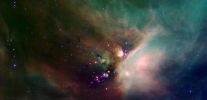
Rho_Ophiuci-PIA10181.jpgRho Ophiuci68 visiteNewborn stars peek out from beneath their natal blanket of dust in this dynamic image of the Rho Ophiuchi dark cloud from NASA's Spitzer Space Telescope. Called "Rho Oph" by astronomers, it's one of the closest star-forming regions to our own solar system. Located near the constellations Scorpius and Ophiuchus, the nebula is about 407 light years away from Earth.
Rho Oph is a complex made up of a large main cloud of molecular hydrogen, a key molecule allowing new stars to form from cold cosmic gas, with two long streamers trailing off in different directions. Recent studies using the latest X-ray and infrared observations reveal more than 300 young stellar objects within the large central cloud. Their median age is only 300,000 years, very young compared to some of the universe's oldest stars, which are more than 12 billion years old.
This false-color image of Rho Oph's main cloud, Lynds 1688, was created with data from Spitzer's infrared array camera, which has the highest spatial resolution of Spitzer's three imaging instruments, and its multiband imaging photometer, best for detecting cooler materials. Blue represents 3.6-micron light; green shows light of 8 microns; and red is 24-micron light. The multiple wavelengths reveal different aspects of the dust surrounding and between the embedded stars, yielding information about the stars and their birthplace.
The colors in this image reflect the relative temperatures and evolutionary states of the various stars. The youngest stars are surrounded by dusty disks of gas from which they, and their potential planetary systems, are forming. These young disk systems show up as red in this image. Some of these young stellar objects are surrounded by their own compact nebulae. More evolved stars, which have shed their natal material, are blue.
The extended white nebula in the center right of the image is a region of the cloud which is glowing in infrared light due to the heating of dust by bright young stars near the right edge of the cloud. Fainter multi-hued diffuse emission fills the image. The color of the nebulosity depends on the temperature, composition and size of the dust grains. Most of the stars forming now are concentrated in a filament of cold, dense gas that shows up as a dark cloud in the lower center and left side of the image against the bright background of the warm dust. Although infrared radiation at 24 microns pierces through dust easily, this dark filament is incredibly opaque, appearing dark even at the longest wavelengths in the image.
MareKromium
|
|

Cassiopeia_A-PIA11748.jpgSNR Cassiopeia "A"68 visiteFor the first time, a multiwavelength three-dimensional reconstruction of a SuperNova Remnant has been created. This stunning visualization of Cassiopeia A, or Cas A, the result of an explosion approximately 330 years ago, uses data from several telescopes: X-ray data from NASA's Chandra X-ray Observatory, InfraRed data from NASA's Spitzer Space Telescope and optical data from the National Optical Astronomy Observatory 4-meter telescope at Kitt Peak, Ariz., and the Michigan-Dartmouth-MIT 2.4-meter telescope, also at Kitt Peak. In this visualization, the green region is mostly Iron observed in X-rays. The yellow region is a combination of Argon and Silicon seen in X-rays, optical, and infrared — including jets of Silicon — plus outer debris seen in the optical. The red region is cold debris seen in the infrared. Finally, the blue reveals the outer blast wave, most prominently detected in X-rays.
Most of the material shown in this visualization is debris from the explosion that has been heated by a shock moving inwards. The red material interior to the yellow/orange ring has not yet encountered the inward moving shock and so has not yet been heated. These unshocked debris were known to exist because they absorb background radio light, but they were only recently discovered in infrared emission with Spitzer. The blue region is composed of gas surrounding the explosion that was heated when it was struck by the outgoing blast wave, as clearly seen in Chandra images.
To create this visualization, scientists took advantage of both a previously known phenomenon — the Doppler effect — and a new technology that bridges astronomy and medicine. When elements created inside a supernova, such as Iron, Silicon and Argon, are heated they emit light at certain wavelengths. Material moving towards the observer will have shorter wavelengths and material moving away will have longer wavelengths. Since the amount of the wavelength shift is related to the speed of motion, one can determine how fast the debris are moving in either direction.
Because Cas A is the result of an explosion, the stellar debris is expanding radially outwards from the explosion center. Using simple geometry, the scientists were able to construct a 3-D model using all of this information. A program called 3-D Slicer — modified for astronomical use by the Astronomical Medicine Project at Harvard University in Cambridge, Mass. — was used to display and manipulate the 3-D model. Commercial software was then used to create the 3-D fly-through.
The blue filaments defining the blast wave were not mapped using the Doppler Effect because they emit a different kind of light —synchrotron radiation — that does not emit light at discrete wavelengths, but rather in a broad continuum. The blue filaments are only a representation of the actual filaments observed at the blast wave.
This visualization shows that there are two main components to this supernova remnant: a spherical component in the outer parts of the remnant and a flattened (disk-like) component in the inner region. The spherical component consists of the outer layer of the star that exploded, probably made of helium and carbon. These layers drove a spherical blast wave into the diffuse gas surrounding the star.
The flattened component — that astronomers were unable to map into 3-D prior to these Spitzer observations — consists of the inner layers of the star. It is made from various heavier elements, not all shown in the visualization, such as Oxygen, Neon, Silicon, Sulphur, Argon and Iron.
High-velocity plumes, or jets, of this material are shooting out from the explosion in the plane of the disk-like component mentioned above. Plumes of Silicon appear in the North/East and South/West, while those of Iron are seen in the South/East and North. These jets were already known and Doppler velocity measurements have been made for these structures, but their orientation and position with respect to the rest of the debris field had never been mapped before now.
This new insight into the structure of Cas A gained from this 3-D visualization is important for astronomers who build models of supernova explosions. Now, they must consider that the outer layers of the star come off spherically, but the inner layers come out more disk-like with high-velocity jets in multiple directions.MareKromium
|
|
| 157 immagini su 14 pagina(e) |
|
|
4 | |
|
|
|
|
|
|
|
|
|





