| |

| Piú viste - The Universe in Super Definition |

Blue_Star-PIA12174.jpgSpace "Cube"80 visiteThis drawing illustrates the extent to which astronomers have been underestimating the proportion of small to big stars in certain galaxies. Data from NASA's Galaxy Evolution Explorer Spacecraft and the Cerro Tololo Inter-American Observatory in Chile have shown that, in some cases, there can be as many as four times more small stars compared to large ones.
In the drawing, a massive blue star is shown next to a stack of lighter, yellow stars. These big blue stars are 3 to 20 times more massive than our Sun, while the smaller stars are typically about the same mass as the Sun or smaller.
Before the Galaxy Evolution Explorer study, astronomers assumed there were 500 small stars for every massive one (lower stack on right). The new observations reveal that, in certain galaxies, this estimation is off by a factor of four; for every massive star, there could be as many as 2000 small counterparts (such as the entire stack - the "Cube" - on the right).MareKromium
|
|

Black_Hole-PIA13275.jpgDisk around a massive "Baby Star"?80 visiteCaption NASA:"Astronomers have obtained the first clear look at a Dusty Disk closely encircling a massive "Baby Star", providing direct evidence that massive stars do form in the same way as their smaller brethren -- and closing an enduring debate.
This artist's concept shows what such a massive Disk might look like. The Flared Disk extends to about 130 times the Earth-Sun distance (such as 130 UA), and has a mass similar to that of the star, roughly twenty times the Sun. The inner parts of the Disk are shown to be devoid of dust).
Nota Lunexit: questa è dunque, according to NASA, la rappresentazione artistica di un Disco di polveri e materiale Primordiale posizionato attorno ad una giovane stella supermassiva.
Può anche darsi, ma secondo noi la NASA ha scelto male l'immagine da abbinare alla caption e questa, in effetti, è la rappresentazione artistica di un Buco Nero, oppure di un Quasar.
Chissà...MareKromium
|
|
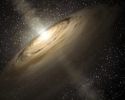
PIA03243.jpgThe way we were...78 visiteThis artist's concept illustrates a solar system that is a much younger version of our own. Dusty disks, like the one shown here circling the star, are thought to be the breeding grounds of planets, including rocky ones like Earth. Astronomers using NASA's Spitzer Space Telescope spotted some of the raw ingredients for DNA and protein in one such disk belonging to a star called IRS 46. The ingredients, gaseous precursors to DNA and protein called acetylene and hydrogen cyanide, were detected in the star's inner disk, the region where scientists believe Earth-like planets would be most likely to form.
|
|
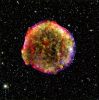
SNR-Tycho-SR-PIA11435.jpgTycho: the most colourful Supernova Remnant78 visiteThis composite image of the Tycho Supernova Remnant combines InfraRed and X-Ray observations obtained with NASA's Spitzer and Chandra space observatories, respectively, and the Calar Alto observatory, Spain.
It shows the scene more than four centuries after the brilliant star explosion witnessed by Tycho Brahe and other astronomers of that era.
The explosion has left a blazing hot cloud of expanding debris (green and yellow). The location of the blast's outer shock wave can be seen as a blue sphere of ultra-energetic electrons. Newly synthesized dust in the ejected material and heated pre-existing dust from the area around the supernova radiate at infrared wavelengths of 24 microns (red).
Foreground and background stars in the image are white.MareKromium
|
|

YoungStar-PIA09266.jpgThe "O"-Star76 visite"The further on the edge, the hotter the intensity," sings Kenny Loggins in "Danger Zone," a song made famous by the movie "Top Gun." The same words ring true for young, cooler stars like our sun that live in the danger zones around scorching hot stars, called O-stars. The closer a young, maverick star happens to be to a super hot O-star, the more likely its burgeoning planets will be blasted into space.
This artist's animation illustrates how this process works. The movie begins by showing an O-star in a murky star-forming region. It then pans out to show a young, cooler star and its swirling disk of planet-forming material. Disks like this one, called protoplanetary disks, are where planets are born. Gas and dust in a disk clumps together into tiny balls that sweep through the material, growing in size to eventually become full-grown planets.
The young star happens to lie within the "danger zone" around the O-star, which means that it is too close to the hot star to keep its disk. Radiation and winds from the O-star boil and blow away the material, respectively. This process, called photoevaporation, is sped up here but takes anywhere from 100,000 to about 1,000,000 years. Without a disk, the young star will not be able to produce planets.
Our own sun and its suite of planets might have grown up on the edge of an O-star's danger zone before migrating to its current, spacious home. However, we know that our young sun didn't linger for too long in any hazardous territory, or our planets, and life, wouldn't be here today.
NASA's Spitzer Space Telescope surveyed the danger zones around five O-stars in the Rosette nebula. It was able to determine that the zones are spheres with a radius of approximately 1.6 light-years, or 10 trillion miles.
MareKromium
|
|

HD-80606b.jpgA Dangerous Summer on HD 80606b76 visiteOn the distant planet HD 80606b, Summers might be dangerous.
Hypothetic life forms floating in HD 080606b's Atmosphere or lurking on one of its (presently hypothetical) moons might fear the 1500 Kelvin Summer heat, which is hot enough not only to melt Lead but also Nickel. Although Summers are defined for Earth by the daily amount of Sunlight, Summers on HD 80606b are more greatly influenced by how close the Planet gets to its Parent Star.
HD 80606b, about 200 LY distant, has the most elliptical orbit of any planet yet discovered. In comparison to the Solar System, the distance to its Parent Star would range from outside the orbit of Venus to well inside the orbit of Mercury.
In this sequence, the night side of HD 80606b is computer simulated as it might glow in infrared light in nearly daily intervals as it passed the closest point in its 111-day orbit around its Parent Star.
The simulation is based on infrared data taken in late 2007 by the Spitzer Space Telescope.
Nota Lunexit (a chi interessa): la Formula di Conversione per le Temperature espresse in Kelvin in Temperature espresse in Celsius è la seguente: T° Celsius = T Kelvin - 273,15
Nel nostro caso di specie, quindi, la temperatura diurna media Estiva di HD 80606b dovrebbe essere pari a circa 1227° C.
Un bel "tepore", davvero...MareKromium
|
|
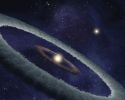
HD-113766-PIA09931.jpgHD 11376675 visiteThis artist's conception shows a binary-star, or two-star, system, called HD 113766, where astronomers suspect a rocky Earth-like planet is forming around one of the stars. At approximately 10 to 16 MY old, astronomers suspect this star is at just the right age for forming rocky planets. The System is located approx. 424 LY away from Earth.
The two yellow spots in the image represent the System's two stars. The brown ring of material circling closest to the central star depicts a huge belt of dusty material, more than 100 times as much as in our asteroid belt, or enough to build a Mars-size planet or larger. The rocky material in the belt represents the early stages of planet formation, when dust grains clump together to form rocks, and rocks collide to form even more massive rocky bodies called planetesimals. The belt is located in the middle of the system's terrestrial Habitable Zone, or the region around a star where liquid water could exist on any rocky planets that might form.
Earth is located in the middle of our sun's terrestrial habitable zone.
Using NASA's Spitzer Space Telescope, astronomers learned that the belt material in HD 113766 is more processed than the snowball-like stuff that makes up infant solar systems and comets, which contain pristine ingredients from the early solar system. However, it is not as processed as the stuff found in mature planets and asteroids. This means that the dust belt is made out of just the right mix of materials to be forming an Earth-like planet. It is composed mainly of rocky silicates and metal sulfides (like fool's gold), similar to the material found in lava flows.
The white outer ring shows a concentration of icy dust also detected in the system. This material is at the equivalent position of the asteroid belt in our solar system, but only contains about one-sixth as much material as the inner ring. Astronomers say it is not clear from the Spitzer observations if anything is occurring in the icy belt, but they believe it could be a source of water later on for the planet that grows from the inner warm ring.
MareKromium
|
|

GLS-SDSSJ0946+1006.jpgHubble Finds Double "Einstein Ring"75 visiteNASA's Hubble Space Telescope has revealed a never-before-seen optical alignment in space: a pair of glowing rings, one nestled inside the other like a bull's-eye pattern. The double-ring pattern is caused by the complex bending of light from two distant galaxies strung directly behind a foreground massive galaxy, like three beads on a string.
More than just a novelty, this very rare phenomenon can offer insight into dark matter, dark energy, the nature of distant galaxies, and even the curvature of the universe.
The ring was found by an international team of astronomers led by Raphael Gavazzi and Tommaso Treu of the University of California, Santa Barbara. The discovery is part of the ongoing Sloan Lens Advanced Camera for Surveys (SLACS) program. The team is reporting its results at the 211th meeting of the American Astronomical Society in Austin, Texas. A paper has been submitted to The Astrophysical Journal.
The phenomenon, called gravitational lensing, occurs when a massive galaxy in the foreground bends the light rays from a distant galaxy behind it, in much the same way as a magnifying glass would. When both galaxies are exactly lined up, the light forms a circle, called an "Einstein ring," around the foreground galaxy. If another background galaxy lies precisely on the same sightline, a second, larger ring will appear.
Because the odds of seeing such a special alignment are estimated to be 1 in 10,000, Tommaso says that they "hit the jackpot." The odds of seeing this phenomenon are less than winning two consecutive bets on a single number at Roulette.
"Such stunning cosmic coincidences reveal so much about nature. Dark matter is not hidden to lensing," added Leonidas Moustakas of the Jet Propulsion Laboratory in Pasadena, Calif. "The elegance of this lens is trumped only by the secrets of nature that it reveals."
The massive foreground galaxy is almost perfectly aligned in the sky with two background galaxies at different distances. The foreground galaxy is 3 billion light-years away. The inner ring and outer ring are comprised of multiple images of two galaxies at a distance of 6 billion and approximately 11 billion light-years.
SLACS team member Adam Bolton of the University of Hawaii's Institute for Astronomy in Honolulu first identified the lens in the Sloan Digital Sky Survey (SDSS). "The original signature that led us to this discovery was a mere 500 photons (particles of light) hidden among 500,000 other photons in the SDSS spectrum of the foreground galaxy," commented Bolton.
"The twin rings were clearly visible in the Hubble image, added Tommaso. "When I first saw it I said 'wow, this is insane!' I could not believe it!"
The distribution of dark matter in the foreground galaxies that is warping space to create the gravitational lens can be precisely mapped. Tommaso finds that the fall-off in density of the dark matter is similar to what is seen in spiral galaxies (as measured by the speed of a galaxy's rotation, which yields a value for the amount of dark matter pulling on it), though he emphasizes there is no physical reason to explain this relationship.
In addition, the geometry of the two Einstein rings allowed the team to measure the mass of the middle galaxy precisely to be a value of 1 billion solar masses. The team reports that this is the first measurement of the mass of a dwarf galaxy at cosmological distance (redshift of z=0.6).
A sample of several dozen double rings such as this one would offer a purely independent measure. The comparative radius of the rings could also be used to provide an independent measure of the curvature of space by gravity. This would help in determining the matter content of the universe and the properties of dark energy.
Observations of the cosmic microwave background (a relic from the Big Bang) favor flat geometry. A sample of 50 suitable double Einstein rings would be sufficient to measure the dark matter content of the universe and the equation of state of the dark energy (a measure of its pressure) to 10 percent precision. Other double Einstein rings could be found with wide-field space telescope sky surveys that are being proposed for the Joint Dark Energy Mission (JDEM) and recently recommended by the National Research Council.
MareKromium
|
|

W-5_Star_Forming_Region-PIA11726.jpgIn the Cosmic Hurricane...75 visiteThis image from NASA's Spitzer Space Telescope shows the nasty effects of living near a group of massive stars: radiation and winds from the massive stars (white spot in center) are blasting planet-making material away from stars like our sun. The planetary material can be seen as comet-like tails behind three stars near the center of the picture. The tails are pointing away from the massive stellar furnaces that are blowing them outward. The picture is the best example yet of multiple sun-like stars being stripped of their planet-making dust by massive stars.
The sun-like stars are about 2 three 3 million years old, an age when planets are thought to be growing out of surrounding disks of dust and gas. Astronomers say the dust being blown from the stars is from their outer disks. This means that any Earth-like planets forming around the sun-like stars would be safe, while outer planets like Uranus might be nothing more than dust in the wind.
This image shows a portion of the W5 star-forming region, located 6,500 light-years away in the constellation Cassiopeia. It is a composite of infrared data from Spitzer's infrared array camera and multiband imaging photometer. Light with a wavelength of 3.5 microns is blue, while light from the dust of 24 microns is orange-red.MareKromium
|
|
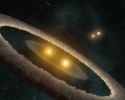
HD98800-PIA09939.jpgEvidence for Strange Stellar Family74 visiteThis artist concept depicts a Quadruple-Star System called HD 98800. The System is approx. 10 MY old, and is located 150 LY away in the constellation TW Hydrae.
HD 98800 contains four stars, which are paired off into doublets, or binaries.
The stars in the binary pairs orbit around each other, and the two pairs also circle each other like choreographed ballerinas. One of the stellar pairs, called HD 98800B, has a disk of dust around it, while the other pair does not.
Although the four stars are gravitationally bound, the distance separating the two binary pairs is about 50 astronomical units (AU) -- slightly more than the average distance between our sun and Pluto.
Using NASA's Spitzer Space Telescope, scientists finally have a detailed view of HD 98800B's potential planet-forming disk. Astronomers used the telescope's infrared spectrometer to detect the presence of two belts in the disk made of large dust grains. One belt sits approx. 5.9 AU away from the central binary, or about the distance from the sun to Jupiter, and is likely made up of asteroids and comets. The other belt sits at 1.5 to 2 AU, comparable to the area where Mars and the asteroid belt sit, and is made up of sand-sized dust grains.
MareKromium
|
|

M 55.jpgM 55 - Globular Star Cluster73 visiteM 55 is a large Globular Star Cluster of around 100.000 stars. Only 20.000 LY away in the constellation Sagittarius, M 55 appears to earth-bound observers to be nearly 2/3 the size of the full Moon. Globular star clusters like M 55 roam the halo of our Milky Way Galaxy as gravitationally bound populations of stars known to be much older than stellar groups found in the galactic disk. Astronomers who make detailed studies of globular cluster stars can accurately measure the cluster ages and distances. Their results ultimately constrain the age of the Universe and provide a fundamental rung on the astronomical distance ladder.
|
|

Asteroid-PIA11735.jpgUnsuccesful crossing of the Roche Limit72 visiteIl Limite di Roche è la distanza minima dal centro di un Pianeta o di una Stella (qui di seguito definiti "Corpo Maggiore"), al di sotto della quale un satellite, o un pianeta (qui di seguito definito "Corpo Minore"), si può frammentare a causa delle Onde Gravitazionali Mareali (o "Forze di Marea"). Se si suppone che entrambi i Corpi (Maggiore e Minore) considerati abbiano la medesima densità, il Limite di Roche viene fatto pari a circa 2,5 volte il raggio del Corpo Maggiore (Pianeta o Stella che sia).
È possibile che all'interno di tale Limite esistano dei satelliti, ma essi devono essere sufficientemente piccoli e leggeri, così che le tensioni ad essi interne gli impediscano la frammentazione.
In un disco di frammenti che avvolge un pianeta appena formato (cd. "Protoplanetary Cloud Remainders" o anche "Accretion Disk"), la materia esistente oltre il Limite di Roche può assemblarsi in uno o più satelliti di modeste dimensioni, poichè all'interno di tale Limite le Forze di Marea impediscono la formazione di satelliti grandi.
Un buon esempio di questo tipo di fenomeno è negli anelli che vediamo intorno a Giove, Saturno, Urano e Nettuno: tutti questi anelli, infatti e ad esempio, si trovano all'interno del Limite di Roche.
Nel Sistema Solare sono quattro i pianeti che presentano anelli e per ciascuno di essi è stato calcolato il relativo Limite di Roche:
Giove = 175.000 Km
Saturno = 147.000 Km
Urano = 62.000 Km
Nettuno = 59.000 Km
Édouard Albert Roche, nel 1850, studiò in particolare gli Anelli di Saturno e giunse a dimostrare che il valore di 2,44 Raggi Planetari Saturniani si posizionava leggermente al di fuori dell'Anello più esterno, dentro il quale effettivamente non esistevano corpi di rilevanza.
Dalle riprese effettuate durante i Programmi Voyager e CASSINI-Huygens, si è potuto notare che gli Anelli di Saturno (al pari di quelli di tutti i Giganti Gassosi) non sono "unitari e compatti", bensì composti da aggregazioni promiscue di rocce di modeste dimensioni e ghiaccio: tutti elementi, questi, che - come detto - trovandosi all'interno del Limite di Roche ed avendo resistito alle Onde Gravitazionali emanate da Saturno, ci dimostrano una scarsissima densità intrinseca (e dunque una evidente idoneità alla "sopravvivenza" verso le Onde Gravitazionali Mareali).MareKromium
|
|
| 157 immagini su 14 pagina(e) |
|
3 | |
|
|
|
|
|
|
|
|
|
|





