| |

| Piú viste - The Universe in Super Definition |

Red_Sun-PIA13994.jpgRed Sun128 visiteCaption NASA:"This artist's concept illustrates a young, Red Dwarf Star surrounded by three planets. Such stars are dimmer and smaller than yellow stars like our Sun, which makes them ideal targets for astronomers wishing to take images of planets (called "Exoplanets") outside our Solar System. NASA's Galaxy Evolution Explorer is helping to identify young, Red Dwarf Stars that are close to us by detecting their UltraViolet Light (stars give off a lot of UV Light in their youth). Astronomers will use telescopes to try to image giant planets that orbit farther out from these stars, such as the one depicted here at lower left".MareKromium
|
|

M 17.jpgM 17 - The "Omega Nebula" detail mgnf126 visiteIn the depths of the dark clouds of dust and molecular gas known as M 17, stars continue to form. Also known as the Omega Nebula and Horseshoe Nebula, the darkness of M17's molecular clouds results from background starlight being absorbed by thick filaments of carbon-based smoke-sized dust. As bright massive stars form, they produce intense and energetic light that slowly boils away the dark shroud. Colors in the above image were picked to highlight specific elements that emit nebular light: red indicates emission from sulfur, green from hydrogen, and blue from oxygen. The Swan Nebula is visible with binoculars towards the constellation of Sagittarius, lies 5000 LY away, and spans 20 LY across.
|
|

Proxima_Centauri_B_-_4.jpgNightside of Proxima Centauri "b" (Imagination)126 visitenessun commentoMareKromium
|
|
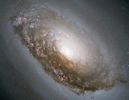
M 64.jpgM 64 (NGC 4826) - Great Spiral Galaxy111 visiteThe "Sleeping Beauty Galaxy" may appear peaceful at first sight but it is actually tossing and turning. In an unexpected twist, recent observations have shown that the gas in the outer regions of this spiral is rotating in the opposite direction from all of the stars! Collisions between gas in the inner and outer regions are creating many hot blue stars and pink emission nebulae. The above image was taken by the Hubble Space Telescope in 2001. The fascinating internal motions of M 64 (also known as NGC 4826), are thought to be the result of a collision between a small galaxy and a large galaxy where the resultant mix has not yet settled down.
|
|

NGC-2237_and_NGC-2244-SST.jpgThe "O" Stars inside the Rosette Nebula111 visiteIn this sub-frame are highlighted 5 dangerous hot stars that can be found inside the Rosette Nebula; these stars are classified as "O" Stars (meaning stars with a surface temperatures of 25.000 Kelvins - such as 24.726,85° Celsius - or higher).
Astronomers calculate that cool stars wandering within about 1,6 Light-Years of the Rosette's "O" Stars are in danger of having their planet forming disks destroyed.
MareKromium
|
|

NGC-2683.jpgNGC 2683 - Spiral Edge-On Galaxy107 visitenessun commentoMareKromium
|
|

Proxima_Centauri_B_-_5.jpgOverview of Proxima and its Parent Star106 visiteOverview and comparison of the orbital distance of the habitable zones of Proxima Centauri compared to the Solar System.MareKromium
|
|

NGC-4696.jpgNGC 469697 visiteIn many cosmic environments, when material falls toward a Black Hole energy is produced as some of the matter is blasted back out in jets. In fact, such Black Hole "Engines" appear to be the most efficient in the Universe, at least on a galactic scale. This composite image illustrates one example of an elliptical galaxy with an efficient Black Hole Engine, NGC 4696. The large galaxy is the brightest member of the Centaurus galaxy cluster, some 150 MLY away. Exploring NGC 4696 in X-Rays (red) astronomers can measure the rate at which infalling matter fuels the supermassive Black Hole and compare it to the energy output in the jets to produce giant radio emitting bubbles. The bubbles, shown here in blue, are about 10.000 LY across. The results confirm that the process is much more efficient than producing energy through nuclear reactions - not to mention using fossil fuels. Astronomers also suggest that as the Black Hole pumps out energy and heats the surrounding gas, star formation is ultimately shut off, limiting the size of large galaxies like NGC 4696.
|
|

M-083-a.jpgHubble Wide Field Camera 3 - Image Details Star Birth in Galaxy M-8389 visiteThe spectacular new camera installed on NASA's Hubble Space Telescope during Servicing Mission 4 in May has delivered the most detailed view of star birth in the graceful, curving arms of the nearby spiral galaxy M83.
Nicknamed the Southern Pinwheel, M83 is undergoing more rapid star formation than our own Milky Way galaxy, especially in its nucleus. The sharp "eye" of the Wide Field Camera 3 (WFC3) has captured hundreds of young star clusters, ancient swarms of globular star clusters, and hundreds of thousands of individual stars, mostly blue supergiants and red supergiants.
The image, taken in August 2009, provides a close-up view of the myriad stars near the galaxy's core, the bright whitish region at far right.
WFC3's broad wavelength range, from ultraviolet to near-infrared, reveals stars at different stages of evolution, allowing astronomers to dissect the galaxy's star-formation history.
The image reveals in unprecedented detail the current rapid rate of star birth in this famous "grand design" spiral galaxy. The newest generations of stars are forming largely in clusters on the edges of the dark dust lanes, the backbone of the spiral arms. These fledgling stars, only a few million years old, are bursting out of their dusty cocoons and producing bubbles of reddish glowing hydrogen gas.
The excavated regions give a colorful "Swiss cheese" appearance to the spiral arm. Gradually, the young stars' fierce winds (streams of charged particles) blow away the gas, revealing bright blue star clusters. These stars are about 1 million to 10 million years old. The older populations of stars are not as blue.
A bar of stars, gas, and dust slicing across the core of the galaxy may be instigating most of the star birth in the galaxy's core. The bar funnels material to the galaxy's center, where the most active star formation is taking place. The brightest star clusters reside along an arc near the core.
The remains of about 60 supernova blasts, the deaths of massive stars, can be seen in the image, five times more than known previously in this region. WFC3 identified the remnants of exploded stars. By studying these remnants, astronomers can better understand the nature of the progenitor stars, which are responsible for the creation and dispersal of most of the galaxy's heavy elements.
M83, located in the Southern Hemisphere, is often compared to M51, dubbed the Whirlpool galaxy, in the Northern Hemisphere. Located 15 million light-years away in the constellation Hydra, M83 is two times closer to Earth than M51.
MareKromium
|
|

M-087.jpgM 87 - Elliptical Galaxy88 visiteElliptical galaxy M 87 is a type of galaxy that looks much different than our own Milky Way Galaxy. Even for an elliptical galaxy, though, M 87 is peculiar. M 87 is MUCH bigger than an average galaxy, appears near the center of a whole cluster of galaxies (known as the Virgo Cluster) and shows an unusually high number of globular clusters. These globular clusters are visible as faint spots surrounding the bright center of M 87. In general, elliptical galaxies contain similar numbers of stars as spiral galaxies, but are ellipsoidal in shape (spirals are mostly flat), have no spiral structure and little gas and dust.
|
|

M-002-PIA04926.jpgM 2 - Globular Star Cluster in Aquarius81 visiteCaption NASA originale:"This image of the Globular Cluster Messier 2 (M2) was taken by Galaxy Evolution Explorer on August 20, 2003. This image is a small section of a single All Sky Imaging Survey exposure of only 129 seconds in the constellation Aquarius. This picture is a combination of Galaxy Evolution Explorer images taken with the far ultraviolet (colored blue) and near ultraviolet detectors (colored red). Globular clusters are gravitationally bound systems of hundreds of thousands of stars that orbit in the halos of galaxies. The globular clusters in out Milky Way galaxy contain some of the oldest stars known. M2 lies 33.000 LY from our Sun with stars distributed in a spherical system with a radius of approximately 100 LY".
|
|

Cepheid-HST-2009-08-a-print.jpgRefined Hubble Constant narrows possible explanations for Dark Energy81 visiteWhatever Dark Energy is, explanations for it have less wiggle room following a Hubble Space Telescope observation that has refined the measurement of the Universe's present Expansion Rate to a precision where the error is smaller than 5%. The new value for the Expansion Rate, known as the "Hubble Constant", or "H0" (after Edwin Hubble who first measured the expansion of the universe nearly a century ago), is 74,2 Km-per-second-per-megaparsec (with an error margin of ± 3,6).
The results agree closely with an earlier measurement gleaned from Hubble of 72 ± 8 km/sec/megaparsec, but are now more than twice as precise.
The Hubble measurement, conducted by the SHOES (Supernova H0 for the Equation of State) Team and led by Adam Riess, of the Space Telescope Science Institute and the Johns Hopkins University, uses a number of refinements to streamline and strengthen the construction of a cosmic "Distance Ladder", a Billion LY in length, that astronomers use to determine the Universe's Expansion Rate.
Hubble observations of pulsating stars called "Cepheid Variables" in a nearby cosmic mile marker, the galaxy NGC 4258, and in the host galaxies of recent supernovae, directly link these distance indicators. The use of Hubble to bridge these rungs in the ladder eliminated the systematic errors that are almost unavoidably introduced by comparing measurements from different telescopes.
Riess explains the new technique: "It's like measuring a building with a long tape measure instead of moving a yard stick end over end. You avoid compounding the little errors you make every time you move the yardstick. The higher the building, the greater the error".
Lucas Macri, professor of physics and astronomy at Texas A&M, and a significant contributor to the results, said, "Cepheids are the backbone of the distance ladder because their pulsation periods, which are easily observed, correlate directly with their luminosities. Another refinement of our ladder is the fact that we have observed the Cepheids in the Near-InfraRed parts of the electromagnetic spectrum where these variable stars are better distance indicators than at optical wavelengths."
This new, more precise value of the Hubble Constant was used to test and constrain the properties of Dark Energy, the form of energy that produces a repulsive force in space, which is causing the expansion rate of the Universe to accelerate.
By bracketing the expansion history of the universe between today and when the universe was only approx. 380.000 years old, the astronomers were able to place limits on the nature of the Dark Energy that is causing the expansion to speed up.
(The measurement for the far, early universe is derived from fluctuations in the Cosmic Microwave Background (---> Radiazione di Fondo), as resolved by NASA's Wilkinson Microwave Anisotropy Probe, WMAP, in 2003.)
Their result is consistent with the simplest interpretation of Dark Energy: that it is mathematically equivalent to Albert Einstein's hypothesized Cosmological Constant, introduced a century ago to push on the fabric of space and prevent the Universe from collapsing under the pull of gravity. (Einstein, however, removed the Constant once the expansion of the universe was discovered by Edwin Hubble.)
"If you put in a box all the ways that Dark Energy might differ from the Cosmological Constant, that box would now be 3 times smaller", says Riess. "That's progress, but we still have a long way to go to pin down the nature of Dark Energy".
Though the cosmological constant was conceived of long ago, observational evidence for Dark Energy didn't come along until 11 years ago, when two studies, one led by Riess and Brian Schmidt of Mount Stromlo Observatory, and the other by Saul Perlmutter of Lawrence Berkeley National Laboratory, discovered Dark Energy independently, in part with Hubble observations. Since then astronomers have been pursuing observations to better characterize Dark Energy.
Riess's approach to narrowing alternative explanations for Dark Energy — whether it is a static Cosmological Constant or a dynamical field (like the repulsive force that drove inflation after the Big Bang) — is to further refine measurements of the Universe's expansion history.
Before Hubble was launched in 1990, the estimates of the Hubble Constant varied by a factor of two. In the late 1990s the Hubble Space Telescope Key Project on the Extragalactic Distance Scale refined the value of the Hubble constant to an error of only about 10%. This was accomplished by observing Cepheid variables at optical wavelengths out to greater distances than obtained previously and comparing those to similar measurements from ground-based telescopes.
The SHOES team used Hubble's Near Infrared Camera and Multi-Object Spectrometer (NICMOS) and the Advanced Camera for Surveys (ACS) to observe 240 Cepheid variable stars across 7 galaxies. One of these galaxies was NGC 4258, whose distance was very accurately determined through observations with radio telescopes. The other 6 galaxies recently hosted Type Ia Supernovae that are reliable distance indicators for even farther measurements in the Universe.
Type Ia Supernovae all explode with nearly the same amount of energy and therefore have almost the same intrinsic brightness.
By observing Cepheids with very similar properties at Near-InfraRed wavelengths in all 7 galaxies and using the same telescope and instrument, the team was able to more precisely calibrate the luminosity of Supernovae.
With Hubble's powerful capabilities, the team was able to sidestep some of the shakiest rungs along the previous Distance Ladder involving uncertainties in the behavior of Cepheids. Riess would eventually like to see the Hubble constant refined to a value with an error of no more than 1%, to put even tighter constraints on solutions to Dark Energy.MareKromium
|
|
| 157 immagini su 14 pagina(e) |
2 | |
|
|
|
|
|
|
|
|
|
|
|





