| |

| Piú viste - The Universe in Super Definition |

Sharpless308-Goldman.jpgSharpless 30864 visiteCaption NASA:"Blown by fast winds from a hot, massive star, this cosmic bubble is huge. Cataloged as Sharpless 308 it lies some 5200 LY away in the constellation Canis Major and covers over 2/3° on the sky (compared with 0,5° for the Full Moon). That corresponds to a diameter of 60 LY at its estimated distance. The massive star itself, a Wolf-Rayet Star, is the bright blue one near the center of the Nebula.
Wolf-Rayet Stars have over 20 times the mass of the Sun and are thought to be in a brief, pre-supernova phase of massive star evolution. Fast winds from this Wolf-Rayet Star create the bubble-shaped nebula as they sweep up slower moving material from an earlier phase of evolution.
The windblown nebula has an age of about 70.000 years. Relatively faint emission captured in the expansive image is dominated by the glow of Ionized Oxygen atoms mapped to bluish hues".MareKromium
|
|
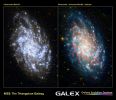
M-033-a.jpgM 33 - The "Triangulum" Spiral Galaxy (a.k.a. NGC 598)64 visiteNASA's Galaxy Evolution Explorer Mission celebrates its sixth anniversary studying galaxies beyond our Milky Way through its sensitive UltraViolet telescope, the only such far-UltraViolet detector in space.
The mission studies the shape, brightness, size and distance of distant galaxies across 10 BY of cosmic history, giving scientists a wealth of data to help us better understand the origins of the universe. One such object is pictured here, the galaxy NGC 598, more commonly known as M 33.
The image shows a map of the recent star formation history of M 33. The bright blue and white areas are where star formation has been extremely active over the past few million years. The patches of yellow and gold are regions where star formation was more active 100 MY ago.
In addition, the UltraViolet image shows the most massive young stars in M 33. These stars burn their large supply of Hydrogen fuel quickly, burning hot and bright while emitting most of their energy at UV wavelengths. Compared with low-mass stars like our Sun, which live for billions of years, these massive stars never reach old age, having a lifespan as short as a few million years.
The California Institute of Technology, in Pasadena, Calif., leads the Galaxy Evolution Explorer Mission and is responsible for science operations and data analysis. NASA's Jet Propulsion Laboratory, also in Pasadena, manages the mission and built the science instrument. The mission was developed under NASA's Explorers Program managed by the Goddard Space Flight Center, Greenbelt, Md. South Korea and France are the mission's international partners.MareKromium
|
|
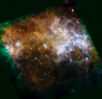
Milky_Way-PIA12251.jpgCold Region in the Milky Way64 visiteSome of the coldest and darkest dust in space shines brightly in this InfraRed image from the Herschel Observatory, a European Space Agency Mission with important participation from NASA.
The image is a composite of light captured simultaneously by two of Herschel's three instruments -- the photodetector array camera and spectrometer, and its spectral and photometric imaging receiver.
The image reveals a cold and turbulent region where material is just beginning to condense into new stars. It is located in the plane of our Milky Way galaxy, 60° from the center. Blue shows warmer material, red the coolest, while green represents intermediate temperatures.
The red filaments are made up of the coldest material pictured here -- material that is slightly warmer than the coldest temperature theoretically attainable in the Universe.
Light captured by the photodetector array camera and spectrometer is colored blue and green (blue represents 70-micron light, and green, 160 micron light). The light detected by the spectral and photometric imaging receiver is colored red (and shows the combined wavelengths of 250, 350 and 500 microns). The image spans a region 2.1 by 2.2 degrees.MareKromium
|
|

M 45 - PIA08260.jpgM 45 - The "Seven Sisters", from Cassini63 visiteCaption NASA originale:"The stars of the Pleiades cluster, also known by the names "M 45" and "The Seven Sisters," shine brightly in this view from the Cassini spacecraft. The cluster is comprised of hundreds of stars, a few of which are visible to the unaided eye on Earth as a brilliant grouping in the constellation Taurus.
Some faint nebulous material is seen here. This reflection nebula is dust that reflects the light of the hot, blue stars in the cluster.
The monochrome view was made by combining 49 clear filter images of the Pleiades taken with the Cassini spacecraft wide-angle camera on Aug. 1, 2006. The images were taken as a part of a sequence designed to help calibrate the camera electronics".
|
|
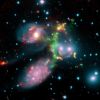
Stephan_s Quintet-PIA02587.jpgStephan's Quintet63 visiteThis false-color composite image of the Stephan's Quintet galaxy cluster clearly shows one of the largest shock waves ever seen (green arc). The wave was produced by one galaxy falling toward another at speeds of more than one million miles per hour. The image is made up of data from NASA's Spitzer Space Telescope and a ground-based telescope in Spain.
Four of the five galaxies in this picture are involved in a violent collision, which has already stripped most of the hydrogen gas from the interiors of the galaxies. The centers of the galaxies appear as bright yellow-pink knots inside a blue haze of stars, and the galaxy producing all the turmoil, NGC7318b, is the left of two small bright regions in the middle right of the image. One galaxy, the large spiral at the bottom left of the image, is a foreground object and is not associated with the cluster.
The titanic shock wave, larger than our own Milky Way galaxy, was detected by the ground-based telescope using visible-light wavelengths. It consists of hot hydrogen gas. As NGC7318b collides with gas spread throughout the cluster, atoms of hydrogen are heated in the shock wave, producing the green glow.
Spitzer pointed its infrared spectrograph at the peak of this shock wave (middle of green glow) to learn more about its inner workings. This instrument breaks light apart into its basic components. Data from the instrument are referred to as spectra and are displayed as curving lines that indicate the amount of light coming at each specific wavelength.
The Spitzer spectrum showed a strong infrared signature for incredibly turbulent gas made up of hydrogen molecules. This gas is caused when atoms of hydrogen rapidly pair-up to form molecules in the wake of the shock wave. Molecular hydrogen, unlike atomic hydrogen, gives off most of its energy through vibrations that emit in the infrared.
This highly disturbed gas is the most turbulent molecular hydrogen ever seen. Astronomers were surprised not only by the turbulence of the gas, but by the incredible strength of the emission. The reason the molecular hydrogen emission is so powerful is not yet completely understood.
Stephan's Quintet is located 300 million light-years away in the Pegasus constellation.
This image is composed of three data sets: near-infrared light (blue) and visible light called H-alpha (green) from the Calar Alto Observatory in Spain, operated by the Max Planck Institute in Germany; and 8-micron infrared light (red) from Spitzer's infrared array camera.
|
|

M 74-PIA08533_fig3.jpgSupernova SN2003gd in January 2005 (2)63 visiteBy January 2005, the dust had cooled and completely faded from the camera's view (here). However, it was still detected in January 2005 by another instrument aboard Spitzer called the Multiband Imaging Photometer.
All the images are false-color, infrared composites, in which 3,6-micron light is blue, 4,5-micron light is green, and 8-micron light is red.
|
|

M 42-PIA08654-ed.jpgInfrared Orion63 visiteThis image composite compares infrared and visible views of the famous Orion nebula and its surrounding cloud, an industrious star-making region located near the hunter constellation's sword. The infrared picture is from NASA's Spitzer Space Telescope, and the visible image is from the National Optical Astronomy Observatory, headquartered in Tucson, Ariz.
In addition to Orion, two other nebulas can be seen in both pictures. The Orion nebula, or M42, is the largest and takes up the lower half of the images; the small nebula to the upper left of Orion is called M43; and the medium-sized nebula at the top is NGC 1977. Each nebula is marked by a ring of dust that stands out in the infrared view. These rings make up the walls of cavities that are being excavated by radiation and winds from massive stars. The visible view of the nebulas shows gas heated by ultraviolet radiation from the massive stars.
Above the Orion nebula, where the massive stars have not yet ejected much of the obscuring dust, the visible image appears dark with only a faint glow. In contrast, the infrared view penetrates the dark lanes of dust, revealing bright swirling clouds and numerous developing stars that have shot out jets of gas (green). This is because infrared light can travel through dust, whereas visible light is stopped short by it.
The infrared image shows light captured by Spitzer's infrared array camera. Light with wavelengths of 8 and 5.8 microns (red and orange) comes mainly from dust that has been heated by starlight. Light of 4.5 microns (green) shows hot gas and dust; and light of 3.6 microns (blue) is from starlight.
|
|

M 42-PIA08656.jpgOrion's "Sword"63 visiteThis image composite outlines the region near Orion's sword that was surveyed by NASA's Spitzer Space Telescope (white box). The view on the left (figure 1) is from a visible-light telescope, and the view on the right (figure 2) shows infrared light captured by a previous infrared mission, the Infrared Astronomical Satellite.
The Orion nebula, our closest massive star-making factory, is the brightest spot near the hunter's sword. On a dark night, it can appear to the naked eye as a fuzzy star, and it looks like a ghostly blob through a pair of binoculars. The Orion constellation is one of the most prominent winter constellations, and can be seen from all northern latitudes starting in the fall.
Spitzer used its infrared eyes to probe the dusty clouds of a region called Orion cloud A. outlined here in the hockey stick-shaped box (see PIA08655). This giant cloud stretches almost a quarter of the length of the constellation, an area equivalent to 18 full moons. The small box within the hockey stick shows the location of another image released by Spitzer (see PIA08653), which mainly features the Orion nebula itself.
The bright spot that shows up in the infrared view in the area of Orion's belt is known as Orion cloud B. Together, Orion clouds A and B make up the Orion cloud complex. In a survey of this entire complex, Spitzer unearthed 2,300 stars circled by disks of planet-forming dust and 200 stellar embryos too young to have developed disks.
The Infrared Astronomical Satellite was a joint effort between NASA, the Science and Engineering Research Council, United Kingdom and the Netherlands Agency for Aerospace Programmes, the Netherlands. Spitzer has extended the legacy of the satellite by providing much better resolution and sensitivity.
The visible-light image comes courtesy of Howard McCallon of the Infrared Processing and Analysis Center at the California Institute of Technology of Pasadena.
|
|

Upsilon Andromedae-PIA01937.jpgUpsilon Andromedae63 visiteThe top graph consists of infrared data from NASA's Spitzer Space Telescope. It tells astronomers that a distant planet, called Upsilon Andromedae b, always has a giant hot spot on the side that faces the star, while the other side is cold and dark. The artist's concepts above the graph illustrate how the planet might look throughout its orbit if viewed up close with infrared eyes.
Spitzer was able to determine the difference in temperature between the two sides of this planet by measuring the planet's infrared light, or heat, at five points during its 4.6-day-long trip around its star. The temperature rose and fell depending on which face, the sunlit or dark, was pointed toward Spitzer's cameras. Those temperature oscillations are traced by the wavy orange curve. They indicate that Upsilon Andromedae b has an extreme range of temperatures across its surface, about 1,400 degrees Celsius (2,550 degrees Fahrenheit). This means that hot gas moving across the bright side of the planet cools off by the time it reaches the dark side.
The bottom graph and artist's concepts represent what astronomers might have seen if the planet had bands of different temperatures girdling it, like Jupiter. Some astronomers had speculated that "hot-Jupiter" planets like Upsilon Andromedae b, which circle very closely around their stars, might resemble Jupiter in this way. If Upsilon Andromedae b had been like this, there would have been no difference between the average temperatures of the sunlit and dark sides to detect, and Spitzer's data would have appeared as a flat line.
|
|
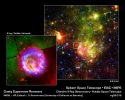
N76-PIA08516-2.jpgThe "N 76 Nebula"62 visiteThe supernova remnant1E0102.2-7219 sits next to the Nebula N76 in a bright, Star-Forming Region of the Small Magellanic Cloud, a satellite galaxy to our Milky Way galaxy located about 200.000 LY from Earth. A Supernova Remnant is made up of the messy bits and pieces of a massive star that exploded, or went Supernova. This image shows glowing dust grains in three wavelengths of infrared radiation: 24 microns (red) measured by the Multiband Imaging Photometer aboard NASA's Spitzer Space Telescope; and 8.0 microns (green) and 3.6 microns (blue) measured by Spitzer's infrared array camera. The red bubble is a dust envelope around the supernova remnant E0102, which is being heated by the shock wave created in the explosion of the remnant's massive progenitor star some 1,000 years ago. Most of the blue stars are in the Small Magellanic Cloud, though some are in our own galaxy.
|
|

Spectrum-PIA09198.jpgSpectrum of an Alien World62 visiteThis infrared data from NASA's Spitzer Space Telescope - called a spectrum - tells astronomers that a distant gas planet, a so-called "hot Jupiter" called HD 209458b, might be smothered with high clouds. It is one of the first spectra of an alien world.
A spectrum is created when an instrument called a spectrograph spreads light from an object apart into a rainbow of different wavelengths. Patterns or ripples within the spectrum indicate the presence, or absence, of molecules making up the object.
Astronomers using Spitzer's spectrograph were able to obtain infrared spectra for two so-called "transiting" hot-Jupiter planets using the "secondary eclipse" technique. In this method, the spectrograph first collects the combined infrared light from the planet plus its star, then, as the planet is eclipsed by the star, the infrared light of just the star. Subtracting the latter from the former reveals the planet's own rainbow of infrared colors.
When astronomers first saw the infrared spectrum above, they were shocked. It doesn't look anything like what theorists had predicted. Theorists though the spectra for hot, Jupiter-like planets like this one would be filled with the signatures of molecules in the planets' atmospheres. But the spectrum doesn't show any molecules. It is what astronomers call "flat." For example, theorists thought there'd be signatures of water in the wavelength ranges of 8 to 9 microns. The fact that water is not seen there might indicate that the water is hidden under a thick blanket of high, dry clouds.
This spectrum was produced by Dr. Mark R. Swain of NASA's Jet Propulsion Laboratory in Pasadena, Calif., using a complex set of mathematical tools. It was derived using two different methods, both of which led to the same result. The data were taken on July 6 and 13, 2005, by Dr. Jeremy Richardson of NASA's Goddard Space Flight Center and his team using Spitzer's infrared spectrograph.
|
|

Spectrum-PIA09196.jpgHow to get a Spectrum of an Alien World62 visiteThis diagram illustrates how astronomers using NASA's Spitzer Space Telescope can capture the elusive spectra of hot-Jupiter planets. Spectra are an object's light spread apart into its basic components, or wavelengths. By dissecting light in this way, scientists can sort through it and uncover clues about the composition of the object giving off the light.
To obtain a spectrum for an object, one first needs to capture its light. Hot-Jupiter planets are so close to their stars that even the most powerful telescopes can't distinguish their light from the light of their much brighter stars.
But, there are a few planetary systems that allow astronomers to measure the light from just the planet by using a clever technique. Such "transiting" systems are oriented in such a way that, from our vantage point, the planets' orbits are seen edge-on and cross directly in front of and behind their stars.
In this technique, known as the secondary eclipse method, changes in the total infrared light from a star system are measured as its planet transits behind the star, vanishing from our Earthly point of view. The dip in observed light can then be attributed to the planet alone.
To capture a spectrum of the planet, Spitzer must observe the system twice. It takes a spectrum of the star together with the planet (first panel), then, as the planet disappears from view, a spectrum of just the star (second panel). By subtracting the star's spectrum from the combined spectrum of the star plus the planet, it is able to get the spectrum for just the planet (third panel).
This ground-breaking technique was used by Spitzer to obtain the first-ever spectra of two planets beyond our solar system, HD 209458b and HD 189733b. The results suggest that the hot planets are socked in with dry clouds high up in the planet's stratospheres. In addition, HD 209458b showed hints of silicates, indicating those high clouds might be made of very fine sand-like particles.
|
|
| 157 immagini su 14 pagina(e) |
|
|
|
|
|
|
|
|
|
13 |
|
|
|





