| |

| Piú viste - The Universe in Super Definition |
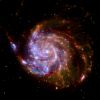
M-101-PIA11797.jpgM 10165 visiteIn 1609, Galileo improved the newly invented telescope, turned it toward the heavens, and revolutionized our view of the universe. In celebration of the 400th anniversary of this milestone, 2009 has been designated as the International Year of Astronomy.
Today, NASA's Great Observatories are continuing Galileo's legacy with stunning images and breakthrough science from the Hubble Space Telescope, the Spitzer Space Telescope, and the Chandra X-ray Observatory.
While Galileo observed the sky using visible light seen by the human eye, technology now allows us to observe in many wavelengths, including Spitzer's infrared view and Chandra's view in X-rays. Each wavelength region shows different aspects of celestial objects and often reveals new objects that could not otherwise be studied.
This image of the spiral galaxy Messier 101 is a composite of views from Spitzer, Hubble, and Chandra.
The red color shows Spitzer's view in infrared light. It highlights the heat emitted by dust lanes in the galaxy where stars can form.
The yellow color is Hubble's view in visible light. Most of this light comes from stars, and they trace the same spiral structure as the dust lanes.
The blue color shows Chandra's view in X-ray light. Sources of X-rays include million-degree gas, exploded stars, and material colliding around black holes.
Such composite images allow astronomers to see how features seen in one wavelength match up with those seen in another wavelength. It's like seeing with a camera, night vision goggles, and X-ray vision all at once.
In the four centuries since Galileo, astronomy has changed dramatically. Yet our curiosity and quest for knowledge remain the same. So, too, does our wonder at the splendor of the universe.
The International Year of Astronomy Great Observatories Image Unveiling is supported by the NASA Science Mission Directorate Astrophysics Division. The project is a collaboration between the Space Telescope Science Institute, the Spitzer Science Center, and the Chandra X-ray Center.
MareKromium
|
|

M-033-PIA11970.jpgM 33 - Spiral Galaxy65 visiteOne of our closest galactic neighbors shows its awesome beauty in this new image from NASA's Spitzer Space Telescope.
M 33, also known as the "Triangulum Galaxy", is a member of what's known as our Local Group of galaxies. Along with our own Milky Way, this group travels together in the universe, as they are gravitationally bound.
In fact, M 33 is one of the few galaxies that is moving toward the Milky Way despite the fact that space itself is expanding, causing most galaxies in the universe to grow farther and farther apart.
When viewed with Spitzer's InfraRed eyes, this elegant spiral galaxy sparkles with color and detail. Stars appear as glistening blue gems (many of which are actually foreground stars in our own galaxy), while dust in the spiral disk of the galaxy glows pink and red. But not only is this new image beautiful, it also shows M 33 to be surprising large —bigger than its Visible-Light appearance would suggest.
With its ability to detect cold, dark dust, Spitzer can see emission from cooler material well beyond the visible range of M 33's disk. Exactly how this cold material moved outward from the galaxy is still a mystery, but winds from giant stars or supernovas may be responsible.
M 33 is located about 2,9 MLY away in the constellation Triangulum. This composite image was taken by Spitzer's InfraRed Array Camera (a.k.a.: IRAC). The color blue indicates InfraRed Light of 3.6 microns, green shows 4.5-micron light, and red 8.0 microns.MareKromium
|
|

M-033-PIA11969.jpgM 33 - Spiral Galaxy (3-color composite)65 visiteOne of our closest galactic neighbors shows its awesome beauty in this new image from NASA's Spitzer Space Telescope. M 33, also known as the "Triangulum Galaxy", is a member of what's known as our Local Group of galaxies.
Along with our own Milky Way, this group travels together in the universe, as they are gravitationally bound. In fact, M 33 is one of the few galaxies that is moving toward the Milky Way despite the fact that space itself is expanding, causing most galaxies in the universe to grow farther and farther apart.
When viewed with Spitzer's InfraRed eyes, this elegant spiral galaxy sparkles with color and detail. Stars appear as glistening blue gems (several of which are actually foreground stars in our own galaxy), while dust rich in organic molecules glows green. The diffuse orange-red glowing areas indicate star-forming regions, while small red flecks outside the spiral disk of M 33 are most likely distant background galaxies. But not only is this new image beautiful, it also shows M 33 to be surprising large — bigger than its Visible-Light appearance would suggest.
With its ability to detect cold, dark dust, Spitzer can see emission from cooler material well beyond the visible range of M 33's disk. Exactly how this cold material moved outward from the galaxy is still a mystery, but winds from giant stars or supernovas may be responsible.
M 33 is located about 2,9 MLY away in the constellation Triangulum. This is a three-color composite image showing InfraRed observations from two of Spitzer instruments. Blue represents combined 3.6- and 4.5-micron light and green shows light of 8 microns, both captured by Spitzer's IRAC.
Red is 24-micron light detected by Spitzer's Multiband Imaging Photometer.MareKromium
|
|

K4-55-HST.jpgK4-55 Planetary Nebula65 visiteThe Hubble Community bids farewell to the soon-to-be decommissioned Wide Field Planetary Camera 2 (WFPC2) onboard the Hubble Space Telescope.
In tribute to Hubble's longest-running optical camera, Planetary Nebula K 4-55 has been imaged as WFPC2's final "pretty picture".MareKromium
|
|

M 74-PIA08533_fig1.jpgM 74 and Supernova SN2003gd64 visiteThis image is the galaxy M 74, as seen by SST's infrared array camera. The white box to the left of the Galaxy's center identifies the location of the Supernova Remnant. In all the images, the blue dots represent hot gas and stars. The galaxy's cool dust is shown in red.
Astronomers using NASA's SST have spotted a "dust factory" 30 MLY away in the spiral galaxy M 74. The factory is located at the scene of a massive star's explosive death, or supernova.
While astronomers have suspected for years that supernovae could be producers of cosmic dust particles, the technology to confirm this suspicion has only recently become available.
|
|

M 74-PIA08533_fig2.jpgSupernova SN2003gd in July 2004 (1)64 visiteThe dust factory, also known as supernova SN 2003gd, is shown at the center of the two small insets from Spitzer's infrared array camera. A white arrow points to its exact location.
The yellow-green dot shown in the July 2004 inset (here) shows that the source's temperature is warmer than the surrounding material. This is because newly formed dust within the Supernova is just starting to cool.
|
|
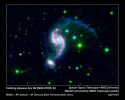
NGC-2535-PIA09106.jpgNGC 2535 and NGC 2536 (alias Arp 82)64 visiteA pair of interacting galaxies might be experiencing the galactic equivalent of a mid-life crisis. For some reason, the pair, called Arp 82, didn't make their stars early on as is typical of most galaxies. Instead, they got a second wind later in life -- about 2 billion years ago -- and started pumping out waves of new stars as if they were young again.
Arp 82 is an interacting pair of galaxies with a strong bridge and a long tail. NGC 2535 is the big galaxy and NGC 2536 is its smaller companion. The disk of the main galaxy looks like an eye, with a bright "pupil" in the center and oval-shaped "eyelids." Dramatic "beads on a string" features are visible as chains of evenly spaced star-formation complexes along the eyelids. These are presumably the result of large-scale gaseous shocks from a grazing encounter. The colors of this galaxy indicate that the observed stars are young to intermediate in age, around 2 million to 2 billion years old, much less than the age of the universe (13.7 billion years).
The puzzle is: why didn't Arp 82 form many stars earlier, like most galaxies of that mass range? Scientifically, it is an oddball and provides a relatively nearby lab for studying the age of intermediate-mass galaxies.
This picture is a composite captured by Spitzer's infrared array camera with light at wavelength 8 microns shown in red, NASA's Galaxy Evolution Explorer combined 1530 and 2310 Angstroms shown in blue, and the Southeastern Association for Research in Astronomy Observatory light at 6940 Angstroms shown in green.
|
|

Spectrum-PIA09197.jpgSpectrum of an Alien World64 visiteThis infrared data from NASA's Spitzer Space Telescope - called a spectrum - tells astronomers that a distant gas planet, a so-called "hot Jupiter" called HD 209458b, might be smothered with high clouds. It is one of the first spectra of an alien world.
A spectrum is created when an instrument called a spectrograph cracks light from an object open into a rainbow of different wavelengths. Patterns or ripples within the spectrum indicate the presence, or absence, of molecules making up the object.
Astronomers using Spitzer's spectrograph were able to obtain infrared spectra for two so-called "transiting" hot-Jupiter planets using the "secondary eclipse" technique. In this method, the spectrograph first collects the combined infrared light from the planet plus its star, then, as the planet is eclipsed by the star, the infrared light of just the star. Subtracting the latter from the former reveals the planet's own rainbow of infrared colors.
When astronomers first saw the infrared spectrum above, they were shocked. It doesn't look anything like what theorists had predicted. For example, theorists thought there'd be signatures of water in the wavelength ranges of 8 to 9 microns. The fact that water is not detected might indicate that it is hidden under a thick blanket of high, dry clouds.
In addition, the spectrum shows signs of silicate dust -- tiny grains of sand -- in the wavelength range of 9 to 10 microns. This suggests that the planet's skies could be filled with high clouds of dust unlike anything seen in our own solar system.
There is also an unidentified molecular signature at 7.78 microns. Future observations using Spitzer's spectrograph should be able to determine the nature of the mysterious feature.
This spectrum was produced by Dr. Jeremy Richardson of NASA's Goddard Space Flight Center, Greenbelt, Md. and his colleagues. The data were taken by Spitzer's infrared spectrograph on July 6 and 13, 2005.
|
|

NGC-2237-PIA09267.jpgNGC 2237 - The "Rosette Nebula", and Globular Star Cluster NGC 224464 visiteThis infrared image from NASA's Spitzer Space Telescope shows the Rosette nebula, a pretty star-forming region more than 5,000 light-years away in the constellation Monoceros. In optical light, the nebula looks like a rosebud, or the "rosette" adornments that date back to antiquity.
But lurking inside this delicate cosmic rosebud are so-called planetary "danger zones" (see spheres illustrations in figure 1). These zones surround super hot stars, called O-stars (blue stars inside spheres), which give off intense winds and radiation. Young, cooler stars that just happen to reside within one of these zones are in danger of having their dusty planet-forming materials stripped away.
While O-star danger zones were known about before, their parameters were not. Astronomers used Spitzer's infrared vision to survey the extent of the five danger zones shown here. The results showed that young stars lying beyond 1.6 light-years, or 10 trillion miles, of any O-stars are safe, while young stars within this zone are likely to have their potential planets blasted into space.
Radiation and winds from the super hot stars have collectively blown layers of dust (green) and gas away, revealing the cavity of cooler dust (red). The largest two blue stars in this picture are in the foreground, and not in the nebula itself.
This image shows infrared light captured by Spitzer's infrared array camera. Light with wavelengths of 24 microns is red; light of 8 microns is green; and light of 4.5 microns is blue.
MareKromium
|
|
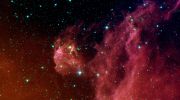
M-042-PIA09412.jpgOut of Orion's Head (2)64 visiteThis image from NASA's SST shows infant stars "hatching" in the Head of the Hunter constellation, Orion. Astronomers suspect that shockwaves from a supernova explosion in Orion's head, nearly 3 MY ago, may have initiated this newfound birth
The Region featured in this Spitzer image is called Barnard 30.
It is located approximately 1300 LY away and sits on the right side of Orion's "Head" just North of the massive star Lambda Orionis. Wisps of red in the cloud are organic molecules called polycyclic aromatic hydrocarbons. These molecules are formed anytime carbon-based materials are burned incompletely. On Earth, they can be found in the sooty exhaust from automobile and airplane engines. They also coat the grills where charcoal-broiled meats are cooked.
This image shows infrared light captured by Spitzer's infrared array camera. Light with wavelengths of 8 and 5.8 microns (red and orange) comes mainly from dust that has been heated by starlight.
Light of 4.5 microns (green) shows hot gas and dust; and light of 3.6 microns (blue) is from starlight.
MareKromium
|
|
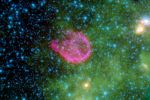
SNR-N132D-PIA09604.jpgThe "Shock-Waves" of N132D64 visiteSupernovae are the explosive deaths of the universe's most massive stars. In death, these volatile creatures blast tons of energetic waves into the cosmos, destroying much of the dust surrounding them.
This false-color composite from NASA's Spitzer Space Telescope and NASA's Chandra X-ray Observatory shows the remnant of one such explosion. The remnant, called N132D, is the wispy pink shell of gas at the center of this image. The pinkish color reveals a clash between the explosion's high-energy shockwaves and surrounding dust grains.
In the background, small organic molecules called polycyclic aromatic hydrocarbons are shown as tints of green. The blue spots represent stars in our galaxy along this line of sight.
N132D is located 163.000 LY away in the Large Magellanic Cloud.
In this image, infrared light at 4,5 microns is mapped to blue, 8,0 microns to green and 24 microns to red. Broadband X-ray light is mapped purple. The infrared data were taken by Spitzer's infrared array camera and multiband imaging photometer, while the X-ray data were captured by Chandra.
MareKromium
|
|
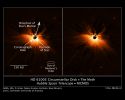
HD_61005.jpgCircumstellar Dust Takes Flight in 'The Moth'64 visiteWhat superficially resembles a giant moth floating in space is giving astronomers new insight into the formation and evolution of planetary systems.
This is not your typical flying insect. It has a wingspan of about 22 billion miles. The wing- like structure is actually a dust disk encircling the nearby, young star HD 61005, dubbed "The Moth." Its shape is produced by starlight scattering off dust.
Dust disks around roughly 100-million-year-old stars like HD 61005 are typically flat, pancake-shaped structures where planets can form. But images taken with NASA's Hubble Space Telescope of "The Moth" are showing that some disks sport surprising shapes.
"It is completely unexpected to find a dust disk with this unusual shape," said senior research scientist Dean Hines of the Space Science Institute, New Mexico Office in Corrales, New Mexico, and a member of the Hubble team that discovered the disk. "We think HD 61005 is plowing through a local patch of higher-density gas in the interstellar medium, causing material within HD 61005's disk to be swept behind the star. What effect this might have on the disk, and any planets forming within it, is unknown."
Hines called this possible collision "unusual, because we don't expect very much interstellar material to be in the solar neighborhood. That's because the area through which our Sun is moving was evacuated within the past few million years by at least one supernova, the explosion of a massive star. Yet, here's evidence of dense material that's very close, only 100 light-years away."
Astronomers have found evidence that the environment in which a star forms influences its prospects for planet formation. Hubble has actually seen that young planet-forming disks can be affected directly by their environment. The harsh stellar radiation from the Trapezium stars in the Orion Nebula has altered some disks. It is unclear, however, what effect passage through a cloud similar to the one in which HD 61005 finds itself would have on planet formation. Researchers have speculated that passage through dense regions of the interstellar medium could impact the atmospheres of evolving planets.
The Moth is part of a survey of Sun-like stars that Hines and collaborators observed with Hubble's Near-Infrared Camera and Multi-Object Spectrometer (NICMOS) and NASA's Spitzer Space Telescope to study the formation and evolution of planetary systems. Under the lead of Michael Meyer of the University of Arizona in Tucson, the team initially used Spitzer to look for heat radiation—the tell-tale sign of dust warmed by the star—to identify interesting star systems.
Hines then teamed with Glenn Schneider of the University of Arizona to use Hubble's high- contrast imaging capability of the NICMOS coronagraph to image these disks and reveal where the dust detected by Spitzer resides. The NICMOS coronagraph blocked out the starlight so that astronomers could see details in the surrounding disk.
"These symbiotic capabilities, uniquely implemented in NASA's Great Observatories, provide astronomers with the powerful observational tools to study the circumstellar environments of potentially planet-forming systems," Schneider said.
Added Meyer: "Combining observations from these two spacecraft gives us information about the composition of the dust grains, whether they're icy or sandy, or whether they're like the sooty smoke particles rising from a chimney. The composition and sizes of the dust can tell us a lot about the dynamics and evolution of a solar system. In our solar system, for example, astronomers have evidence of rocks smashing into each other and generating dust, as in the asteroid and Kuiper belts. We're seeing these same processes unfold in other planetary systems."
MareKromium
|
|
| 157 immagini su 14 pagina(e) |
|
|
|
|
|
|
|
|
12 | |
|
|
|





