| |

| Piú viste - The Universe in Super Definition |

M-033-PIA11970.jpgM 33 - Spiral Galaxy64 visiteOne of our closest galactic neighbors shows its awesome beauty in this new image from NASA's Spitzer Space Telescope.
M 33, also known as the "Triangulum Galaxy", is a member of what's known as our Local Group of galaxies. Along with our own Milky Way, this group travels together in the universe, as they are gravitationally bound.
In fact, M 33 is one of the few galaxies that is moving toward the Milky Way despite the fact that space itself is expanding, causing most galaxies in the universe to grow farther and farther apart.
When viewed with Spitzer's InfraRed eyes, this elegant spiral galaxy sparkles with color and detail. Stars appear as glistening blue gems (many of which are actually foreground stars in our own galaxy), while dust in the spiral disk of the galaxy glows pink and red. But not only is this new image beautiful, it also shows M 33 to be surprising large —bigger than its Visible-Light appearance would suggest.
With its ability to detect cold, dark dust, Spitzer can see emission from cooler material well beyond the visible range of M 33's disk. Exactly how this cold material moved outward from the galaxy is still a mystery, but winds from giant stars or supernovas may be responsible.
M 33 is located about 2,9 MLY away in the constellation Triangulum. This composite image was taken by Spitzer's InfraRed Array Camera (a.k.a.: IRAC). The color blue indicates InfraRed Light of 3.6 microns, green shows 4.5-micron light, and red 8.0 microns.MareKromium
|
|

M-033-PIA11969.jpgM 33 - Spiral Galaxy (3-color composite)64 visiteOne of our closest galactic neighbors shows its awesome beauty in this new image from NASA's Spitzer Space Telescope. M 33, also known as the "Triangulum Galaxy", is a member of what's known as our Local Group of galaxies.
Along with our own Milky Way, this group travels together in the universe, as they are gravitationally bound. In fact, M 33 is one of the few galaxies that is moving toward the Milky Way despite the fact that space itself is expanding, causing most galaxies in the universe to grow farther and farther apart.
When viewed with Spitzer's InfraRed eyes, this elegant spiral galaxy sparkles with color and detail. Stars appear as glistening blue gems (several of which are actually foreground stars in our own galaxy), while dust rich in organic molecules glows green. The diffuse orange-red glowing areas indicate star-forming regions, while small red flecks outside the spiral disk of M 33 are most likely distant background galaxies. But not only is this new image beautiful, it also shows M 33 to be surprising large — bigger than its Visible-Light appearance would suggest.
With its ability to detect cold, dark dust, Spitzer can see emission from cooler material well beyond the visible range of M 33's disk. Exactly how this cold material moved outward from the galaxy is still a mystery, but winds from giant stars or supernovas may be responsible.
M 33 is located about 2,9 MLY away in the constellation Triangulum. This is a three-color composite image showing InfraRed observations from two of Spitzer instruments. Blue represents combined 3.6- and 4.5-micron light and green shows light of 8 microns, both captured by Spitzer's IRAC.
Red is 24-micron light detected by Spitzer's Multiband Imaging Photometer.MareKromium
|
|

K4-55-HST.jpgK4-55 Planetary Nebula64 visiteThe Hubble Community bids farewell to the soon-to-be decommissioned Wide Field Planetary Camera 2 (WFPC2) onboard the Hubble Space Telescope.
In tribute to Hubble's longest-running optical camera, Planetary Nebula K 4-55 has been imaged as WFPC2's final "pretty picture".MareKromium
|
|

VB10-b-PIA12014.jpgThe VB10 Star System and the Solar System64 visiteThis artist's diagram compares our Solar System (below) to the VB 10 Star System. Astronomers successfully used the astrometry planet-hunting method for the first time to discover a gas planet, called VB 10b, around a very tiny star, VB 10. All of the bodies in this diagram are shown in circular insets at the same relative scales.
The VB 10 star is one of the smallest known — and holds the record for the smallest known to host a planet. It's a dim, red M-dwarf with only one-tenth the size, and one-twelfth the mass, of our sun. Its planet, on the other hand, is quite hefty, with six times the mass of Jupiter. Though the planet is less massive than the star, the two orbs would be about the same size.
The VB 10 Star System is essentially a shrunken version of our Solar System. Even though its planet is at a similar distance from its star as Mercury is from our Sun, it wouldn't receive as much heat and would be classified as a "cold Jupiter" similar to our own. If any rocky planets do orbit in the VB 10 System, they would be located even closer in than VB 10b, and could lie within the star's "Habitable Zone" — a region where temperatures are right for water to be liquid.
Astrometry involves measuring the wobble of a star on the sky, caused by an unseen planet yanking it back and forth. Because the VB 10b Planet is so big relative to its star, it really tugs the star around. The red circle seen at the center of the VB 10 system shows just how big this wobble is. Because our sun is more massive than VB 10, its planets do not cause it to wobble nearly as much.MareKromium
|
|
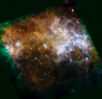
Milky_Way-PIA12251.jpgCold Region in the Milky Way64 visiteSome of the coldest and darkest dust in space shines brightly in this InfraRed image from the Herschel Observatory, a European Space Agency Mission with important participation from NASA.
The image is a composite of light captured simultaneously by two of Herschel's three instruments -- the photodetector array camera and spectrometer, and its spectral and photometric imaging receiver.
The image reveals a cold and turbulent region where material is just beginning to condense into new stars. It is located in the plane of our Milky Way galaxy, 60° from the center. Blue shows warmer material, red the coolest, while green represents intermediate temperatures.
The red filaments are made up of the coldest material pictured here -- material that is slightly warmer than the coldest temperature theoretically attainable in the Universe.
Light captured by the photodetector array camera and spectrometer is colored blue and green (blue represents 70-micron light, and green, 160 micron light). The light detected by the spectral and photometric imaging receiver is colored red (and shows the combined wavelengths of 250, 350 and 500 microns). The image spans a region 2.1 by 2.2 degrees.MareKromium
|
|
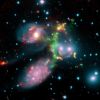
Stephan_s Quintet-PIA02587.jpgStephan's Quintet63 visiteThis false-color composite image of the Stephan's Quintet galaxy cluster clearly shows one of the largest shock waves ever seen (green arc). The wave was produced by one galaxy falling toward another at speeds of more than one million miles per hour. The image is made up of data from NASA's Spitzer Space Telescope and a ground-based telescope in Spain.
Four of the five galaxies in this picture are involved in a violent collision, which has already stripped most of the hydrogen gas from the interiors of the galaxies. The centers of the galaxies appear as bright yellow-pink knots inside a blue haze of stars, and the galaxy producing all the turmoil, NGC7318b, is the left of two small bright regions in the middle right of the image. One galaxy, the large spiral at the bottom left of the image, is a foreground object and is not associated with the cluster.
The titanic shock wave, larger than our own Milky Way galaxy, was detected by the ground-based telescope using visible-light wavelengths. It consists of hot hydrogen gas. As NGC7318b collides with gas spread throughout the cluster, atoms of hydrogen are heated in the shock wave, producing the green glow.
Spitzer pointed its infrared spectrograph at the peak of this shock wave (middle of green glow) to learn more about its inner workings. This instrument breaks light apart into its basic components. Data from the instrument are referred to as spectra and are displayed as curving lines that indicate the amount of light coming at each specific wavelength.
The Spitzer spectrum showed a strong infrared signature for incredibly turbulent gas made up of hydrogen molecules. This gas is caused when atoms of hydrogen rapidly pair-up to form molecules in the wake of the shock wave. Molecular hydrogen, unlike atomic hydrogen, gives off most of its energy through vibrations that emit in the infrared.
This highly disturbed gas is the most turbulent molecular hydrogen ever seen. Astronomers were surprised not only by the turbulence of the gas, but by the incredible strength of the emission. The reason the molecular hydrogen emission is so powerful is not yet completely understood.
Stephan's Quintet is located 300 million light-years away in the Pegasus constellation.
This image is composed of three data sets: near-infrared light (blue) and visible light called H-alpha (green) from the Calar Alto Observatory in Spain, operated by the Max Planck Institute in Germany; and 8-micron infrared light (red) from Spitzer's infrared array camera.
|
|

M 74-PIA08533_fig2.jpgSupernova SN2003gd in July 2004 (1)63 visiteThe dust factory, also known as supernova SN 2003gd, is shown at the center of the two small insets from Spitzer's infrared array camera. A white arrow points to its exact location.
The yellow-green dot shown in the July 2004 inset (here) shows that the source's temperature is warmer than the surrounding material. This is because newly formed dust within the Supernova is just starting to cool.
|
|

M 74-PIA08533.jpgM 74 - Spiral Galaxy63 visite
|
|

Upsilon Andromedae-PIA01937.jpgUpsilon Andromedae63 visiteThe top graph consists of infrared data from NASA's Spitzer Space Telescope. It tells astronomers that a distant planet, called Upsilon Andromedae b, always has a giant hot spot on the side that faces the star, while the other side is cold and dark. The artist's concepts above the graph illustrate how the planet might look throughout its orbit if viewed up close with infrared eyes.
Spitzer was able to determine the difference in temperature between the two sides of this planet by measuring the planet's infrared light, or heat, at five points during its 4.6-day-long trip around its star. The temperature rose and fell depending on which face, the sunlit or dark, was pointed toward Spitzer's cameras. Those temperature oscillations are traced by the wavy orange curve. They indicate that Upsilon Andromedae b has an extreme range of temperatures across its surface, about 1,400 degrees Celsius (2,550 degrees Fahrenheit). This means that hot gas moving across the bright side of the planet cools off by the time it reaches the dark side.
The bottom graph and artist's concepts represent what astronomers might have seen if the planet had bands of different temperatures girdling it, like Jupiter. Some astronomers had speculated that "hot-Jupiter" planets like Upsilon Andromedae b, which circle very closely around their stars, might resemble Jupiter in this way. If Upsilon Andromedae b had been like this, there would have been no difference between the average temperatures of the sunlit and dark sides to detect, and Spitzer's data would have appeared as a flat line.
|
|

M-016-PIA09109.jpgM 16 - The "Eagle Nebula"63 visiteThis image composite highlights the pillars of the Eagle Nebula, as seen in infrared light by NASA's Spitzer Space Telescope (bottom) and visible light by NASA's Hubble Space Telescope (top insets).
The top right inset focuses on the 3 famous pillars, dubbed the "Pillars of Creation", which were photographed by Hubble in 1995. Hubble's optical view shows the dusty towers in exquisite detail, while Spitzer's infrared eyes penetrate through the thick dust, revealing ghostly transparent structures. The same effect can be seen for the pillar outlined in the top left box.
In both cases, Spitzer's view exposes newborn stars that were hidden inside the cocoon-like pillars, invisible to Hubble. These stars were first uncovered by the European Space Agency's Infrared Satellite Observatory. In the Spitzer image, two embedded stars are visible at the tip and the base of the left pillar, while one star can be seen at the tip of the tallest pillar on the right.
|
|
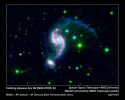
NGC-2535-PIA09106.jpgNGC 2535 and NGC 2536 (alias Arp 82)63 visiteA pair of interacting galaxies might be experiencing the galactic equivalent of a mid-life crisis. For some reason, the pair, called Arp 82, didn't make their stars early on as is typical of most galaxies. Instead, they got a second wind later in life -- about 2 billion years ago -- and started pumping out waves of new stars as if they were young again.
Arp 82 is an interacting pair of galaxies with a strong bridge and a long tail. NGC 2535 is the big galaxy and NGC 2536 is its smaller companion. The disk of the main galaxy looks like an eye, with a bright "pupil" in the center and oval-shaped "eyelids." Dramatic "beads on a string" features are visible as chains of evenly spaced star-formation complexes along the eyelids. These are presumably the result of large-scale gaseous shocks from a grazing encounter. The colors of this galaxy indicate that the observed stars are young to intermediate in age, around 2 million to 2 billion years old, much less than the age of the universe (13.7 billion years).
The puzzle is: why didn't Arp 82 form many stars earlier, like most galaxies of that mass range? Scientifically, it is an oddball and provides a relatively nearby lab for studying the age of intermediate-mass galaxies.
This picture is a composite captured by Spitzer's infrared array camera with light at wavelength 8 microns shown in red, NASA's Galaxy Evolution Explorer combined 1530 and 2310 Angstroms shown in blue, and the Southeastern Association for Research in Astronomy Observatory light at 6940 Angstroms shown in green.
|
|
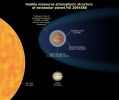
HD-209458b-01.jpgExtra-Solar Planet HD-209458b (2)63 visiteAlthough HD 209458b does not have a twin in our Solar System, it has plenty of relatives beyond our Solar System. About 10 to 15% of the more than 200 known extrasolar planets are hot Jupiters. A recent HST survey netted 16 hot Jupiter candidates in the central region of our Milky Way Galaxy, suggesting that there may be billions of these gas-giant star huggers in our galaxy.
HD 209458b is one of the most intensely studied extrasolar planets because it is one of the few known alien worlds that can be seen passing in front of, or transiting, its star, causing the star to dim slightly. In fact, the gas giant is the first such alien world discovered to transit its star.
HD 209458b is 150 LY from Earth, in the Constellation of Pegasus.
The planet's transits allow astronomers to analyze the structure and chemical makeup of the gas giant's atmosphere by sampling the starlight that passes through it. The effect is similar to finding fingerprints on a window by watching how sunlight filters through the glass.
Previous HST observatoins revealed Oxygen, Carbon and Sodium in the planet's atmosphere, as well as a huge Hydrogen upper atmosphere with a comet-like tail. These landmark studies provided the first detection of the chemical makeup of an extrasolar planet's atmosphere.
Additional observations by NASA's SST captured the infrared glow from the planet's hot atmosphere.
The new study by Ballester and her team is based on an analysis of archival observations made in 2003 with HST's Imaging Spectrograph by David Charbonneau of the Harvard-Smithsonian Center for Astrophysics in Cambridge, Mass. Ballester's team analyzed spectra from hot hydrogen atoms in the planet's upper atmosphere, a region not studied by Charbonneau's group.
|
|
| 157 immagini su 14 pagina(e) |
|
|
|
|
|
|
|
11 | |
|
|
|
|





