| |

| Piú viste - The Universe in Super Definition |
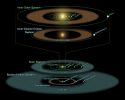
Epsilon_Eridani-PIA11376.JPGSolar Systems65 visiteThis artist's diagram compares the Epsilon Eridani System to our own Solar System. The two systems are structured similarly, and both host asteroids (brown), comets (blue) and planets (white dots).
Epsilon Eridani is our closest known planetary system, located about 10 LY away in the constellation Eridanus. Its central star is a younger, fainter version of our Sun, and is about 800 million years old — about the same age of our Solar System when life first took root on Earth.
Observations from NASA's Spitzer Space Telescope show that the System hosts two Asteroid Belts, in addition to previously identified candidate planets and an Outer Comet Ring.
Epsilon Eridani's inner Asteroid Belt is located at about the same position as ours, approximately 3 AU from its star (aone AU is the distance between Earth and Sun). The system's second, denser Belt lies at about the same place where Uranus orbits in our Solar System, or 20 AU from the star.
In the same way that Jupiter lies just outside our Asteroid Belt, shepherding its rocky debris into a ring, Epsilon Eridani is thought to have planets orbiting near the rims of its two Belts. The first of these planets was identified in 2000 via the Radial Velocity Technique.
Called "Epsilon Eridani b", it orbits at an average distance of 3,4 AU — placing it just outside the System's inner Asteroid Belt.
The second planet orbiting near the rim of the outer Asteroid Belt at 20 AU was inferred when Spitzer discovered the belt.
A third planet might orbit in Epsilon Eridani at the inner edge of its outermost Comet Ring, which lies between 35 and 90 AU. This planet was first hinted at in 1998 due to observed lumpiness in the Comet Ring.
The outer Comet Ring around Epsilon Eridani is denser than our Comet Ring, called Kuiper Belt, because the system is younger.
Over time, Epsilon Eridani's ring will become wispier like the Kuiper Belt. Its comets will collide with each other and break up, or get pushed out of the ring by the gravitational influences of the planets. MareKromium
|
|

From_HST-2009-19-a-print.jpgStarbursts in Dwarf Galaxies are a Global Affair65 visiteBursts of star making in a galaxy have been compared to a Fourth of July fireworks display: They occur at a fast and furious pace, lighting up a region for a short time before winking out.
But these fleeting starbursts are only pieces of the story, astronomers say. An analysis of archival images of small, or dwarf, galaxies taken by NASA's Hubble Space Telescope suggests that starbursts, intense regions of star formation, sweep across the whole galaxy and last 100 times longer than astronomers thought. The longer duration may affect how dwarf galaxies change over time, and therefore may shed light on galaxy evolution.
"Our analysis shows that starburst activity in a dwarf galaxy happens on a global scale", explains Kristen McQuinn of the University of Minnesota in Minneapolis and leader of the study. "There are pockets of intense star formation that propagate throughout the galaxy, like a string of firecrackers going off". According to McQuinn, the duration of all the starburst events in a single dwarf galaxy would total 200 to 400 MYs.
These longer timescales are vastly more than the 5 to 10 MYs proposed by astronomers who have studied star formation in dwarf galaxies. "They were only looking at individual clusters and not the whole galaxy, so they assumed starbursts in galaxies lasted for a short time".
Dwarf galaxies are considered by many astronomers to be the building blocks of the large galaxies seen today, so the length of starbursts is important for understanding how galaxies evolve.
"Astronomers are really interested to find out the steps of galaxy evolution", McQuinn says. "Exploring these smaller galaxies is important because, according to popular theory, large galaxies are created from the merger of smaller, dwarf galaxies. So understanding these smaller pieces is an important part of filling in that scenario".
McQuinn's team analyzed archival Advanced Camera for Surveys data of three dwarf galaxies, NGC 4163, NGC 4068 and IC 4662. Their distances range from 8 to 14 MLYs away. The trio is part of a survey of starbursts in 18 nearby dwarf galaxies. Hubble's superb resolution allowed McQuinn's team to pick out individual stars in the galaxies and measure their brightness and color, two important characteristics astronomers use to determine stellar ages.
By determining the ages of the stars, the astronomers could reconstruct the starburst history in each galaxy.
Two of the galaxies, NGC 4068 and IC 4662, show active, brilliant starburst regions in the Hubble images. The most recent starburst in the third galaxy, NGC 4163, occurred 200 MYs ago and has faded from view. The team looked at regions of high and low densities of stars, piecing together a picture of the starbursts. The galaxies were making a few stars, when something, perhaps an encounter with another galaxy, pushed them into high star-making mode. Instead of forming eight stars every thousand years, the galaxies started making 40 stars every thousand years, which is a lot for a small galaxy, McQuinn says. The typical dwarf is 10 to 30.000 LYs wide. By comparison, a normal-sized galaxy such as our Milky Way is about 100.000 LYs wide.
About 300 to 400 MYs ago star formation occurred in the outer areas of the galaxies. Then it began migrating inward as explosions of massive stars triggered new star formation in adjoining regions. Starbursts are still occurring in the inner parts of NGC 4068 and IC 4662.
The total duration of starburst activity depends on many factors, including the amount of gas in a galaxy, the distribution and density of the gas, and the event that triggered the starburst. A merger or an interaction with a large galaxy, for example, could create a longer starburst event than an interaction with a smaller system.
McQuinn plans to expand her study to a larger sample of more than 20 galaxies. "Studying nearby dwarf galaxies, where we can see the stars in great detail, will help us interpret observations of galaxies in the distant universe, where starbursts were much more common because galaxies had more gas with which to make stars".
McQuinn's results appeared in the April 10 issue of The Astrophysical Journal.MareKromium
|
|
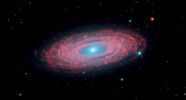
NGC-2841-PIA12001.jpgNGC 2841 - Spiral Galaxy65 visiteThis image from NASA's Spitzer Space Telescope shows the Spiral Galaxy NGC 2841, located about 46 MLY from Earth in the constellation Ursa Major. The galaxy is helping astronomers solve one of the oldest puzzles in astronomy: Why do galaxies look so smooth, with stars sprinkled evenly throughout?
An international team of astronomers has discovered that rivers of young stars flow from their hot, dense stellar nurseries, dispersing out to form large, smooth distributions.
This image is a composite of three different wavelengths from Spitzer's InfraRed Array Camera. The shortest wavelengths are displayed in blue, and mostly show the older stars in NGC 2841, as well as foreground stars in our own Milky Way galaxy. The cooler areas are highlighted in red, and show the dusty, gaseous regions of the galaxy.
Blue shows InfraRed Light of 3,6 microns, green represents 4,5-micron light and red, 8,0-micron light. The contribution from starlight measured at 3,6 microns has been subtracted from the 8,0-micron data to enhance the visibility of the dust features. The shortest wavelengths are displayed in blue, and mostly show the older stars in NGC 2841, as well as foreground stars in our own Milky Way Galaxy.MareKromium
|
|

NGC-2976.jpgNGC 2976 - Galaxy or "Galactic Star-Factory"?65 visiteGalaxies throughout the Universe are ablaze with star birth. But for a nearby, small spiral galaxy, the star-making party is almost over. Astronomers were surprised to find that star-formation activities in the outer regions of NGC 2976 have been virtually asleep because they shut down millions of years ago. The celebration is confined to a few die-hard partygoers huddled in the galaxy's inner region.
The explanation, astronomers say, is that a raucous interaction with the neighboring M 81 group of galaxies ignited star birth in NGC 2976.
Now the star-making fun is beginning to end. Images from NASA's Hubble Space Telescope show that star formation in the galaxy began fizzling out in its outskirts about 500 MY ago as some of the gas was stripped away and the rest collapsed toward the center. With no gas left to fuel the party, more and more regions of the galaxy are taking a much-needed nap. The star-making region is now confined to about 5000 LY around the core.
NGC 2976 does not look like a typical Spiral Galaxy, as this Hubble image shows. In this view of the oddball galaxy's inner region, there are no obvious spiral arms. Dusty filaments running through the disk show no clear spiral structure. Although the gas is centrally concentrated, the galaxy does not have a central bulge of stars. Astronomers pieced together the galaxy's star-formation story with the help of Hubble's sharp vision. The galaxy's relatively close distance to Earth allowed Hubble's Advanced Camera for Surveys (ACS) to resolve hundreds of thousands of individual stars. What look like grains of sand in the image are actually individual stars.
Studying the individual stars allowed astronomers to determine their color and brightness, which provided information about when they formed. The astronomers combined the Hubble results with a map, made from radio observations, showing the current distribution of hydrogen across the galaxy. By analyzing the combined data, the Hubble research team then reconstructed the star-making history for large areas of the galaxy. The Hubble observations are part of the ACS Nearby Galaxy Survey Treasury (ANGST) program. The map is part of The HI Nearby Galaxy Survey by the National Radio Astronomy Observatory's Very Large Array in New Mexico.
The blue dots are fledgling blue giant stars residing in the remaining active star-birth regions. NGC 2976 resides on the fringe of the M 81 Group of Galaxies, located about 12 MLY away in the constellation Ursa Major.MareKromium
|
|
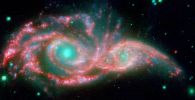
NGC-2207-PIA08097.jpgNGC 2207 and IC 2163: Colliding Galaxies64 visiteThese shape-shifting galaxies have taken on the form of a giant mask. The icy blue eyes are actually the cores of two merging galaxies, called NGC 2207 and IC 2163, and the mask is their spiral arms. The false-colored image consists of infrared data from NASA's Spitzer Space Telescope (red) and visible data from NASA's Hubble Space Telescope (blue/green).
NGC 2207 and IC 2163 met and began a sort of gravitational tango about 40 million years ago. The two galaxies are tugging at each other, stimulating new stars to form. Eventually, this cosmic ball will come to an end, when the galaxies meld into one. The dancing duo is located 140 million light-years away in the Canis Major constellation.
The infrared data from Spitzer highlight the galaxies' dusty regions, while the visible data from Hubble indicates starlight. In the Hubble-only image (not pictured here), the dusty regions appear as dark lanes.
The Hubble data correspond to light with wavelengths of .44 and .55 microns (blue and green, respectively). The Spitzer data represent light of 8 microns.
|
|

Spectrum-PIA09199.jpgSpectrum of an Alien World64 visiteThis infrared data from NASA's Spitzer Space Telescope - called a spectrum - tells astronomers that a distant gas planet, a so-called "hot Jupiter" called HD 189733b, might be smothered with high clouds. It is one of the first spectra of an alien world.
A spectrum is created when an instrument called a spectrograph cracks light from an object open into a rainbow of different wavelengths. Patterns or ripples within the spectrum indicate the presence, or absence, of molecules making up the object.
Astronomers using Spitzer's spectrograph were able to obtain infrared spectra for two so-called "transiting" hot-Jupiter planets using the "secondary eclipse" technique. In this method, the spectrograph first collects the combined infrared light from the planet plus its star, then, as the planet is eclipsed by the star, the infrared light of just the star. Subtracting the latter from the former reveals the planet's own rainbow of infrared colors.
Astronomers were perplexed when they first saw the infrared spectrum above. It doesn't look anything like what theorists had predicted. Theorists thought the spectra of hot, Jupiter-like planets like this one would be filled with the signatures of molecules in the planets' atmospheres. But the spectrum doesn't show any molecules, and is instead what astronomers call "flat." For example, theorists thought there'd be a strong signature of water in the form of a big drop in the wavelength range between 7 and 10 microns. The fact that water is not detected may indicate that it is hidden underneath a thick blanket of high, dry clouds. The average brightness of the spectrum is also a bit lower than theoretical predictions, suggesting that very high winds are rapidly moving the terrific heat of the noonday sun from the day side of HD 189733b to the night side.
This spectrum was produced by Dr. Carl Grillmair of NASA's Spitzer Science Center at the California Institute of Technology in Pasadena, Calif., and his colleagues. The data were taken by Spitzer's infrared spectrograph on November 22, 2006.
|
|

NGC-2237-PIA09267.jpgNGC 2237 - The "Rosette Nebula", and Globular Star Cluster NGC 224464 visiteThis infrared image from NASA's Spitzer Space Telescope shows the Rosette nebula, a pretty star-forming region more than 5,000 light-years away in the constellation Monoceros. In optical light, the nebula looks like a rosebud, or the "rosette" adornments that date back to antiquity.
But lurking inside this delicate cosmic rosebud are so-called planetary "danger zones" (see spheres illustrations in figure 1). These zones surround super hot stars, called O-stars (blue stars inside spheres), which give off intense winds and radiation. Young, cooler stars that just happen to reside within one of these zones are in danger of having their dusty planet-forming materials stripped away.
While O-star danger zones were known about before, their parameters were not. Astronomers used Spitzer's infrared vision to survey the extent of the five danger zones shown here. The results showed that young stars lying beyond 1.6 light-years, or 10 trillion miles, of any O-stars are safe, while young stars within this zone are likely to have their potential planets blasted into space.
Radiation and winds from the super hot stars have collectively blown layers of dust (green) and gas away, revealing the cavity of cooler dust (red). The largest two blue stars in this picture are in the foreground, and not in the nebula itself.
This image shows infrared light captured by Spitzer's infrared array camera. Light with wavelengths of 24 microns is red; light of 8 microns is green; and light of 4.5 microns is blue.
MareKromium
|
|
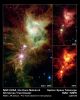
NGC-2264.jpgNGC 2264 - The "Snowflake Cluster" versus the "Cone Nebula"64 visiteCaption NASA:"Strange shapes and textures can be found in the neighborhood of the Cone Nebula.
These patterns result from the tumultuous unrest that accompanies the formation of the open cluster of stars known as NGC 2264, the Snowflake Cluster. To better understand this process, a detailed image of this Region was taken in two colors of infrared light by the orbiting Spitzer Space Telescope (SST). Bright stars from the Snowflake cluster dot the field. These stars soon heat up and destroy the gas and dust mountains in which they formed. One such dust mountain is the famous Cone Nebula, visible in the above image on the left, pointing toward a bright star near the center of the field.
The entire NGC 2264 Region is located about 2500 LY away toward the constellation of the Unicorn (Monoceros)".MareKromium
|
|
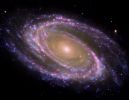
M-081-PIA09579.jpgThe M 81 Galaxy is "Pretty in Pink"64 visiteThe perfectly picturesque Spiral Galaxy known as Messier 81, or M81, looks sharp in this new composite from NASA's Spitzer (SST) and Hubble Space Telescopes (HST) and NASA's Galaxy Evolution Explorer.
M81 is a "grand design" spiral galaxy, which means its elegant arms curl all the way down into its center. It is located about 12 MLY away in the Ursa Major Constellation and is one of the brightest galaxies that can be seen from Earth through telescopes.
The colors in this picture represent a trio of light wavelengths: blue is ultraviolet light captured by the Galaxy Evolution Explorer; yellowish white is visible light seen by Hubble; and red is infrared light detected by Spitzer.
The blue areas show the hottest, youngest stars, while the reddish-pink denotes lanes of dust that line the spiral arms. The orange center is made up of older stars. MareKromium
|
|
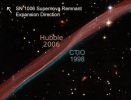
SN-1006-PIA10926.jpgStars and a Stripe in Celestial Fireworks64 visiteA delicate ribbon of gas floats eerily in our galaxy. A contrail from an alien spaceship? A jet from a black-hole? Actually this image, taken by NASA's Hubble Space Telescope, is a very thin section of a supernova remnant caused by a stellar explosion that occurred more than 1,000 years ago.
On or around May 1, 1006 A.D., observers from Africa to Europe to the Far East witnessed and recorded the arrival of light from what is now called SN 1006, a tremendous supernova explosion caused by the final death throes of a white dwarf star nearly 7,000 light-years away. The supernova was probably the brightest star ever seen by humans, and surpassed Venus as the brightest object in the night time sky, only to be surpassed by the moon. It was visible even during the day for weeks, and remained visible to the naked eye for at least two and a half years before fading away.
It wasn't until the mid-1960s that radio astronomers first detected a nearly circular ring of material at the recorded position of the supernova. The ring was almost 30 arcminutes across, the same angular diameter as the full moon. The size of the remnant implied that the blast wave from the supernova had expanded at nearly 20 million miles per hour over the nearly 1,000 years since the explosion occurred.
In 1976, the first detection of exceedingly faint optical emission of the supernova remnant was reported, but only for a filament located on the northwest edge of the radio ring. A tiny portion of this filament is revealed in detail by the Hubble observation. The twisting ribbon of light seen by Hubble corresponds to locations where the expanding blast wave from the supernova is now sweeping into very tenuous surrounding gas.
The hydrogen gas heated by this fast shock wave emits radiation in visible light. Hence, the optical emission provides astronomers with a detailed "snapshot" of the actual position and geometry of the shock front at any given time. Bright edges within the ribbon correspond to places where the shock wave is seen exactly edge on to our line of sight.
Today we know that SN 1006 has a diameter of nearly 60 light-years, and it is still expanding at roughly 6 million miles per hour. Even at this tremendous speed, however, it takes observations typically separated by years to see significant outward motion of the shock wave against the grid of background stars. In the Hubble image as displayed, the supernova would have occurred far off the lower right corner of the image, and the motion would be toward the upper left.
SN 1006 resides within our Milky Way Galaxy. Located more than 14 degrees off the plane of the galaxy's disk, there is relatively little confusion with other foreground and background objects in the field when trying to study this object. In the Hubble image, many background galaxies (orange extended objects) far off in the distant universe can be seen dotting the image. Most of the white dots are foreground or background stars in our Milky Way galaxy.
This image is a composite of hydrogen-light observations taken with Hubble's Advanced Camera for Surveys in February 2006 and Wide Field Planetary Camera 2 observations in blue, yellow-green, and near-infrared light taken in April 2008. The supernova remnant, visible only in the hydrogen-light filter was assigned a red hue in the Heritage color image.
For images and more information about SN 1006, visit:
http://hubblesite.org/news/2008/22
http://heritage.stsci.edu/2008/22
For additional information, contact:
Ray Villard Space Telescope Science Institute, Baltimore, Md. 410-338-4514 villard@stsci.edu
William Blair Johns Hopkins University, Baltimore, Md. 410-516-8447 wpb@pha.jhu.edu
MareKromium
|
|
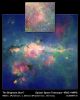
PIA10955.jpgThe brightest Stars of the (known) Universe64 visiteIf our galaxy, the Milky Way, were to host its own version of the Olympics, the title for the brightest known star would go to a massive star called Eta Carinae. However, a new runner-up — now the second-brightest star in our galaxy — has been discovered in the galaxy's dusty and frenzied interior. This image from NASA's Spitzer Space Telescope shows the new silver medalist, circled in the inset above, in the central region of our Milky Way.
Dubbed the 'Peony Nebula' star, this blazing ball of gas shines with the equivalent light of 3,2 million Suns. The reigning champ, Eta Carinae, produces the equivalent of 4,7 million Suns worth of light — though astronomers say these estimates are uncertain, and it's possible that the Peony Nebula star could be even brighter than Eta Carinae.
If the Peony Star is so bright, why doesn't it stand out more in this view? The answer is dust. This star is located in a very dusty region jam packed with stars. In fact, there could be other super bright stars still hidden deep in the stellar crowd. Spitzer's infrared eyes allowed it to pierce the dust and assess the Peony Nebula star's true brightness.
Likewise, infrared data from the European Southern Observatory's New Technology Telescope in Chile were integral in calculating the Peony Nebula star's luminosity.
The Peony Nebula, which surrounds the Peony nebular star, is the reddish cloud of dust in and around the white circle.
This is a three-color composite showing infrared observations from two Spitzer instruments. Blue represents 3.6-micron light and green shows light of 8 microns, both captured by Spitzer's infrared array camera. Red is 24-micron light detected by Spitzer's multiband imaging photometer.MareKromium
|
|
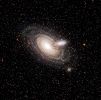
NGC-0253-HST.jpgCosmic Alignment! (2MASX J00482185-2507365)64 visiteNASA's Hubble Space Telescope has captured a rare alignment between two spiral galaxies. The outer rim of a small, foreground galaxy is silhouetted in front of a larger background galaxy. Skeletal tentacles of dust can be seen extending beyond the small galaxy's disk of starlight.
Such outer dark dusty structures, which appear to be devoid of stars, like barren branches, are rarely so visible in a galaxy because there is usually nothing behind them to illuminate them. Astronomers have never seen dust this far beyond the visible edge of a galaxy. They do not know if these dusty structures are common features in galaxies.
Understanding a galaxy's color and how dust affects and dims that color are crucial to measuring a galaxy's true brightness. By knowing the true brightness, astronomers can calculate the galaxy's distance from Earth.
Astronomers calculated that the background galaxy is 780 MLY away. They have not as yet calculated the distance between the two galaxies, although they think the two are relatively close, but not close enough to interact. The background galaxy is about the size of the Milky Way Galaxy and is about 10 times larger than the foreground galaxy.
Most of the stars speckled across this image belong to the nearby spiral galaxy NGC 253, which is out of view to the right. Astronomers used Hubble's Advanced Camera for Surveys to snap images of NGC 253 when they spied the two galaxies in the background. From ground-based telescopes, the two galaxies look like a single blob. But the Advanced Camera's sharp "eye" distinguished the blob as two galaxies, cataloged as 2MASX J00482185-2507365. The images were taken on Sept. 19, 2006.
The results have been submitted for publication in The Astronomical Journal.
For additional information, contact:
Donna Weaver/Ray Villard
Space Telescope Science Institute, Baltimore, Md.
410-338-4493 / 410-338-4514
dweaver@stsci.edu / villard@stsci.edu
Benne Holwerda
Space Telescope Science Institute, Baltimore, Md.
/University of Cape Town, South Africa
holwerda@stsci.edu
Object Name: 2MASX J00482185-2507365
MareKromium
|
|
| 157 immagini su 14 pagina(e) |
|
|
|
|
|
|
10 | |
|
|
|
|
|





