| Piú viste - The Universe in Super Definition |

SN-1987A-Starfield_-_HST_(dtl).jpgSupernova 1987A - HST209 visiteDa NASA - Picture of the Day del 9-02-1999: "Bright stars don't last forever. A bright star similar to others in this field exploded in a spectacular supernova that was witnessed on Earth in 1987. The result is visible even today as unusual rings and glowing gas. The above picture is a composite of recent images taken over several years. The explosion originated from a bright massive star that ran out of nuclear fuel. SN1987A occurred in the Large Magellanic Cloud (LMC), a satellite galaxy only 150.000 LY from our Milky Way Galaxy. The rings of SN1987A are currently excited by light from the initial explosion. Astronomers expect the inner ring to brighten in the next few years as expanding supernova debris overtakes it".
|
|

M 42.jpgM 42 in different colors178 visiteUna suggestiva combinazione di immagini ottenute con 3 filtri distinti, ciascuno capace di registrare una diversa linea di emissione: Zolfo (S), Ossigeno (O2) e Idrogeno (H). A bassa densità (ovvero nelle condizioni esistenti all'interno della Grande Nebulosa di Orione), S ed H emettono luce rossa mentre l'O2 emette luce verde. Per distinguerli bene nell'immagine, tuttavia, allo Zolfo è stato - in sede di sviluppo finale - assegnato il rosso, all'Idrogeno il verde ed all'Ossigeno il blu.
Il risultato, sebbene la colorazione finale NON sia "realistica", appare comunque non solo utile a fini della ricerca e dell'esatta mappatura dei gas presenti nella Nebulosa, ma anche molto suggestivo.
|
|
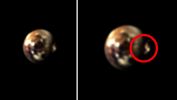
Proxima_Centauri_B_-_1.jpgProxima Centauri "b" - Alien City Lights or Super-volcanic Activity? (1)177 visiteE', a mio umile avviso, un Fenomeno di Super-vulcanismo che accade su scala (di fatto) planetaria. Guardate BENE! E guardate bene le foto di "Io"...MareKromium
|
|
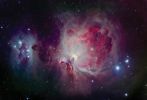
M 42~0.jpgM 42 in real colors166 visiteUna visione ad HD della Grande Nebulosa di Orione: visibile nei nostri cieli invernali anche ad occhio nudo, ma in forma di gran lunga meno spettacolare rispetto a quanto ci è dato vedere in questa ed in altre immagini similari. Ma cos'è che permette alla splendida Grande Nebulosa di Orione di manifestarsi così come noi la vediamo? La "fonte" dello splendore della Nebulosa è dato dal "Trapezio": un gruppo di 4 stelle, le più luminose presenti nella nebulosa. Le strutture a "filamento" che rendono la Nebulosa ancora più suggestiva alla vista sono il prodotto di "onde d'urto" (ovvero di "collisioni" vere e proprie fra elementi pesanti - e che si muovono velocemente nello spazio - con gas stazionari o anch'essi in movimento, ma più lentamente rispetto ai primi). La Grande Nebulosa di Orione si estende nello spazio interstellare per oltre 40 AL e si trova ad una distanza da noi pari a circa 1500 AL, comunque all'interno del medesimo braccio della Via Lattea in cui si trova il nostro Sole (e noi con esso).
|
|

Kepler_10b-PIA13776.jpgExo-Planet "Kepler 10b"159 visiteCaption NASA:"Artist's concept of the first rocky world discovered by NASA's Kepler Mission. The Planet, called Kepler 10-b, is shown in front of its Host (Parent) Star".MareKromium
|
|
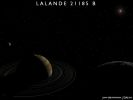
Lalande Solar System.jpgLalande 21185 and a possible extra-solar system156 visiteThe closest extrasolar planetary system could be made by the planets of the dim red dwarf star known as Lalande 21185: only 8 LY distant! This star is too faint to be seen by the naked eye and its planets have never been imaged directly but their presence is inferred by a long series of telescopic observations, tracking the star as it wiggles and wobbles in mutual gravitational response to the masses of its orbiting planets. University of Pitsburgh astronomer George Gatewood recently announced that much of Lalande 21185's wobble is most likely due to an unseen planet with approximately 90% of the mass of Jupiter and an orbital period of 5.8 years. His work also indicates that a second and possibly third planet of similar mass could well be present in the system.
|
|

Unusual_Phenomenon~1.jpgUnusual Phenomenon in the Space of Saturn (sometime things go wrong...)154 visitenessun commentoMareKromium
|
|
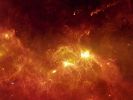
M 42~3.jpgM 42 - In Memory Of IRAS (infrared vision)146 visiteCaption NASA originale:"Do you recognize the constellation Orion? This striking but unfamiliar looking picture of the familiar Orion region of the sky was produced using survey data from the now-defunct InfraRed Astronomical Satellite (IRAS). The above image combines information recorded at three different invisible infrared wavelengths and covers about 30x24° on the sky. Most of Orion's visually impressive stars don't stand out, but bright Betelgeuse does appear as a small bright purplish dot on the lower left. The bright region on the right contains the Great Nebula in Orion, while the bright region just above the image bottom is the Rosette Nebula. Surrounding these regions are a jumble of chaotic glowing gas and dark dust jettisoned by stars forming and exploding over millions of years".
|
|
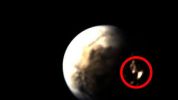
Proxima_Centauri_B_-_2.jpgProxima Centauri "b" - Alien City Lights or Super-volcanic Activity? (2)145 visiteE', a mio umile avviso, un Fenomeno di Super-vulcanismo che accade su scala (di fatto) planetaria. Guardate BENE! E guardate bene le foto di "Io"...MareKromium
|
|

IC-348-PIA12210.jpgCreation...140 visiteThis artist's conception shows a lump of material in a swirling, planet- forming disk. Astronomers using NASA's Spitzer Space Telescope found evidence that a companion to a star -- either another star or a planet -- could be pushing planetary material together, as illustrated here.
Planets are born out of spinning disks of gas and dust. They can carve out lanes or gaps in the disks as they grow bigger and bigger. Scientists used Spitzer's infrared vision to study the disk around a star called LRLL 31, located about 1000 LY away in the IC 348 Region of the constellation Perseus. Spitzer's new infrared observations reveal that the disk has both an inner and outer gap.
What's more, the data show that infrared light from the disk is changing over as little time as one week -- a very unusual occurrence. In particular, light of different wavelengths seesawed back and forth, with short-wavelength light going up when long-wavelength light went down, and vice versa.
According to astronomers, this change could be caused by a companion to the star (illustrated as a planet in this picture). As the companion spins around, its gravity would cause the wall of the inner disk to squeeze into a lump. This lump would also spin around the star, shadowing part of the outer disk. When the bright side of the lump is on the far side of the star, and facing Earth, more infrared light at shorter wavelengths should be observed (hotter material closer to the star emits shorter wavelengths of infrared light). In addition, the shadow of the lump should cause longer-wavelength infrared light from the outer disk to decrease. The opposite would be true when the lump is in front of the star and its bright side is hidden (shorter-wavelength light would go down, and longer- wavelength light up). This is precisely what Spitzer observed.
The size of the lump and the planet have been exaggerated to better illustrate the dynamics of the system.MareKromium
|
|
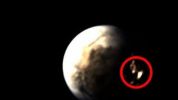
Proxima_Centauri_B_-_3~0.jpgProxima Centauri "b" - Just like Tharsis, BUT ACTIVE! (Extra Mgnf - 3)136 visiteE' come Tharsis, attiva, enorme e situata sul Pianeta (una "Super-Terra") Proxima Centauri b.MareKromium
|
|

Wasp_12b-PIA13691.jpgExo-Planet "Wasp 12b"134 visiteCaption NASA:"This artist's concept shows the searing-hot Gas Planet WASP-12b (the orange orb) and its Parent (or Host) Star. NASA's Spitzer Space Telescope discovered that the Planet has more Carbon than Oxygen, making it the first Carbon-rich Planet ever observed. Our Earth has relatively little amounts of Carbon - which it is made largely of Oxygen and Silicon.
Other gas planets in our Solar System, for example Jupiter, are expected to have less Carbon than Oxygen, but this is not known. Unlike WASP-12b, these Planets harbor water, the main Oxygen carrier, deep in their Atmospheres, where it is difficult to measure.
Concentrated Carbon can take the form of diamond, so Astronomers say that Carbon-rich Gas Planets could have abundant diamond in their interiors. WASP-12b is located roughly 1200 LY (Light Years) away in the constellation Auriga. It swings around its Parent Star every 1,1 days. Because the Planet is so close to its Parent Star, the Star's gravity stretches it slightly into an egg shape. The Star's gravity also pulls material off the Planet thus creating a disk around the Parent Star itself (shown here in transparent, white hues)".MareKromium
|
|
| 157 immagini su 14 pagina(e) |
1 |
 |
|
|
|
|
|
|
|
|
|





