| Risultati della ricerca nelle immagini - "right" |
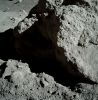
APOLLO_17_-_AS_17-137-20925-0.jpgAS 17-137-20925 - Hiding in the Darkness... (ctx frame)89 visiteUn frame "chiave" per la corretta e completa lettura dell'Epopea Apollo...MareKromium
|
|

APOLLO_17_-_AS_17-137-20925-1.jpgAS 17-137-20925 - Hiding in the Darkness... (edm)84 visite...per i più "distratti", un piccolo aiuto (solo la magnificazione del dettaglio, MA SENZA modifica del colore e/o della luminosità originali del medesimo).MareKromium
|
|

Channels-Unnamed_Outflow_Channel-PIA00483.jpgOutflow Channel in South Nawka Vallis (possible Natural Colors; credits: Dr Paolo C. Fienga - Lunexit Team)78 visiteThis SAR image from the Southern portion of Navka (24,4-25,3° South Latitude and 338,5-340,5° East Longitude) is a mosaic of twelve Magellan orbits that covers approx. 180 Km (about 108 miles) in width and approx. 78 Km (about 47 miles) in length.
In the center of this image are two bright Deposits running North to South.
These Deposits outline an Outflow Channel that flowed from an about 60-Km diameter Crater that is to the South of the Channel itself. Inside the Outflow Channel and outlined by some so-called 'Bathtub Ring' Deposits are small Cones, most likely of volcanic origin.
At the end of the Outflow Channel, where one would expect the smallest particles to be deposited, are specular features which may represent Sand Dunes.
Seasat and space shuttle radar images of sand dunes on Earth also show specular reflections from smooth dune faces that are near-normal to the radar beam.
Other evidence for aeolian activity are the dark and bright Windstreaks running East to West and that formed behind the Cones. Notice how the wind changes direction from a South/East-North/West flow at the right of the image to an East-West flow at the eastern edge of the Outflow Channel.MareKromium
|
|

ESP_022593_1595_RED_abrowse-PCF-LXTT.jpgBright Southern Dunes (Absolute Natural Colors; credits for the additional process. and color.: Dr Paolo C. Fienga - Lunexit Team)133 visitenessun commentoMareKromium
|
|
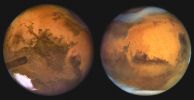
MARS-000.jpgMars: the Orange, Greenish, Bluish, Gray and White Planet (True Colors; credits: NASA)75 visitenessun commentoMareKromium
|
|
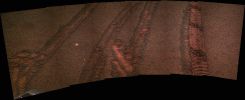
OPP-SOL1636-EB1-LXTT.jpgRover Tracks - Sol 1636 (an Image-Mosaic in Absolute Natural Colors by Elisabetta Bonora - Lunexit Team)63 visiteSe questo splendido paesaggio (Complimentissimi ad Elisabetta Bonora - 2di7!!!) fosse Terrestre, allora i sassolini luccicanti che costellano la Superficie di Meridiani non avremmo avuto paura di quaificarlui come cristalli di Quarzo o di Granito. O magari dei residui vetrosi simili alla Folgorite.
Ma qui siamo su Marte e, come Voi ben sapete, lassù, di Quarzo, non ce n'è (almeno non nei quantitativi in cui lo possiamo invece trovare sulla Terra - praticamente ovunque).
E allora, la domanda sorge spontanea: che cosa stiamo davvero osservando? Probabilmente si tratta di una miriade di frammenti di Ossidiana (un vetro vulcanico); ma se Voi aveste delle idee migliori, non dovete far altro che scrivere e commentare...MareKromium
|
|

PSP_003252_1425_RED_browse-01.jpgBright Gully Deposit in Terra Sirenum (the "crater" - close-up; false colors)68 visiteAs seen in the context image and here, the appearance of the crater wall differs between the Northern and Southern Sides. On the Northern Pole-Facing Side Walls, prominent gullies with channels and aprons are apparent, with many of these having valley-like alcoves near their tops. The morphology of the gullies is consistent with formation by a fluid, most likely water.
On the pole-facing slopes, ground ice or aquifers may be more stable, being subjected to less heating from sunlight compared to equator-facing slopes.
In contrast, the Southern, Equator-Facing Walls are dominated by rocky debris flows that lack prominent channels.MareKromium
|
|
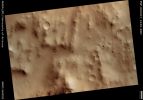
Psp_009437_1650_red.jpgUnnamed Craters with Bright Ejecta Blankets (possible True Colors; credits: Lunar Explorer Italia)64 visiteMars Local Time: 15:29 (early afternoon)
Coord. (centered): 14,9° South Lat. and 194,7° East Long.
Spacecraft altitude: 263,1 Km (such as about 164,5 miles)
Original image scale range: 26,3 cm/pixel (with 1 x 1 binning) so objects ~79 cm across are resolved
Map projected scale: 25 cm/pixel
Map projection: EQUIRECTANGULAR
Emission Angle: 0,2°
Phase Angle: 64,4°
Solar Incidence Angle: 64° (meaning that the Sun is about 26° above the Local Horizon)
Solar Longitude: 106,3° (Northern Summer)
Credits: NASA/JPL/University of Arizona
Additional process. and coloring: Lunar Explorer ItaliaMareKromium
|
|

SOL0069-EB-MF-LXTT-IPF.jpgBright Soil Particle at Rocknest - Sol 69 (an Image-Mosaic in Natural Colors; credits for the additional process. and color.: Elisabetta Bonora and Marco Faccin/Lunar Explorer Italia/Italian Planetary Foundation)100 visiteThese four (4) images show an interesting detail found in a small Pit (or "Bite") created when the NASA - Mars Exploration Rover and Laboratory "Curiosity" collected its second scoop of Martian Soil at a Sandy Patch nicknmaed "Rocknest." The bright Soil Particle visible in the center of each of the four images - which is basically very similar to other particles located elsewhere in the Pit itself, but not visible here - caused a certain and immediate concern because a small, light-toned shred of Debris from the Spacecraft had already been observed just a few Soles before, in a nearby location. However, in this case, the Mission's Science Team assessed that this bright Soil Particle which has ben exposed and scooped in the Pit, is to be considered as Native Martian Material, rather than another Debris coming from the Spacecraft.
These four images were all taken by the Mars Hand Lens Imager (MAHLI) Camera that is positioned on Curiosity's Robotic Arm during the 69th Martian Day, or Sol, of its Mission (such as October, 15, 2012) at Gale Crater, and about a week after the Scoop dug this little hole. The view here covers an area of ground which is less than half a centimeter across.
These four images, which are all NASA - Mars Exploration Rover and Laboratory "Curiosity" b/w frames (identified by the serial n. visible in the lower left side of each picture) have been additionally processed and then colorized in Natural Colors (such as the colors that a perfect human eye - or an Electronic Eye - would actually perceive if someone were on the Surface of Gale Crater - Mars -, near the NASA - Mars Exploration Rover and Laboratory "Curiosity", and then looked down, towards the little Pit excavated on the Surface, by using an original technique created - and, in time, dramatically improved - by the Lunar Explorer Italia Team.MareKromium
|
|
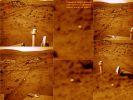
SOL1187-Navigation_Camera.jpgWhat is that bright "stone"?!? - Sol 118764 visiteDal Dr Gianluigi Barca, eccoVi un collage interessante e ben fatto il quale ci mostra, ancora una volta, che i corpi ad albedo elevata (o elevatissima) non sono - su Marte - una rarità. Anzi...
Di che cosa si può trattare?
La lucentezza dell'oggetto è, come vedete, simile - per intensità - a quella dei detriti cristallini (Sali e Solfati, forse) che Spirit continua a portare alla luce con le sue ruote e - per tessitura - a quella della (ormai lontana) "Silver Anomaly" che Spirit incontrò, più di 2 anni fa, sulla via di Bonneville Crater.
Allora la NASA tacque: riprese la Silver Anomaly da svariate distanze ed angolazioni, ma nulla venne mai detto al suo riguardo. Poi arrivò lo Scudo Termico (Heat-Shield) di Spirit (!) sul bordo del Cratere Bonneville e poi...Poi sono arrivate tante altre immagini che riportano e mostrano "bagliori" metallici sulla superficie di Marte, area Gusev Crater (e non solo!).
Alcuni di questi bagliori sono, con ogni probabilità, degli image-artifacts; altri sono stati ben spiegati parlando dell'Heat-Shield e della Backshell - spazzatura spaziale, in altre parole - dei MER Spirit ed Opportunity (Heat-Shield e Backshell precipitati al suolo nei pressi delle zone di landing, così come accadde per la Sonda Pathfinder).
Insomma: alcune spiegazioni ci sono e vanno anche bene, certo; ma è indubitabile che, in qualche caso, i "bagliori" (rectius: le superfici riflettenti ad albedo elevata) che abbiamo individuato, non possono essere spiegati/e ricorrendo alle sole ipotesi di cui sopra e allora, come l'esperienza ci ha insegnato, prima di azzardare ipotesi esotiche e dire di che cosa si potrebbe trattare, bisogna iniziare a capire e dire che cosa questi "riflessi" NON SONO.
La risposta (sebbene solo parziale), in questo caso, è davvero facile: non si tratta dell'Heat-Shield o della Backshell di Spirit; non si tratta di un image artifact e non si tratta di detriti cristallini.
Che cosa stiamo guardando?
Grazie ancora ed ancora complimenti al sempre prezioso Amico e Collega, Dr G. Barca!
MareKromium
|
|

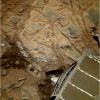
SOL1356-2.jpgBright Spots - Sol 1356 (false colors; credits: Dr G. Barca)90 visiteCuriose scintille di luce caratterizzano i punti della roccia posta ai piedi di Spirit laddove il Rover (probabilmente usando le sue ruote o il RA) ha intaccato lo strato superficiale - ed opaco - di sabbia e polveri che ne "nasconde" le reali fattezze.
Si tratterà di un "impolverato" e "semi-insabbiato" mega-cristallo di Quarzo? Difficile: il Quarzo non è un minerale comune su Marte...
Solo una certezza: l'effetto "Goccia di Luce" che si vede contraddistinguere alcune zone della roccia in questione - sulla base di quanto constatato in qualche annetto di osservazioni - si verifica SOLO in due casi (almeno per quanto ne sappiamo):
1) luce del Sole che colpisce una superficie Cristallina (o ricoperta di Ghiaccio d'Acqua)
2) luce del Sole che colpisce una superficie Metallica
Cosa stiamo osservando in questo caso?!?MareKromium
|
|
SOL1356-3.jpgBright Spots - Sol 1356 (possible True Colors; credits: Dr G. Barca and Lunar Explorer Italia)59 visitenessun commentoMareKromium
|
|
| 16 immagini su 2 pagina(e) |
1 |
|





