| Risultati della ricerca nelle immagini - "pan" |

A - Saturn-a.jpgSaturn, Tethys and Dione in almost true colors214 visiteSaturn Data and Statistics
Mass (kg) = 5.688e+26
Mass (Earth = 1) = 9,5181e+01
Equatorial radius = 60.268 Km
Equatorial radius (Earth = 1) = 9,4494e+00
Mean density (gm/cm^3) = 0,69
Mean distance from the Sun = 1.429.400.000 Km
Mean distance from the Sun (Earth = 1) = 9,5388
Rotational period (hours) = 10,233
Orbital period (years) = 29,458
Mean orbital velocity = 9,67 Km per second
Tilt of axis = 25,33°
Orbital inclination = 2,488°
Equatorial surface gravity (m/sec^2) = 9,05
Equatorial escape velocity = 35,49 Km per second
Magnitude (Vo) = 0,67
Mean cloud temperature = - 125°C
Atmospheric pressure (bars) = 1,4
Atmospheric composition: Hydrogen 97% and Helium 3%
|
|

Dione&Janus-PIA08158.jpgSaturn, Dione and Janus64 visiteCaption originale:"The Cassini spacecraft looks toward the Saturnian horizon as Dione and Janus glide past.
A few craters are visible on Dione, while Janus is slightly blurred due to its motion during the exposure. The Rings appear essentially edge-on in this view, as the Cassini spacecraft continues its recent activities close to the Ring-Plane.
The image was taken with the Cassini spacecraft narrow-angle camera on March 10, 2006, using a filter sensitive to wavelengths of infrared light centered at 750 nnmts. The image was acquired at a distance of approx. 2,9 MKM (about 1,8 MMs) from Saturn.
The image scale is approx. 17 Km (roughly 11 miles) per pixel".
|
|

Jupiter-20070323.gifWatch Jupiter and some of His Moons rotate! (GIF-Movie)68 visiteCaption NASA:"South is toward the top in this frame from a stunning movie featuring Jupiter and moons recorded last Thursday from the Central Coast of New South Wales, Australia. In fact, three Jovian Moons and two red spots are ultimately seen in the full video as they glide around the Solar System's ruling gas giant. In the early frame above, Ganymede, the largest moon in the Solar System, is off the lower right limb of the Planet, while intriguing Europa is visible against Jupiter's cloud tops, also near the lower right. Jupiter's new Red Spot junior is just above the broad white band in the Planet's Southern (upper) Hemisphere. In later frames, as Planet and moons rotate (right to left), red spot junior moves behind Jupiter's left edge while the Great Red Spot itself comes into view from the right. Also finally erupting into view at the right, is Jupiter's volcanic moon, Io (...)".
Note: click on the frame to see the movie
|
|

Mimas and Saturn-PIA06574.jpgMimas and Saturn68 visiteCaption NASA originale:"In a dazzling and dramatic portrait painted by the Sun, the long thin shadows of Saturn's rings sweep across the planet's northern latitudes. Within the shadows, bright bands represent areas where the ring material is less dense, while dark strips and wave patterns reveal areas of denser material. The shadow darkens sharply near upper right, corresponding to the boundary of the thin C-Ring with the denser B-Ring. A wide-field, natural color view of these shadows can be seen in PIA06164.
The globe of Saturn's moon Mimas (398 Km or 247 miles across) has wandered into view near the bottom of the frame. A few of the large craters on this small moon are visible. The image was taken with the Cassini spacecraft narrow angle camera on Jan. 18, 2005, at a distance of 1,4 MKM (889.000 miles) from Saturn using a filter sensitive to wavelengths of infrared light centered at 752 nanometers. The image scale is 9 Km (approx 5,5 miles) per pixel".
|
|
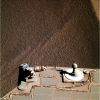
OPP-SOL2228-GB-LXTT~0.jpgSolar Panels and Surface - Sol 2228 (possible True Colors; credits for the additional process. and color.: Dr Gianluigi Barca - Lunexit Team)91 visitenessun commentoMareKromium
|
|
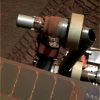
OPP-SOL2233-GB-LXTT.jpgSolar Panels and Surface - Sol 2228 (possible True Colors; credits for the additional process. and color.: Dr Gianluigi Barca - Lunexit Team)84 visitenessun commentoMareKromium
|
|
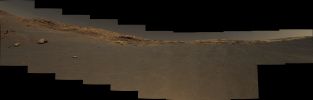
OPP-SOL248-L256.jpgPartial Panorama: the Inner Rim of Endurance Crater - Sol 248 (MULTISPECTRUM; credits: Lunexit)89 visitenessun commentoMareKromium
|
|

Rings-PIA06588.jpgThe "rings" and a "string" of Moons...67 visiteCaption NASA originale:"Moons visible in this image: Mimas (398 Km, or 247 miles across) at right, Pandora (84 Km, or 52 miles across) near center and Janus (181 Km, or 113 miles across) in the lower left corner. Mimas' orbit inclination of 1,6° relative to Saturn's equator is enough to make it appear as if it orbits just beyond the F-Ring when viewed from this vantage point of 5° below the Rings. In fact, it is 34.000 Km (such as approx. 21.000 miles) more distant than Janus".
|
|
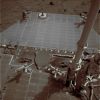
SOL1221-2N234769147EFFATI4P0165R0M1.jpgSpirit's "Solar Panels" - Sol 122173 visitenessun commentoMareKromium
|
|
SOL1229-2P235474338EDNAU00P2277L6M1.jpgReflections on the Solar Panel... - Sol 1229 (Natural colors - elab. Lunexit)64 visitenessun commentoMareKromium
|
|
SOL178-2N142182151EFF69AKP0670L0M1.jpgSunset over Gusev Crater87 visitenessun commento
|
|

Saturn & family-PIA06475_modest.jpgSaturn and Family68 visiteCaption NASA originale:"Satellites visible in this image are (clockwise from upper left): Dione (1.118 Km or 695 miles wide), Enceladus (499 Km or 310 miles wide), Tethys (1.060 Km or 659 miles wide), Mimas (398 Km or 247 miles wide) and Rhea (1.528 Km or 949 miles wide).
The image was taken in visible red light on Aug. 1, 2004, at a distance of 7.8 MKm (4.8 million miles) from Saturn. The image scale is 464 Km (288 miles) per pixel".
|
|
| 59 immagini su 5 pagina(e) |
1 |
 |
|
|








