| Risultati della ricerca nelle immagini - "le" |

00-Aristarchus Crater-2005-29-a-full_jpg.jpg01 - Aristarchus Crater (and Plateau)123 visiteThe HST Advanced Camera for Surveys snapped this close-up view of the Aristarchus crater on Aug. 21, 2005. The crater is 26 miles (about 42 Km) in diameter and approx. 2 miles (such as about 3,2 Km) in depth and sits at the South-Western edge of the Aristarchus Plateau. The Plateau is well known for its rich array of geologic features, including a dense concentration of volcanic rilles (such as river and valley-like landforms that resulted from the collapse of lava tubes) and source vents.
|
|

00-The Moon from HST.jpg00 - The Moon through the "Eyes" of the Hubble Space Telescope112 visite
|
|

000-Clementine.gif000 - Clementine76 visiteDescription
Clementine was a joint project between the Ballistic Missile Defense Organization (BMDO, nee the Strategic Defense Initiative Organization, or SDIO) and NASA. The objective of the mission was to test sensors and spacecraft components under extended exposure to the space environment and to make scientific observations of the Moon and the near-Earth asteroid 1620 Geographos. The Geographos observations were not made due to a malfunction in the spacecraft. The lunar observations made included imaging at various wavelengths in the visible as well as in ultraviolet and infrared, laser ranging altimetry, gravimetry, and charged particle measurements. These observations were for the purposes of obtaining multi-spectral imaging the entire lunar surface, assessing the surface mineralogy of the Moon and obtaining altimetry from 60N to 60S latitude and gravity data for the near side. There were also plans to image and determine the size, shape, rotational characteristics, surface properties, and cratering statistics of Geographos. Clementine carried 7 distinct experiments on-board: a UV/Visible Camera, a Near Infrared Camera, a Long Wavelength Infrared Camera, a High Resolution Camera, two Star Tracker Cameras, a Laser Altimeter, and a Charged Particle Telescope. The S-band transmitter was used for communications, tracking, and the gravimetry experiment.
Spacecraft and Subsystems
The spacecraft was an octagonal prism 1.88 meters high and 1.14 m across with two solar panels protruding on opposite sides parallel to the axis of the prism. A high-gain fixed dish antenna was at one end of the prism, and the 489 N thruster at the other end. The sensor openings were all located together on one of the eight panels, 90 degrees from the solar panels, and protected in flight by a single sensor cover. The spacecraft propulsion system consisted of a nonpropellant hydrazine system for attitude control and a bipropellant nitrogen tetraoxide and monomethyl hydrazine system for the maneuvers in space. The bipropellant system had a total capability of about 1900 m/s with about 550 m/s required for lunar insertion and 540 m/s for lunar departure. Attitude control was achieved with 12 small attitude control jets, two star tracker cameras, and two inertial measurement units. The spacecraft was three-axis stabilized in lunar orbit via reaction wheels with a precision of 0.05 Deg. in control and 0.03 Deg. in knowledge. Power was provided by gimbaled, single axis, GaAs/Ge solar panels which charged a 15 amp-hour, 47-w hr/Kg Nihau (Ni-H) common pressure vessel battery. Spacecraft data processing was performed using a MIL-STD-1750A computer (1.7 million instructions per second) for savemode, attitude control, and housekeeping operations, a RISC 32-bit processor (18 million ips) for image processing and autonomous operations, and an image compression system provided by the French Space Agency CNES. A data handling unit sequenced the cameras, operated the image compression system, and directed the data flow. Data was stored in a 2 Gbit dynamic solid state data recorder.
Mission Profile
The mission had two phases. After two Earth flybys, lunar insertion was achieved approximately one month after launch. Lunar mapping took place over approximately two months, in two parts. The first part consisted of a five hour elliptical polar orbit with a periapsis of about 400 Km at 30 degrees south latitude and an apoapsis of 8300 Km. Each orbit consisted of an 80 minute lunar mapping phase near periapsis and 139 minutes of downlink at apoapsis. After one month of mapping the orbit was rotated to a periapsis at 30 degrees north latitude, where it remained for one more month. This allowed global imaging and altimetry coverage from 60 degrees south to 60 degrees north, over a total of 300 orbits. After a lunar/Earth transfer and two more Earth flybys, the spacecraft was to head for Geographos, arriving three months later for a flyby, with a nominal approach closer than 100 Km. Unfortunately, on May 7, 1994, after the first Earth transfer orbit, a malfunction aboard the craft caused one of the attitude control thrusters to fire for 11 minutes, using up its fuel supply and causing Clementine to spin at 80 rpm. Under these conditions, the asteroid flyby could not yield useful results, so the spacecraft was put into a geocentric orbit passing through the Van Allen radiation belts to test the various components on board. The mission ended in June 1994 when the power level onboard dropped to a point where the telemetry from the spacecraft was no longer intelligible.
|
|

001-Ceres-alone.jpg1-Ceres from Hubble Space Telescope79 visiteNASA's Hubble Space Telescope took these images of the asteroid 1 Ceres over a 2-hour and 20-minute span, the time it takes the Texas-sized object to complete one quarter of a rotation. One day on Ceres lasts 9 hours.
Hubble snapped 267 images of Ceres as it watched the asteroid make more than one rotation. By observing the asteroid during a full rotation, astronomers confirmed that Ceres has a nearly round body like Earth's. Ceres' shape suggests that its interior is layered like those of terrestrial planets such as Earth. Ceres may have a rocky inner core, an icy mantle, and a thim, dusty, outer crust.
The "Bright Spot" that we see is a mistery: it is (obviously) brighter than its surroundings, but it is still very dark (very low albedo) reflecting only a small portion of Sunlight.
|
|

001.jpgSpace-(Heat)-Shields - The "Space-Wreck" on the edge of Bonneville Crater391 visite"Qual è colui che grande inganno ascolta
che li sia fatto, e poi se ne rammarca,
fecesi Flegiàs ne l'ira accolta".
(DANTE ALIGHIERI, La Divina Commedia, Inferno - Canto VIII)
Tra i tanti enigmi marziani che Lunar Explorer Italia tenta di portare alla Vostra attenzione, uno dei più intriganti è lo strano “oggetto” fotografato da Spirit sul bordo del Cratere Bonneville ed identificato - dalla versione ufficiale NASA - come l’Heat-Shield (Scudo Termico) utilizzato dalla Sonda Spirit durante la discesa sul pianeta.
Per verificare l’attendibilità di questa versione proviamo ad esaminare la questione non tanto sul piano scientifico, quanto su quello tipico dei processi di “intelligence”.
1 - L’OGGETTO
In questa prima immagine possiamo vedere la "forma incriminata" così come appare nella maggioranza delle fotografie fornite dalla NASA.
Un aspetto sconcertante è che l’oggetto ripreso nell’arco di diversi giorni presenta visibili modificazioni, non spiegabili con la semplice variazione dei filtri delle fotocamere, come si può verificare in questa sequenza 3D ordinata cronologicamente, ripresa da un articolo della mia rubrica su Space Freedom http://www.margheritacampaniolo.it/Feltri/Int18.gif.
|
|
0017-The_Orientale_Basin.jpgThe Orientale Basin92 visiteart002e012090 (April 6, 2026) - In this view of the Moon, the Artemis II crew captured an intricate snapshot of the rings of the Orientale Basin, one of the Moon’s youngest and best-preserved large Impact Craters on his first shift during the Lunar Fly-By observation period.MareKromium
|
|

002-Aristarchus-detailmgnf-2005-29-l-full_jpg.jpg02 - Aristarchus Crater (detail mgnf)121 visiteAristarchus is also one of the "youngest" craters of the Moon: in fact it probably formed between 100 and 900 MY ago only (!).
|
|

003.jpgSpace Heat-Shields - The Area161 visite3 - IL LUOGO
In questa immagine 3D vediamo il Cratere Bonneville, così come ripreso dalla Sonda "Mars Global Surveyor".
Il numero 1 indica la posizione fornita dalla NASA per l’Heat-Shield; il 2 contrassegna una massiccia perforazione a forma di “8” a cavallo dell’orlo del Cratere ed interessata da visibili protuberanze; il 3 identifica il fondo del Cratere, contrassegnato da stratificazioni visibilmente rilevate.
Le lettere A, B e C evidenziano, invece, lungo il pendio, tre bande di materiale roccioso più chiare rispetto al colore del fondo del Cratere Bonneville stesso (presumibilmente si tratta di rocce aventi una composizione analoga a quelle della piana circostante).
|
|

004-Ceres.jpgMoments of 1-Ceres (1)74 visiteDa "NASA - Picture of the Day", del 21 Agosto 2006:"Is 1-Ceres an Asteroid or a Planet?
Although a trivial designation to some, the recent suggestion by the Planet Definition Committee of the International Astronomical Union would have 1-Ceres reclassified from Asteroid to Planet.
A change in taxonomy might lead to more notoriety for the frequently overlooked world. Ceres, at about 1000 Km across, is the largest object in the main Asteroid Belt between Mars and Jupiter. Under the newly proposed criteria, Ceres would qualify as a planet because it is nearly spherical and sufficiently distant from other planets. Pictured above is the best picture yet of Ceres, taken by the Hubble Space Telescope as part of a series of exposures ending in 2004 January. Currently, NASA's Dawn mission is scheduled to launch in 2007 June to explore Ceres and Vesta, regardless of their future designations".
|
|

004.jpgSpace Heat-Shields - The edge of Bonneville and the "wreck"208 visite4 - LA POSIZIONE
Tralasciando per il momento le altre indicazioni, prendiamo in esame la posizione 1 che, come abbiamo visto, identificherebbe l'area di impatto del (presunto) Heat-Shield con il margine del Bonneville Crater, rapportandola con la ripresa della stessa area effettuata dalla PANCAM di Spirit.
Guardate bene.
|
|
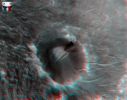
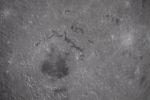
0040.jpgDark "Triangle" in the Crater... (ctx frame - High-Def-3D; credits: Dr M. Faccin & Lunar Explorer Italia)291 visiteUna nuova "Scoperta" del nostro ultra-paziente e bravissimo Dr Faccin: che cosa c'è all'interno di questo piccolo cratere, sperduto su una distesa ricca di rilievi ambigui e, forse, aventi una matrice (se non altro in parte) "Organica"?
E' una "cascata di polveri ferrose"? E' una "frozen waterfall"? O forse è una nave spaziale aliena? O magari non è nulla di tutto ciò?...
Provate ad andare a guardare l'edm, adesso...MareKromium
|
|
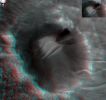
0041.jpgDark "Triangle" in the Crater... (edm - High-Def-3D; credits: Dr M. Faccin & Lunar Explorer Italia)420 visiteGuardate: una sorta di struttura a forma di "Triangolo Isoscele" (nero e con il vertice rivolto verso il basso) giace "appoggiata" su fianco di questo piccolo cratere, sul cui fondo si intuisce la presenza di un cumulo di fango, caratterizzato dalla presenza di due profondi solchi.
Ora, ci domandiamo e Vi domandiamo: CHE COSA può essere/rappresentare una "Struttura" quale è quella che si vede qui, e che - ripetiamo - giace APPOGGIATA ad una parete del Cratere?
Si, lo sappiamo: non ci sono risposte. Solo nuove domande...MareKromium
|
|
| 2479 immagini su 207 pagina(e) |
1 |
 |
|
|
|
|
|
|
|
|
|





