| Risultati della ricerca nelle immagini - "ius" |

27-Zucchius Crater.jpgZucchius Crater94 visiteThis image of the central peaks of crater Zucchius was obtained by AMIE on 14 January 2006 from a distance of about 753 kilometres from the surface, with a ground resolution of 68 metres per pixel.
The imaged area is centred at a latitude of 61.3° South and longitude 50.8° West. Zucchius is a prominent lunar impact crater located near the southwest limb. It is 66 kilometres in diameter, but due to SMART-1's proximity to the surface, the AMIE field of view covers only the central 35 kilometres of the crater in this image.
Because of its location, the crater appears oblong-shaped due to foreshortening. It lies just to the south-southwest of the Segner crater, and northeast of the much larger Bailly walled-plain. To the southeast is the Bettinus crater, a formation only slightly larger than Zucchius.
Zucchius formed in the Copernican era, a period in the lunar planetary history that goes from 1200 million years ago to present times. Another example of craters from this period are Copernicus (about 800 milion years old) and Tycho (100 million years old). Craters from the Copernican era show characteristic ejecta ray patterns - as craters age, ejecta rays darken due to weathering by the flowing solar wind.
The hills near the centre of the image are the central peaks of the crater, features that form in large craters on the Moon. This type of feature is formed by the impact of a small asteroid onto the lunar surface. The surface is molten and, similarly to when a drop of water falls into a full cup of coffee, the hit surface bounces back and solidifies into the central peak.
The Zucchius crater is named after the Italian Mathematician and astronomer Niccolo Zucchi (1586-1670).
|
|

28-Zucchius-1.jpgThe Central "Peak" of Zucchius Crater (HR)118 visiteL'immagine, nonostante gli sforzi dell'ESA e nonostante l'Alta Risoluzione, resta mediocremente sfuocata. Tuttavia, sebbene la certezza non la si può avere, riteniamo di poter dire, con un discreto margine di certezza, che esiste un oggetto anomalo proprio sulla sommità (o nei suoi pressi) di una delle collinette che caratterizzano l'area centrale del Cratere Zucchius. L'oggetto (se seguissimo la Scuola di Hoagland potremmo già parlare di "costruzione") pare avere una base rettangolare e, su questa base (e leggermente alla Sx dell'Osservatore) pare esserci un ulteriore rilievo di forma circolare.
Un'immagine brutta, ripetiamo, ma intrigante ed enigmatica. Da studiare.
|
|

28-Zucchius-2.jpgThe Central "Peak" of Zucchius Crater (HR - extra detail mgnf)115 visiteQuesto extreme detail mgnf del rilievo anomalo di Zucchius non aggiunge molto alle nostre considerazioni e ne siamo consapevoli; tuttavia, per chi ha un "occhio" uso alle Stranezze Lunari (e non solo...), la regolarità sostanziale della forma più chiara (che possiamo chiamare "basamento") ed il rilievo circolare che lo sovrasta - se si osserva con attenzione - non Vi potranno sfuggire.
Certo, da qui a dire che si tratta di un rilievo "artificiale" ce ne passa e, credeteci, nessuno di noi sta inferendo nulla del genere. L'unico dettaglio che desideriamo sottoporre al vaglio critico dei Lettori attiene la curiosa (ed apparente) "regolarità" del rilievo ripreso e la costante "deficienza" (nel senso di "mancanza", ovviamente...) delle Agenzie Spaziali le quali, tutte le volte in cui ci si imbatte in una possibile Anomalìa (da Cydonia, a Giapeto a Zucchius etc.), producono immagini di qualità indecente.
Ecco: perdonateci l'ironia, ma forse quest'ultima riflessione costituisce la vera - e la più grande - "stranezza" di qualsiasi Programma Spaziale!
|
|

33-SulpiciusGallus.jpgSulpicius Gallus' Region91 visiteThis mosaic of three images, taken by the advanced Moon Imaging Experiment (AMIE) on board ESA's SMART-1 spacecraft, shows the area close to the Sulpicius Gallus crater on the Moon.
AMIE obtained this sequence on 18 March 2006, from a distance of 1200 kilometres from the surface, with a ground resolution ranging from 110 to 114 metres per pixel.
The area shown in the top image is centred at a latitude of 19.7º North and longitude 12.2º East; the image in the middle is centred at a latitude of 18.2º North and longitude 12.3º East; the bottom image is centred at a latitude of 16.7º North and longitude 12.5º East.
The prominent crater on the upper left area of this mosaic is called Sulpicius Gallus. It is a fairly fresh, bowl-shaped crater with a diameter of roughly 12 kilometres. The flat lava plains surrounding it belong to the Mare Serenitatis (the 'Sea of Serenity') on the north-eastern side of the Moon facing Earth. The mountains going diagonally through the middle part of the mosaic are called Montes Haemus. They are denoting the edge of the huge impact crater which formed the Mare Serenitatis.
The area around Sulpicius Crater is very interesting for lunar scientists – it is one of the most geologically and compositionally complex areas of the nearside of the Moon. The geologic history of this region has been shaped by impacts of different scales and epochs, by volcanism of variable style and composition with time, and by limited tectonics. Specific findings (Bell and Hawke, 1995) include the detection of relatively fresh highlands materials in the crater.
Good spectroscopic data (that is relative to the mineralogical composition) are available both from the Clementine mission and from ground-based observations, allowing to better constrain the geological evolution of our closest cosmic neighbour.
The area has been suggested to contain mixtures of glassy and black beads generated when large impacts melted part of the lunar surface. However, modelling the spectral properties of material similar to lunar material does not allow to unambiguously match the composition of the material to the measured data.
Colour observations of the AMIE camera will help in further clarifying these issues. So, the combination of high spatial resolution imaging and high spectral resolution spectroscopy from datasets from SMART-1, Clementine and ground based telescopes will finally allow to better model mineral mixtures on the Moon.
The crater Sulpicius Gallus is named after a Roman general, state man and orator. He is famous for having predicted an eclipse of the moon on the night before the battle of Pydna (168 BC). A man of great learning, in his later years he devoted himself to the study of astronomy.
|
|

37-AMI-Mersenius Crater.jpgMersenius "C"69 visiteCaption ESA originale:"This mosaic of 3 images, taken by the Advanced Moon Imaging Experiment (AMIE) on board ESA's SMART-1 spacecraft, shows the crater Mersenius "C" on the Moon.
AMIE obtained this sequence on 13 January 2006, from distance of 1149, 1172 and 1195 Km from the surface, respectively. The ground resolution ranges from 104 to 108 mt per pixel. All images are located at a Long. of 45,7º West and at Lat. of 21,3º, 19,7º and 18,1º South, respectively.
For separate images go to:
AMI_EAE3_001777_00008_00020.JPG; AMI_EAE3_001777_00009_00020.JPG; AMI_EAE3_001777_00010_00020.JPG.
Crater Mersenius "C" is positioned in the highland area between Mare Humorum and the Oceanus Procellarum. The crater has a diameter of 14 Km and is best visible for ground-based observers 4 days after first quarter Moon".
|
|

APOLLO 11 AS 11-37-5445.jpgAS 11-37-5445 - Undocking (3) - Taruntius and Dorsum Cayeux (HR)192 visiteOriginal caption:"CSM Columbia over Craters Taruntius "K", Taruntius "P", and Dorsum Cayeux (in Mare Fecunditatis).
Partially visible are craters Anvil and Taruntius "H".
|
|

APOLLO 15 AS 15-90-12294 HR-1.jpgAS 15-90-12294 - Auwers, Menelaus and Sulpicius Gallus (HR)97 visitenessun commento
|
|

APOLLO_15_-_AS15-87-11701_HR.jpgAS 15-87-11701 - Macrobius Crater ("A" and "B")164 visitenessun commentoMareKromium
|
|

APOLLO_15_-_AS15-87-11703_HR.jpgAS 15-87-11703 - Macrobius Crater ("A" and "B")160 visitenessun commentoMareKromium
|
|
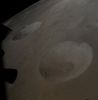
APOLLO_15_-_AS15-87-11703_HR1.jpgAS 15-87-11703 - Possible "Vent" or "Fissure" on Macrobius B (CTX Frame - Natural Colors; additional process.: Dr Paolo C. Fienga - Lunexit Team)138 visitenessun commentoMareKromium
|
|

APOLLO_15_-_AS15-87-11703_HR2.jpgAS 15-87-11703 - Possible "Vent" or "Fissure" on Macrobius B (EDM - Natural Colors; additional process.: Dr Paolo C. Fienga - Lunexit Team)138 visiteAnche a questo livello di magnificazione, il dettaglio rimane, a mio parere, inesplicabile. Potrebbe essere un "Gully", ma i Gullies si posizionano a bordo cratere e seguono linee frastagliate latitudinali e non longitudinali.
La somiglienza con la Volcanic Vent di Arsia Mons (Marte) è forte, ma la Regione Lunare di Macrobius non mi pare possa essere considerata alla stregua di un Distretto Vulcanico (anche se il Vulcanismo Lunare è da sempre stato più ambiguo ed enigmatico di quello Marziano, tanto per restare Off-Earth).
Noto altresì una somiglianza del rilievo controverso di Macrobius con un (forse analogo?) rilievo Lunare famosissimo e noto come "L'Anomalìa di Lobachevsky".
Potrebbe anche trattarsi di una "Fissure" avente natura non vulcanica, ed apertasi a seguito di un sisma o di un qualche altro tipo di stretch subìto dal declivio che caratterizza il lato Ovest di Macrobius.
Escluderei ogni fenomenologia di Gravity o Mass-Wasting.
Al limite posso pensare ad una sorta di Outcrop a pianta longitudinale (simile al "Mistery" Mound che venne localizzato e ripreso nei pressi del Landing Site dell'Apollo 12).
Non è un difetto dell'immagine e la porzione più scura del rilievo non è, a mio parere, un'ombra ma una effettiva coloritura (nera) del suolo.
Onestamente, ad oggi, non mi sento di dire di più. Comunque non penso assolutamente - visti i dati che possediamo - all'Ipotesi Esotica (quella sarebbe una forzatura).
Un Grazie di Cuore ad Acting65 per la segnalazione!MareKromium
|
|

Albategnius-1.jpgAlbategnius Crater (1)159 visiteAlabategnius: un grande cratere del diametro di circa 120 km e con pareti (o murate) che arrivano sino a 4000 mt. Le sue coordinate sono: Lat. 12° Sud e Long. 4° Est. La sua posizione è nella Regione Centrale della Luna, una Regione caratterizzata (in buona misura) da grandi bacini d'impatto.
Albateignus non è difficile da localizzare - leggermente ad Est del Cratere Ptolemaeus.
|
|
| 61 immagini su 6 pagina(e) |
1 |
 |
|
|
|





