| |
| Risultati della ricerca nelle immagini - "di" |
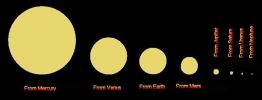
000-The_Sun_from_Space.JPGThe Sun from all the Planets of the Solar System181 visiteCome appare (o meglio: "Quanto grande" dovrebbe apparire) il Disco Solare allorchè osservato da un Mondo diverso dalla Terra?
Senza pretesa di assolutezza matematica, questa Tavola dovrebbe fornirVi un'idea più precisa della questione su cui tanto ci siamo arrovellati sino ad ora.
Nota: i diversi diametri sono stati ipotizzati ragionando in termini di UA (Unità Astronomiche), laddove 1 UA = distanza Sole / Terra = 149.597.970 Km
ergo la distanza fra il Sole e Mercurio viene fatta mediamente pari a (circa *) 0,4 UA
fra il Sole e Venere è mediamente pari a (circa) 0,7 UA
fra il Sole e Marte è mediamente pari a (circa) 1,5 UA
fra il Sole e Giove è mediamente pari a (circa) 5,2 UA
fra il Sole e Saturno è mediamente pari a (circa) 9,5 UA
fra il Sole ed Urano è mediamente pari a (circa) 19,6 UA
fra il Sole e Nettuno è mediamente pari a (circa) 30 UA
fra il Sole ed il Sistema Binario Plutone-Caronte è mediamente pari a (circa) 39 UA
* diciamo circa perchè le orbite dei diversi Pianeti attorno al Sole NON descrivono cerchi perfetti (e quindi con raggio - distanza dal Sole - fisso), bensì delle ellissi più o meno allungate (le quali implicano l'esistenza di un "perielio" - o punto di massima vicinanza del Corpo Celeste considerato rispetto al Sole - ed un "afelio" - o punto di massima lontananza del Corpo Celeste considerato rispetto al Sole.MareKromium
|
|

0002-PIA07966-112203.wavAudio Signals from the the Space of Saturn (1)74 visiteThe news about these sounds that a colleague gave me a long time ago — unless I've missed something significant, and if so, I apologize — can be traced back to Dr. Bergrun (a former NASA consultant, I believe) who, in his pamphlet "The Ringmakers of Saturn," says that Saturn's space (and, even better, its rings) is/are ideal for "parking" gigantic motherships from which UFOs that reach us periodically "detach" themselves.
The theory is flawed (especially when it claims to park spacecraft in a region CERTAINLY susceptible to impact with space debris—Saturn's Rings, to be precise), and the evidence (photographs) it uses to demonstrate its validity is not only false and fake, but also indifferent to the fact that, near and within Saturn's Rings, "ordinary" celestial bodies (i.e., rocks) have already been located. These, sometimes in the form of "moonlets" and sometimes in the form of "propellers," cause/provoke what Bergrun attributes to the action of alien spacecraft (gravitational disturbances).
A tip: listen to this emission with headphones.MareKromium
|
|
0003-PIA07967-072504.wavAudio Signals from the the Space of Saturn (2)75 visiteDr. Bergrun's pamphlet is nice and readable (I have it), but it's full of wild speculation and nonsense.
I would be very careful as far as its scientific evaluation is comncerned.
Even here and for all the other audio-files: to them with headphones.MareKromium
|
|
0004-PIA07966-112203xx.mp3Audio Signals from the the Space of Saturn (3)82 visiteAs for the rest — such as the sounds that you can ear — I can tell you that they are electromagnetic pulses and low-frequency radio waves likely emitted by Saturn itself, or from the Sun, or even more distant sources (including stars, and extrasolar systems).
The possibility that these electromagnetic pulses and radio waves originate from nearby objects, such as alien spacecraft stationed near Saturn, would also be acceptable, but should only be considered once all the other possibilities are eliminated (excluded, I mean).MareKromium
|
|
0005-PHOE-SOL038-AudioSignal-3.wavMartian Winds... - Sol 38 (Phoenix Lander - Vastitas Borealis - File Audio; credits: Lunexit)67 visiteIn this audio product, created by the Lunexit Team, a possible "Martian Wind" was captured by the Phoenix Lander's microphone and then transmitted to Earth as a "semi-hidden attachment" to the images of Vastitas Borealis.
Science fiction? Joke? Special FX? Listen and judge for yourself.
I can only tell you that we don't mean to fool anyone, and that I didn't invent the Phoenix microphone (see the related image hereof).
That said, since "it" exists, it must be useful for something...
MareKromium
|
|
0006-PHOE-SOL038-AudioSignal-4.mp3Martian Winds... - Sol 38 (Phoenix Lander - Vastitas Borealis - File Audio; credits: Lunexit))71 visiteJust to "listen": almost a minute and a half of "Wind," which, at times, seems to blow more intensely and then suddenly calms down.
The small background noises you hear from time to time could be either (real) "noise" or particles of dust impacting the microphone.
Either way: the audio — in my opinion — gives you real goosebumps.
With headphones, you can hear "something" more, but I couldn't really tell you what (Oh, God, if you like, "it sounds like someone is breathing into the microphone," but that's—obviously—a provocation).
The truth is, I don't have enough information to say what we're hearing. I can only speculate, using logic and common sense.
In this regard, I should point out that the playback speed used is based on assumptions and "suggestions" that come directly from the audio program used (which "accelerates" or "stretches" the frequency based on its initial settings and its ability to "recognize" the signal).
The truth, even in this case, is subtle: our decoding could be incorrect (too slow or too fast, therefore), but since we're moving in 100% unknown territory, the final result of the work done is inevitably the product of a series of initial assumptions—which are technical and therefore "scientific," by definition—and a certain amount of "sensitivity"—which, however, is unscientific, also by definition.
Moral: the amount of stretch (in terms of frequency) applied to the signal when transforming it into sound puts us in the position of being—pardon the somewhat risky but, I believe, effective comparison—the "performers" of an unknown piece.
Think of a musician: if you put a rough score in front of him (which could be suitable for a guitarist, a pianist, or a saxophonist) and say "play!" (and you know that he not only doesn't know the piece, but doesn't even have any background information—such as "andante," or "allegro con brio," or "lento," etc.), he will "interpret" the piece as he knows and can, based on his "musical technique" and his "artistic sensibility."
If he has access to a piano, he will play it on the piano using the tempo he deems appropriate; if he has access to a flute, he will do the same. The same goes if he has a guitar, a mandolin, or a polyphonic synthesizer.
He will "interpret."
Perhaps, in the end, something similar to what the creator of the score (i.e., Nature) had in mind will emerge, just as it might turn out to be an abortion. A disgrace.
But, in any case, it can never be said that the Musician was "technically wrong."MareKromium
|
|
0007-PHOE-SOL042-AudioSignal.mp3Martian Sounds... - Sol 42 (Phoenix Lander - Vastitas Borealis - File Audio; credits: Lunexit)82 visiteListen to it, and reflect.
One last word: after years of studying, I still DON'T know exactly what this "noise" really is, but one thing is certain: the "sounds" coming from Sol 42 are partly similar to those I already heard on Sol 38, but partly different.
There's "something" more, beyond a continuous carrier signal, which can be clearly heard around the 55th second.
What do you think?
The usual tip: listen to this emission (obtained by scanning 22 frames from the Phoenix Lander) with headphones.MareKromium
|
|

023-The Moon from Clem-SchroendingerBasin.jpg045 - Schroedinger Basin (detail mgnf)72 visiteDetail from the UV-VIS Clementine Camera of the floor of the basin Schrodinger, showing the coverage (inset strip) of the HR camera for comparison. The Dark Halo Crater (center at 76° South Lat. and 139° East Long.; 5 Km across) is a volcanic vent that erupted ash during the period of mare volcanism on the Moon, more than 3,5 BY ago.
|
|

034-Methane_of_Mars.jpgMap of the "Martian Methane"87 visiteCaption NASA:"Why is there Methane on Mars? No one is sure.
An important confirmation that Methane exists in the Atmosphere of Mars occurred last week, bolstering previous controversial claims made as early as 2003. The confirmation was made spectroscopically using large ground-based telescopes by finding precise colors absorbed on Mars that match those absorbed by Methane on Earth.
Given that Methane is destroyed in the open martian air in a matter of years, the present existence of the fragile gas indicates that it is currently being released, somehow, from the Surface of Mars.
One prospect is that microbes living underground are creating it, or created in the past. If true, this opens the exciting possibility that life might be present under the Surface of Mars even today. Given the present data, however, it is also possible that a purely geologic process, potentially involving volcanism or rust and not involving any life forms, is the Methane creator.
Pictured above is an image of Mars superposed with a map of the recent Methane detection".
Nota Lunexit: se la Mappa NASA è realmente accurata ed il quantitativo di Metano presente in Atmosfera è quello "suggerito" dalla Mappa stessa, allora - sempre seguendo la "Logica NASA" - ci troveremmo davanti a due possibili scenari:
1) Scenario Geologico (Metano come prodotto di processi geologici): Marte è ancora soggetto attivo di fenomeni vulcanici tutt'altro che minori e residuali, visti i quantitativi e la distribuzione del Metano nell'Atmosfera del Pianeta Rosso, oppure
2) Scenario Biologico (Metano come sottoprodotto di attività biologiche attuali): Marte è, letteralmente, "brulicante di Vita" - altro che batteri e micro-organismi - visti, come sopra, i quantitativi e la distribuzione del Metano nell'Atmosfera del Pianeta Rosso.
SOTTOLINEIAMO che queste nostre congetture DERIVANO LOGICAMENTE DALL'ANALISI DEI DATI NASA e NON da nostre speculazioni!
Vi suggeriamo, inoltre, di notare la posizione dei maggiori quantitativi di Metano nell'Atmosfera Marziana...MareKromium
|
|

040-The Moon from Clem-Apollo 16 LandingSite.jpg216-0 - The Apollo 16 "Landing Site" (in natural colors)78 visiteThis is the Apollo 16 Landing Site as seen from Clementine. This is a natural color rendition of the site. Clementine images were deliberately taken at very low phase angles (which means high Sun angles) to emphasize color differences, so surface textures are much less apparent here than in the orbital Apollo view.
Note the very bright appearance of South Ray and North Ray Craters (center right).
Promemoria: l'angolo "di fase" è l'angolo formato da Sole, corpo/rilievo ripreso e Sonda.
|
|

103-OPP-SOL1184-1N233301531EFF8300P0755R0M1.jpgMorning Lights over Victoria (1) - Sol 118480 visitenessun commentoMareKromium
|
|

104-OPP-SOL1184-1N233301582EFF8300P0755L0M1.jpgMorning Lights over Victoria (2) - Sol 118469 visitenessun commentoMareKromium
|
|
| 1184 immagini su 99 pagina(e) |
1 |
 |
|
|
|
|
|
|
|
|
|
|
|








