| Risultati della ricerca nelle immagini - "by" |

APOLLO_12_AS_12-57-8454_HR.jpgAS 12-57-8454 (HR) - Soil surface NOT greatly disturbed by the LM descent engine exhaust66 visitenessun commento
|
|

Adamas_Labyrinthus-PCF-LXTT.jpgAdamas Labyrinthus (Natural Colors; credits for the additional process. and color.: Dr Paolo C. Fienga - Lunexit Team)121 visitenessun commentoMareKromium
|
|

Channel-Noctis_Labyrnthus-PIA13940-PCF-LXTT.jpgUnnamed Channel in Noctis Labyrinthus Region (Absolute Natural Colors; credits for the additional process. and coloring: Dr Paolo C. Fienga - Lunexit Team)207 visitenessun commentoMareKromium
|
|

Craters-Terby_Crater-01.jpgThe Sedimentary Layers of Terby Crater (1 - Original NASA/MGS/MSSS b/w Frame)67 visiteOriginal caption:"This MGS-MOC image shows some of the light-toned, layered, Sedimentary Rock Outcrops in Northern Terby Crater. Terby is located along the North edge of Hellas Planitia. The Sedimentary Rocks might have been deposited in a greater, Hellas-filling sea — or not. Today, the rocks are partly covered by dark-toned Sediment and Debris".
Location near: 27,2° South Lat. and 285,3° West Long.
Image width: ~3 km (~1,9 mi)
Illumination from: upper left
Season: Southern Summer
|
|

Craters-Terby_Crater-02.jpgThe Sedimentary Layers of Terby Crater (2 - Original NASA/MGS/MSSS b/w Frame)63 visitenessun commento
|
|

Craters-Terby_Crater-PIA14152-PCF-LXTT.jpgLayered Features inside Terby Crater (Absolute Natural Colors; credits for the additional process. and color.: Dr Paolo C. Fienga - Lunexit Team)290 visitenessun commentoMareKromium
|
|
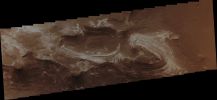
Craters-Terby_Crater-PIA14569-PCF-LXTT.jpgLayered Features inside Terby Crater (Absolute Natural Colors; credits for the additional process. and color.: Dr Paolo C. Fienga - Lunexit Team) 206 visiteOrbit Number: 42741
Latitude: 27,3491° South
Longitude: 74,2625° East
Instrument: VIS
Captured: August, 3rd, 2011
Mars Local Time (M.L.T.): 13:23 (Early Afternoon)
MareKromium
|
|
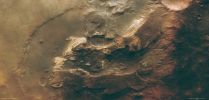
Craters-Terby_Crater.jpgTerby Crater (Natural Colors + MULTISPECTRUM; credits: ESA & Lunexit)78 visiteThe High Resolution Stereo Camera (HRSC) on board ESA’s Mars Express Orbiter imaged the Terby Crater on Mars on 13 April 2007 during orbit 4199.
The Region is of great scientific interest as sediments there hold information on the role of water in the history of the Planet. Eye-catching finger-shaped plateaux extend in the North-South direction. They rise up to 2000 mt above the surrounding terrain. The relatively old crater was filled with sediments in the past, which formed plateaux on erosion.
The flanks of the plateaux clearly exhibit layering of different-coloured material. Differences in colour usually indicate changes in the composition of the material and such layering is called ‘bedding’. Bedding structures are typical of sedimentary rock, which has been deposited either by wind or water. Different rock layers erode differently, forming terraces.
The valleys exhibit gullies, or channels cut in the ground by running liquid, mainly in the Northern part of the image.
These gullies and the rock-bedding structure indicate that the region has been affected by water.
MareKromium
|
|
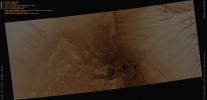
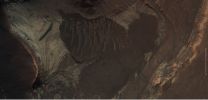
ESP_014287_1685_RED_abrowse-00.jpgNoctis Labyrinthus (Natural Colors; credits for the additional process. and color.: Dr Paolo C. Fienga - Lunexit Team)77 visiteThis image spans the floor and two walls of a pit in Noctis Labyrinthus, a System of deep, steep-walled Valleys on the Western Edge of Valles Marineris.
The Valleys themselves are tectonic features known as "Graben" (---> trench-like features that form in response to extension (or stretching) of the Crust). In the case of Noctis Labyrinthus, volcanic activity in the Tharsis Region may have formed a bulge, which then stretched and fractured the Crust above it.MareKromium
|
|
ESP_014287_1685_RED_abrowse-MF-LXTT.jpgNoctis Labyrinthus (EDM - possible True Colors; credits for the additional process. and color.: Dr Marco Faccin - Lunexit Team)83 visitenessun commentoMareKromium
|
|
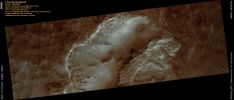
ESP_014320_1840_RED_abrowse.jpgLibya Montes' Massif (Natural Colors; credits: Lunexit)62 visitenessun commentoMareKromium
|
|

ESP_014353_1685_RED_abrowse-01.jpgLight-Toned Deposits in Noctis Labyrinthus (EDM - Natural Colors; credits: Lunexit)77 visiteCRISM observations of this Region of the Noctis Labyrinthus formation have shown indications of Iron-bearing Sulfates and Phyllosilicate (such as "clay" ----> argilla) minerals.
HiRISE observations have revealed exposed layers which are possibly the sources of the signatures seen by CRISM.
In this image, the layering can be seen on the right side of the image.
On the lower left, instead, a large Dunefield which covers other beds can also be seen.MareKromium
|
|
| 65 immagini su 6 pagina(e) |
1 |
 |
|
|
|





