| Risultati della ricerca nelle immagini - "West" |

018-The Moon from Clem-WestLimb-PIA00305.jpg004 - The western limb of the Moon: Mare Orientale and Oceanus Procellarum72 visiteThe so-called Mare Orientale (ringed feature just below image center) is just visible from Earth on the extreme western edge of the Near-Side of the Moon.
Oceanus Procellarum (large dark albedo area in upper right of image) is a familiar Near-Side feature as seen from Earth.
|
|
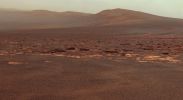
OPP-SOL2678-PIA14507-PCF-LXTT.jpgThe West Rim of Endeavour Crater - Sol 2678 (Natural Colors; credits for the additional process. and color.: Dr Paolo C. Fienga - Lunexit Team)196 visitenessun commentoMareKromium
|
|
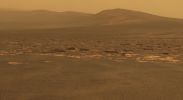
OPP-SOL2678-PIA14508NASA-JPL.jpgThe West Rim of Endeavour Crater - Sol 2678 (Natural Colors; credits: NASA/JPL-Caltech/Cornell/ASU)134 visiteCaption NASA:"A portion of the Western Rim of Endeavour Crater sweeps Southward in this color view from NASA's Mars Exploration Rover Opportunity. This Crater -- with a diameter of about 14 miles (approx 22 Km) -- is more than 25 times wider than any that Opportunity has previously approached during the Rover's 90 months on Mars.
This view combines exposures taken by Opportunity's PanCam on the 2678th Martian day, or Sol, of the Rover's work on Mars (Aug. 6, 2011) before driving on that sol. The subsequent Sol 2678 drive covered 246 feet (75,26 meters), more than half of the remaining distance to the Rim of the Crater. Opportunity arrived at the Rim during its next drive, such as on Sol 2681 (meaning Aug. 9, 2011).
Endeavour Crater has been the Rover Team's destination for Opportunity since the Rover finished exploring Victoria Crater in August 2008. Endeavour offers access to older geological deposits than any Opportunity has seen before.
The closest of the distant Ridges visible along the Endeavour Rim is informally named "Solander Point". Opportunity may investigate that area in the future. The Rover's first destination on the Rim, called "Spirit Point" in tribute to Opportunity's now-inactive twin, Spirit, is to the left (North) of this scene.
The lighter-toned Rocks closer to the Rover in this view are similar to the rocks Opportunity has driven over for most of the mission. However, the darker-toned and rougher Rocks just beyond that might be a different type for Opportunity to investigate. The ground in the foreground is covered with iron-rich Spherules, nicknamed "Blueberries," which Opportunity has observed frequently since the first days after landing. They are about 0,2" (5 millimeters) or more in diameter.
This view combines images taken through three different PanCam filters admitting light with wavelengths centered at 753 nanometers (near infrared), 535 nanometers (green) and 432 nanometers (violet). This "Natural Color" is the Rover Team's best estimate of what the scene would look like if humans were there and able to see it with their own eyes. Seams have been eliminated from the Sky portion of the mosaic to better simulate the vista a person standing on Mars would see".MareKromium
|
|

OPP-SOL3163-PIA16555-PCF-LXTT-IPF.jpgOnaping - Sol 3163 (Absolute Natural Colors; credits for the additional process. and color. Dr Paolo C. Fienga/Lunar Explorer Italia/Italian Planetary Foundation)91 visiteCaption NASA:"This image from the Front Hazard-Avoidance Camera (HazCam) located on the NASA - Mars Exploration Rover (MER) Opportunity, shows the Rover's Robotic Arm (RA) extended for examination of a target called "Onaping", at the base of a Rocky Outcrop called "Copper Cliff", in the Matijevic Hill area of the West Rim of Endeavour Crater".MareKromium
|
|
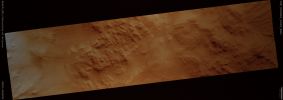
PSP_009660_2020_RED.jpgWest Olympus Mons (Extremely Saturated Natural Colors; credits for the additional process. and color.: Dr Paolo C. Fienga - Lunar Explorer Italia)77 visiteMars Local Time: 15:25 (early afternoon)
Coord. (centered): 21,5° North Lat. and 221,9° East Long.
Spacecraft altitude: 280,3 Km (such as about 175,2 miles)
Original image scale range: 28,0 cm/pixel (with 1 x 1 binning) so objects ~56,1 cm across are resolved
Map projected scale: 25 cm/pixel
Map projection: EQUIRECTANGULAR
Emission Angle: 0,4°
Phase Angle: 47,5°
Solar Incidence Angle: 47° (meaning that the Sun is about 43° above the Local Horizon)
Solar Longitude: 114,3° (Northern Summer)
Credits: NASA/JPL/University of Arizona
Additional process. and coloring: Lunar Explorer ItaliaMareKromium
|
|
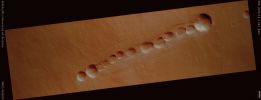
PSP_009712_1785_RED.jpgPit-Chain in South-Western Pavonis Mons (possible True Colors; credits: Lunar Explorer Italia)89 visiteMars Local Time: 15:30 (middle afternoon)
Coord. (centered): 1,4° South Lat. and 245,1° East Long.
Spacecraft altitude: 254,6 Km (such as about 159,1 miles)
Original image scale range: 50,9 cm/pixel (with 1 x 1 binning) so objects ~1,53 mt across are resolved
Map projected scale: 50 cm/pixel
Map projection: EQUIRECTANGULAR
Emission Angle: 0,5°
Phase Angle: 56,9°
Solar Incidence Angle: 56° (meaning that the Sun is about 34° above the Local Horizon)
Solar Longitude: 116,2° (Northern Summer)
Credits: NASA/JPL/University of Arizona
Additional process. and coloring: Lunar Explorer ItaliaMareKromium
|
|
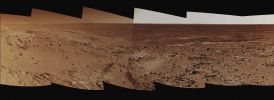
SOL305-2-site_A89_CY_navcam_360_cyp_L-A365R1_br2-PCF-LXTT.jpgWest Spur (Saturated Natural Colors; credits for the additional process. and color.: Dr Paolo C. Fienga - Lunexit Team)161 visitenessun commentoMareKromium
|
|
as17-148-22629.JPGAS 17-148-22629 - Grootfontain73 visitenessun commentoMareKromium
|
|

as17-148-22630.JPGAS 17-148-22630 - Kubango River72 visitenessun commentoMareKromium
|
|

as17-148-22631.JPGAS 17-148-22631 - Grootfontain78 visitenessun commentoMareKromium
|
|
|
|
| 10 immagini su 1 pagina(e) |
|








