| Risultati della ricerca nelle immagini - "Walls" |
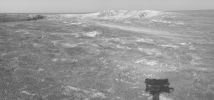
OPP-SOL108-1NN108EFF23CYL00P1981L000M1-B110R1.jpgThe "Outer Walls" of Endurance Crater - Sol 10874 visiteCaption NASA originale:"This cylindrical-projection mosaic was created from 3 NavCam frames that NASA's Mars Exploration Rover Opportunity acquired at about 16:05 MLT, on Sol 108 (such as May 13, 2004). Opportunity is sitting along the rim of Endurance Crater.
NASA has not yet determined whether Opportunity will venture inside the Crater, which is about 130 mt (about 430 feet) in diameter".
Come ben sappiamo, Opportunity si addentrerà - eccome! - nel Cratere e ci soggiornerà per oltre 6 mesi.
|
|
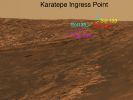
OPP-SOL132-WayDown.jpgThe path inside Endurance (approximately true colors) - Sol 13273 visiteCaption NASA originale:"This image from NASA's Mars Exploration Rover Opportunity PanCam shows the Rover's drive path into Endurance Crater, starting near the target called Karatepe.
The drive began on Sol 133 (June 8, 2004)".
|
|

OPP-SOL150-B_P2575_L257_DCS-B156R1_br2.jpg"Decorrelation Stretch": layers inside Endurance (stretched colors) - Sol 14370 visiteCaption NASA originale:"This PanCam image from Opportunity has been processed using a technique known as "Decorrelation Stretch" (DS) to exaggerate the colors. The area in the image includes 3 holes created inside Endurance Crater by Opportunity's RAT between Sol 143 and Sol 148 (June 18 and June 23, 2004). Because color variations are so subtle in the pictured area, stretched images are useful for discriminating color differences that can alert scientists to compositional and textural variations. For example: without the exaggeration, no color difference would be discernable among the tailings left behind after the grinding of these holes, but in this stretched image, the tailings around 'London' (top) appear more red than those of the other holes (Virginia', middle, and 'Cobble Hill,' bottom). Scientists believe that is because the RAT sliced through 2 "blueberries" or spherules (visible on the upper left and upper right sides of the circle). When the blades break up these spherules, composed of mostly gray hematite, the result is a bright red powder. In this image, you can see the rock layers that made the team want to grind holes in each identified layer. The top layer is yellowish red, the middle is yellowish green and the lower layer is green. Another advantage to viewing this stretched image is the clear detail of the distribution of the rock abrasion tool tailings (heading down-slope) and the differences in rock texture".
|
|

OPP-SOL150-B_P2575_L257enh-B156R1_br2.jpgLayers inside Endurance (enhanced colors) - Sol 14364 visiteCaption NASA originale:"This enhanced-color PanCam image from the Rover Opportunity features 3 holes created by the RAT between Sol 143 and Sol 148 (June 18 and June 23, 2004) inside Endurance Crater.
The enhanced image makes the red colors a little redder and blue colors a little bluer, allowing viewers to see differences too subtle to be seen without the exaggeration. When compared with an approximately true color image, the tailings from the RAT and the interior of the abraded holes are more prominent in this view. Being able to discriminate color variations helps scientists determine rocks' compositional differences and texture variations".
|
|

OPP-SOL150-B_P2575_L456-B156R1_br2.jpgLayers inside Endurance (approximately true colors) - Sol 14378 visiteCaption NASA originale:"This image, from the Rover's PanCam, is an approximately true color rendering of the slope of Endurance Crater, which NASA's MER Opportunity is currently exploring. Between Sol 143 and Sol 148 (June 18 to June 23, 2004), the Rover's RAT ground into 3 targets: "London" in the "D" layer (top) is 4,5 mm (0,18") deep; "Virginia" in the "C" layer (middle) is 4,3 mm (0,17") deep and "Cobble Hill" in the "B" layer (bottom) is 3 mm (0,12") deep.
The shadow from the Rover's camera mast is visible in the lower right corner of the image".
Una splendida veduta ravvicinata dei "mattoni" che sembrano rivestire l'interno di Endurance Crater.
Anche le "sferule" (che abbondano nella zona di Meridiani Planum) sono perfettamente visibili, al pari delle tre tracce lasciate dalla Sonda nel suo tentativo (riuscito) di scalfire le rocce.
E' una bella immagine ed i colori sono credibili; d'altra parte la perdita di "realismo cromatico" avviene, di regola, nelle vedute più ad ampio respiro (i panorami, ad esempio) e nelle istantanee del cielo di Marte.
|
|

OPP-SOL169-mer_b_sol169_nav_ratholes-B175R1.jpgInside Endurance Crater - Sol 16969 visiteAppena visibili, in questa foto in b/n, le tracce delle ruote del Rover che indicano la strada della discesa all'interno di Endurance. Piuttosto difficili da individuare - ma visibili molto chiaramente, una volta "inquadrate" - le tracce del RAT. Le vedete?!?
Caption NASA originale:"Using its Rock Abrasion Tool, otherwise known as RAT, NASA's Mars Exploration Rover Opportunity dotted the slope of Endurance Crater with dimples that give scientists a glimpse into its layered geologic history. This image from the Rover's NavCam, taken on Sol 169 (July 15, 2004), highlights the prolific work of the robotic 'rodent'. How many Rat holes can you identify? (...)".
|
|

OPP-SOL169-mer_b_sol169_ratholes_labels-B176R1.jpgInside Endurance Crater - Sol 16981 visiteLa risposta al quesito posto dagli Amici della NASA con il precedente frame è 7, I "RAT's Holes" sono 7.
EccoVi la caption NASA originale:"NASA's MER Opportunity's RAT has nibbled 7 holes into the slope of Endurance Crater. This image from the Rover's NavCam was released previously (PIA06716) without the holes labeled so that Viewers could try to find the holes themselves. Here, the holes have been identified. Starting from the uppermost pictured (closest to the Crater's rim) to the lowest, the RAT's holes targets are:
1) Tennessee,
2) Cobblehill,
3) Virginia,
4) London,
5) Grindstone,
6) Kettlestone and
7) Drammensfjorden.
These holes were drilled on Sol 138 (June 13, 2004), 143 (June 18), 145 (June 20), 148 (June 23), 151 (June 26), 153 (June 28) and 161 (July 7), respectively. Each hole is 4,5 cm (about 1,8") in diameter".
|
|
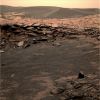
OPP-SOL744-1.jpgThe "Walls" of Payson Outcrop in Meridiani Planum - Sol 744 (natural colors; credits: Dr G. Barca)63 visitenessun commentoMareKromium
|
|
| 8 immagini su 1 pagina(e) |
|








