| |
| Risultati della ricerca nelle immagini - "V" |

0-SMART-1.jpgSMART-1 and the Moon101 visiteThe solar electric primary propulsion on-board SMART-1 is a Stationary Plasma Hall-effect thruster, the PPS-1350 developed by SNECMA, France. Using Xenon gas as propellant and the power from the spacecraft's solar arrays, the thruster is capable of providing a thrust of something like 70 milliNewtons. Using the thrust of the electric propulsion system, SMART-1 progressively expanded its orbit, spiralling out from Earth and was caught by the Moon's gravitational field on 15 November 2004, nearly 14 months after launch. In order to enhance the capture opportunities and to save precious fuel, SMART-1 also made use of celestial mechanics, including Moon resonances and swing-bys. The spacecraft exploited the unstable regions of space where the gravity field of Earth and Moon compete and which are normally avoided by conventional trajectories. It passed through the L1 point of the Earth-Moon System which allowed for the spacecraft to be caught by the Moon's gravity.
|
|

0-Venus.jpgVenus from Mariner 10193 visiteVenus Data and Statistics
Mass (kg) = 4.869e+24
Mass (Earth = 1) = 81476
Equatorial radius = 6.051,8 Km
Equatorial radius (Earth = 1) = 0,94886
Mean density (gm/cm^3) = 5,25
Mean distance from the Sun = 108.200.000 Km
Mean distance from the Sun (Earth = 1) = 0,7233
Rotational period (days) = 243,0187
Orbital period (days) = 224,701
Mean orbital velocity = 35,02 Km per second
Tilt of axis = 177,36°
Orbital inclination = 3,394°
Equatorial surface gravity (m/sec^2) = 8,87
Equatorial escape velocity = 10,36 Km per second
Magnitude (Vo) = - 4,4
Mean surface temperature = + 482°C
Atmospheric pressure (bars) = 92
Atmospheric composition: Carbon dioxide 96%, Nitrogen 3% and trace amounts of: Sulfur dioxide, water vapor, carbon monoxide, argon, helium, neon, hydrogen chloride and hydrogen fluoride.
|
|

00-SMART1.jpgSMART-1 and the Moon104 visiteSMART-1's science payload, with a total mass of some 15 Kg, features many innovative instruments and advanced technologies. These are:
- AMIE, a miniaturised HR camera for Lunar Surface imaging;
- SIR, a Near-Infrared Point-Spectrometer for Lunar mineralogy investigation;
- D-CIXS, a very compact X-ray Spectrometer with a new type of detector and micro-collimator which will provide fluorescence spectroscopy and imagery of the Moon's surface elemental composition;
- XSM, an X-ray monitor to support D-CIXS by providing measurements of solar X-ray emission for calibration:
- KaTE, an experiment aimed at demonstrating deep-space telemetry and telecommand communications in the X and Ka-bands;
- RSIS, a Radio-Science Experiment relying on KaTE. It monitors the electric propulsion by means of tracking techniques. In lunar orbit it will, with AMIE, also study the Moon's libration.
|
|
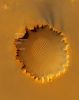
00-VictoriafromMRO.jpgVictoria Crater, from MRO (natural colors)209 visiteQuesto (spettacolare) frame lo potete trovare, in "Approximate True Colors", anche sui Siti NASA dedicati alle Missioni Mars Reconnaissance Orbiter, Opportunity e sul NASA Planetary Photojournal.
Noi, dopo aver valutato le immagini a colori della Regione di Meridiani (sia ottenute dal suolo, sia orbitali), abbiamo concluso che questo frame è stato elaborato non solo in falsi colori, ma "a tavolino", usando un Programma tipo "Paint" o "Photoshop".
Ciò premesso, abbiamo prima decolorizzato il frame NASA Originale e quindi lo abbiamo raffinato e ricolorizzato usando un nostro modestissimo software.
Risultato (che potrete verificare Voi stessi avendo solo un pizzico di pazienza e quindi ponendo a confronto il frame "NASA Originale" con questo): la densità cromatica del frame elaborato da noi è finalmente omogenea (con colori credibili e congrui rispetto ai colori visibili "dal suolo") ed il frame, qualora sottoposto a stretching, non si sgrana (come invece accade al frame NASA Originale).
Attenzione: noi non stiamo dicendo che "siamo più bravi" della NASA! Stiamo solo dicendo che la NASA, per motivi che preferiamo non commentare, "pasticcia" il suo stesso lavoro.
Pensateci sopra...MareKromium
|
|

000-0-Mars.jpgMeteor strike on Mars122 visiteMars may have lost much of its atmosphere during asteroid impacts early in its history.
The Beagle 2 lander will look for signatures of life on Mars, whether long-dead or still-living, by measuring the ratio of two different types of carbon in the rocks. Biological processes on Earth favour the lighter isotope of carbon, carbon-12, over the heavier carbon-13. Hence, a high carbon-12 to carbon-13 ratio is taken as evidence of life and has been found in rocks up to 4 billion years old, even where geological processing has occurred. The hope is that the same occurred on Mars.
|
|
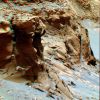
000-OPP-SOL1095-MF-LXT.jpgVictoria's Capes - Sol 1095 (Hi-Def3-D - credits and Copyright: Dr M. Faccin and Lunar Explorer Italia)110 visiteUna "Nuova Visione" di Marte, Made by Lunexit: si tratta di frames processati tridimensionalmente, ma adottando una tecnica ed un processing totalmente innovativi.
Confrontate queste "Visioni di Marte" con i 3D "Standard" NASA e...Vedrete la differenza, e CHE differenza!
Questa tecnica di elaborazione delle immagini (sviluppata da Marco Faccin e Gianluigi Barca, sotto Copyright Lunar Explorer Italia) è il primo passo verso la creazione di frames tridimensionali a colori (non più il "solito" blu/verde e rosso) e ad altissima definizione. Frames che permetteranno a chiunque li guardi (ed anche a persone che hanno problemi di vista) di mettere - letteralmente - gli occhi ed il naso "all'interno del paesaggio ripreso".
Ed ora (e per il momento), indossate gli "occhialini" e...in un istante Vi ritroverete DENTRO e AD UN PASSO dal margine e dai Promontori di Victoria Crater!
MareKromium
|
|
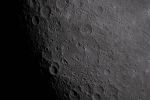
0018-Hertzprung_Basin_Rim.jpgVavilov Crater Along the Hertzsprung Basin Rim87 visiteart002e012093 (April 6, 2026) - Hertzsprung Basin comes into view with its distinctive two concentric rings of mountains, revealing the scale of this ancient impact structure.
Near the lower left, Vavilov crater — identified by its Central Peak — stands out, a feature often described by the Artemis II crew during their Lunar Fly-by.MareKromium
|
|

0020.jpgUnusual White "V-Shaped" Surface Feature (ctx frame; High-Def-3D; credits: Dr M. Faccin & Lunar Explorer Italia)207 visiteUn profilo superficiale intrigante si staglia davanti a noi, circa a centro frame: si tratta di una sorta di "V", posizionata orizzontalmente rispetto all'Orizzonte dell'Osservatore.
Questa Surface Feature, individuata dal nostro eccezionale Marco Faccin, è sicuramente intrigante ma, almeno da questa ripresa, assolutamente indecifrabile.
Proviamo dunque ad avvicinarci un pò...
NOTA: nell'angolo inferiore Sx del frame, un'altra "follìa" della Natura: una roccia a forma di cubo che riflette i raggi del Sole. Da notare che la forma cubica del rilievo è quasi regolare e del tutto palese, senza che sia necessario ricorrere a particolari ingrandimenti o accentuazione dei contrasti.MareKromium
|
|

0021.jpgUnusual White "V-Shaped" Surface Feature (edm; High-Def-3D; credits: Dr M. Faccin & Lunar Explorer Italia)216 visiteL'avvicinamento al dettaglio controverso non ci è purtroppo di grande aiuto per capire "che cosa" stiamo guardando, ma la tridimensionalità ci permette di evidenziare qualche aspetto "certo":
1) si tratta di un profilo/rilievo (Surface Feature) assolutamente reale (non è un'ombra, non è un image-artifact e non è una Struttura Effimera);
2) la "V" che ci appare è la porzione superiore di un rilievo parzialmente infossato (è una sorta di "cresta" che emerge dal suolo) la cui porzione maggiore è immersa nell'ombra;
3) il rilievo controverso giace sul fianco di una leggera depressione naturale a forma di conchiglia la quale SEMBRA un cratere ma non lo è (e se si trattasse di un cratere, allora esso è talmente degradato che i suoi tratti distintivi essenziali - l'Outer Rim, su tutti - sono ormai indistinguibili);
4) l'albedo e la texture della "V" è la stessa dei profili esterni alla depressione su cui il rilievo si stende e quindi, da un punto di vista geologico, dobbiamo ritenere che il materiale che forma la "V" è dello stesso tipo (medesima natura) di quello che si trova nei suoi dintorni;
5) l'area scura che caratterizza il fondo della depressione non è un'ombra: è materiale scuro (sabbia, forse fango).
Oltre non possiamo andare, purtroppo...MareKromium
|
|

007-The Moon from Clem-Gagarin.JPG030 - Jules Verne Crater85 visiteThis oblique image was acquired by Clementine during orbit 255. The images used to form this color composite were taken with the UV/VIS camera at wavelengths of 415, 750, and 1000 nnmts. In the lower right are seen mare materials (flood lavas) in the floor of the impact crater Jules Verne. To the left, near the Limb of Gagarin, is another mare unit in the floor of Tsiolkovsky.
|
|

015-Ceres_and_Vesta.jpg4-Vesta and 1-Ceres from HST (natural colors)76 visiteThese Hubble Space Telescope images of Vesta and 1-Ceres show two of the most massive asteroids in the Asteroid Belt, a Region between Mars and Jupiter.
The images are helping astronomers plan for the Dawn spacecraft’s tour of these hefty asteroids. On July 7, 2007, NASA is scheduled to launch the spacecraft on a 4-year journey to the Asteroid Belt. Once there, Dawn will do some asteroid-hopping, going into orbit around Vesta in 2011 and Ceres in 2015. Dawn will be the first spacecraft to orbit two targets. At least 100.000 asteroids inhabit the Asteroid Belt, a reservoir of leftover material from the formation of our Solar-System planets some 4,6 Billion Years (BY) ago.MareKromium
|
|

018-Vesta-6-PIA13428.jpgSome of the "Faces" of 4-Vesta, from Hubble Space Telescope111 visiteNASA's Hubble Space Telescope snapped these images of the Asteroid 4-Vesta in preparation for the Dawn Spacecraft's visit in 2011. Each of the 4 Hubble images captures views of Vesta during its 5,34-hour rotation period. Hubble's sharp "eye" can see features as small as about 40 Km (24,84 miles) across in these images. Vesta was 211 MKM (approx. 131 MMs) from Earth when Hubble made the observations.
The images show the difference in brightness and color on the Asteroid's Surface. These characteristics hint at the large-scale features that the Dawn Spacecraft will see when it visits the potato-shaped asteroid.
Astronomers used the images, taken with Hubble's Wide Field Camera 3, to better determine 4-Vesta's Spin Axis. Based on the HST observations, astronomers calculated a slightly different, and more precise, Rotation Axis for Vesta. The new calculation will change the pattern of sunlight expected to illuminate the Asteroid when Dawn arrives.
Determining a more accurate Spin Axis for 4-Vesta will also help scientists refine the Dawn Spacecraft's orbit around the Asteroid. Dawn will orbit the rocky object for a year, beginning in July 2011. The Spacecraft will then travel to the "Dwarf Planet" 1-Ceres, arriving in 2015.
Hubble has kept its "eye" on 4-Vesta for more than 15 years, beginning in 1994. Hubble images of 4-Vesta in 1997 helped astronomers discover the Asteroid's very large Impact crater. Astronomers combined views of 4-Vesta in Near-UltraViolet and blue light to construct these images and the images were taken on Feb. 25, 2010.MareKromium
|
|
| 1760 immagini su 147 pagina(e) |
1 |
 |
|
|
|
|
|
|
|
|
|
|
|





