| Risultati della ricerca nelle immagini - "Upper" |

003-vg1_p23073.jpgDifferent colors, different elements and different speeds...67 visitenessun commento
|
|

005-vg2_4362030.jpgThe atmosphere of Saturn63 visitenessun commento
|
|

007-vg2_4397840.jpgThe North Pole of Saturn68 visitenessun commento
|
|

009-vg2_p23915.jpgThe restless atmosphere of Saturn...66 visitenessun commento
|
|

010-vg2_p23919.jpgDense clouds and "tiny" cyclons...64 visitenessun commento
|
|

012-vg2_p23938.jpgThe "Great Red Spot" of Saturn66 visitenessun commento
|
|

Jupiter-Clouds_NewHorizons_big.jpgJupiter's Clouds (from New Horizon) - HR69 visiteCaption NASA:"The New Horizons Spacecraft took some stunning images of Jupiter earlier this year while on the way out to Pluto. Famous for its Great Red Spot, Jupiter is also known for its regular, equatorial cloud bands, visible through even modest sized telescopes. The above image was taken near Jupiter's Terminator, and shows that the Jovian giant possibly has the widest diversity of cloud patterns in our Solar System. On the far left are clouds closest to Jupiter's South Pole.
Here turbulent whirlpools and swirls are seen in a dark region, dubbed a belt, that rings the Planet.
Even light colored regions, called zones, show tremendous structure, complete with complex wave patterns. The energy that drives these waves likely comes from below. New Horizons is the fastest space probe ever launched, and is zipping through the Solar System on track to reach Pluto in 2015".MareKromium
|
|
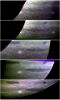
Jupiter-PIA10076.jpgAmmonia Ice-Clouds on Jupiter68 visiteCaption NASA:"The top cloud layer on Jupiter is thought to consist of ammonia ice, but most of that ammonia "hides" from spectrometers. It does not absorb light in the same way ammonia does. To many scientists, this implies that ammonia churned up from lower layers of the atmosphere "ages" in some way after it condenses, possibly by being covered with a photochemically generated hydrocarbon mixture.
The New Horizons Linear Etalon Imaging Spectral Array (LEISA), the half of the Ralph instrument that is able to see in infrared wavelengths that are absorbed by ammonia ice, spotted these clouds and watched them evolve over 5 Jupiter days (about 40 Earth hours). In these images, spectroscopically identified fresh ammonia clouds are shown in bright blue. The largest cloud appeared as a localized source on day 1, intensified and broadened on day 2, became more diffuse on days 3 and 4, and disappeared on day 5.
The diffusion seemed to follow the movement of a dark spot along the boundary of the oval region. Because the source of this ammonia lies deeper than the cloud, images like these can tell scientists much about the dynamics and heat conduction in Jupiter's lower atmosphere".MareKromium
|
|

Jupiter-PIA10096.jpgPolar Lightning on Jupiter67 visiteCaption NASA:"Images taken by the New Horizons Long-Range Reconnaissance Imager (LORRI) of Jupiter's night side showed lightning strikes.
Each "strike" is probably the cumulative brightness of multiple strikes. This is the first lightning seen at High Latitudes on Jupiter; it demonstrates that convection is not confined to lower latitudes, implying an internal driving heat source.
Their power is consistent with previous lightning measurements at Jupiter's Lower Latitudes, equivalent to extremely bright terrestrial "super bolts".MareKromium
|
|
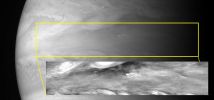
Jupiter-PIA10097.jpgAtmospheric Waves79 visiteWith its Multispectral Visible Imaging Camera (MVIC), half of the Ralph instrument, New Horizons captured several pictures of mesoscale gravity waves in Jupiter's Equatorial Atmosphere. Buoyancy waves of this type are seen frequently on Earth - for example, they can be caused when air flows over a mountain and a regular cloud pattern forms downstream. In Jupiter's case there are no mountains, but if conditions in the atmosphere are just right, it is possible to form long trains of these small waves.
The source of the wave excitation seems to lie deep in Jupiter's atmosphere, below the visible cloud layers at depths corresponding to pressures 10 times that at Earth's surface. The New Horizons measurements showed that the waves move about 100 mt-per-second faster than surrounding clouds; this is about 25% of the speed of sound on Earth and is much greater than current models of these waves predict.
Scientists can "read" the speed and patterns these waves to learn more about activity and stability in the atmospheric layers below".MareKromium
|
|

Jupiter-Upper_Atmosphere-PIA16837-PCF-LXTT-IPF.jpgInside Jupiter's Atmosphere (Absolute Natural Colors; credits for the additional process. and color.: Dr Paolo C. Fienga/Lunar Explorer Italia/Italian Planetary Foundation)85 visiteThe Jupiter's "Dark Hot Spot" visible in this image - taken on December, 13 of the AD 2000 by the NASA - Cassini Spacecraft Imaging Science Subsystem (while Cassini was on its way to the Saturnian System) - is, in a manner of speaking, a "window" that opens deep inside into Jupiter's Upper Atmosphere. In fact, all around the Dark Hot Spot, there are Layers of higher Clouds, with shapes and colors that can help us to identify which Layer of the Jovian Amosphere they actually belong to.
For instance, the three small gray-bluish Clouds visible to to the right of the frame, are located in the Jovian Upper Troposphere, or perhaps even higher, into the Jovian Stratosphere. On the other hand, the large Gray Band located under the Dark Hot Spot (inside which can be - really - barely seen a few bizarre-looking dense Cloud Formations), is positioned in the Lower Troposphere of Jupiter. In addition, a high, gauzy orangish Haze seems to cover a large portion of the frame.
This picture (which is an Original NASA - Cassini Spacecraft b/w false-color frame published on the NASA - Planetary Photojournal with the ID n. PIA 16837) has been additionally processed and then re-colorized in Absolute Natural Colors (such as the colors that an average human eye would actually perceive if someone were onboard the NASA - CASSINI Spececraft and then looked outside, towards the Jupiter), by using an original technique created - and, in time, dramatically improved - by the Lunar Explorer Italia Team.
Note: we apologize to our Readers, but some of the details (i.e.: a so-called "Gyre" and a "Plume") which characterize part of the dense Cloud-Formations located in the Lower Troposphere of Jupiter can ONLY be seen by watching the false-color version of this frame, as edited by NASA, and found in the Planetary Photojournal. If seen through "human eyes", the aformentioned details disappear almost completely (only the Plume, in fact, can be barely spotted, left of center of the gray Clouds-Band).MareKromium
|
|

Neptune-PIA01982.jpgClouds near the "Eye" of Neptune (Natural Colors; credits: Lunexit)111 visiteCaption NASA:"The bright cirrus-like clouds of Neptune change rapidly, often forming and dissipating over periods of several to tens of hours. In this sequence, Voyager 2 observed cloud evolution in the region around the Great Dark Spot (GDS).
The surprisingly rapid changes which occur separating each panel shows that in this Region Neptune's weather is perhaps as dynamic and variable as that of the Earth. However, the scale is immense by our standards -- the Earth and the GDS are of similar size -- and in Neptune's frigid Atmosphere, where temperatures are as low as 55 degrees Kelvin (-360 F), the cirrus clouds are composed of frozen Methane rather than Earth's crystals of water ice".MareKromium
|
|
| 94 immagini su 8 pagina(e) |
1 |
 |
|
|
|
|
|








