| Risultati della ricerca nelle immagini - "Uplift" |
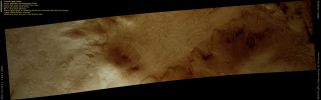
ESP_013071_1365_RED_abrowse.jpgCentral Peak Gullies (Natural Colors; credits: Lunar Explorer Italia)88 visitenessun commentoMareKromium
|
|

ESP_020873_1640_RED_abrowse.jpgLayered Bedrock in Central Uplift (Absolute Natural Colors; credits: Dr Paolo C. Fienga - Lunexit Team)294 visitenessun commentoMareKromium
|
|

ESP_020929_1360_RED_abrowse.jpgUplifted Bedrock (Absolute Natural Colors; credits for the additional process. and color.: Dr Paolo C. Fienga - Lunexit Team)353 visiteCaption NASA:"Large Impact Craters expose deep Bedrock. After the transient cavity forms, the Crater Floor rebounds and creates a permanent structural Uplift, typically equivalent to about 10% of the Crater diameter.
A Crater approx. 70 Km (43,47 miles) wide like this one, can raise up and expose Bedrock that was approx. 7 Km (4,34 miles) lower in elevation prior to the Impact.
Deeper rocks are usually older, and on Mars the oldest rocks are interesting because they are more likely to have been altered by water and provide clues to ancient environments and processes. This image reveals good Bedrock exposures with diverse rock types (as indicated by colors and textures)".MareKromium
|
|
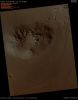
ESP_020949_2115_RED_abrowse.jpgUnnamed Crater's Central Uplift in Amazonis Planitia (Natural Colors; credits for the additional process. and color.: Dr Paolo C. Fienga - Lunexit Team)192 visitenessun commentoMareKromium
|
|
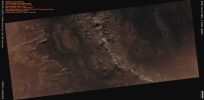
ESP_022580_1560_RED_abrowse-PCF-LXTT.jpgUplifted Layered Materials (Absolute Natural Colors; credits for the additional process. and color.: Dr Paolo C. Fienga - Lunexit Team)185 visitenessun commentoMareKromium
|
|
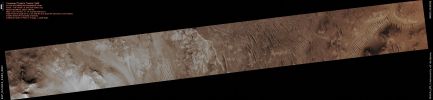
ESP_023024_1685_RED_abrowse-PCF-LXTT-00.jpgUplifted Rocks in Crater Center (CTX Frame - Absolute Natural Colors; credits for the additional process. and color.: Dr Paolo C. Fienga - Lunexit Team)208 visiteCaption NASA:"Impacts forming Craters excavate holes deep into the ground, exposing rocks from far below the present Surface. At the center of large Craters, rocks from still further below can be uplifted, rebounding upwards during the last stages of Crater formation. This image shows the Central Peak of a large Impact Crater located in the Southern Highlands of Mars".MareKromium
|
|

ESP_023024_1685_RED_abrowse-PCF-LXTT-01.jpgUplifted Rocks in Crater Center (EDM - Absolute Natural Colors; credits for the additional process. and color.: Dr Paolo C. Fienga - Lunexit Team)211 visiteCaption NASA:"This EDM reveals varied colors, suggesting that a range of rock types are present. Studies of these rocks from far below the Surface help us to understand ancient Mars as well as the processes that have altered the rocks after they formed and were buried".MareKromium
|
|

PSP_005409_1530_RED_abrowse-00.jpgUnnamed Southern Crater with Central Peak (CTX Frame - Enhanced Natural Colors; credits for the additional process. and color.: Dr Paolo C. Fienga - Lunexit Team)128 visitenessun commentoMareKromium
|
|

PSP_005409_1530_RED_abrowse-01.jpgUnnamed Southern Crater with Central Peak (EDM - Enhanced Natural Colors; credits for the additional process. and color.: Dr Paolo C. Fienga - Lunexit Team)125 visitenessun commentoMareKromium
|
|
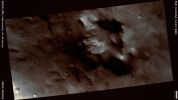
PSP_010454_1635_RED_abrowse.jpgCentral Uplift within an Unnamed Impact Crater (Natural Colors; credits: Lunar Explorer Italia)88 visiteMars Local Time: 15:45 (middle afternoon)
Coord. (centered): 16,1° South Lat. and 150,2° East Long.
Spacecraft altitude: 261,3 Km (such as about 163,3 miles)
Original image scale range: 26,1 cm/pixel (with 1 x 1 binning) so objects ~ 78 cm across are resolved
Map projected scale: 25 cm/pixel
Map projection: EQUIRECTANGULAR
Emission Angle: 8,4°
Phase Angle: 56,6°
Solar Incidence Angle: 63° (meaning that the Sun is about 27° above the Local Horizon)
Solar Longitude: 144,0° (Northern Summer)
Credits: NASA/JPL/University of Arizona
Additional process. and coloring: Lunar Explorer ItaliaMareKromium
|
|
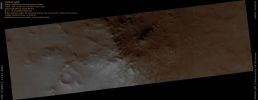
PSP_010877_1610_RED_abrowse-PCF-LXTT.jpgCentral Uplift (Absolute Natural Colors; additional process.: Dr Paolo C. Fienga - Lunexit Team)110 visitenessun commentoMareKromium
|
|
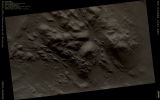
PSP_010888_2030_RED_abrowse.jpgMojave Crater's Floor and Central Uplift (Natural Colors; credits: Dr Paolo C. Fienga - Lunexit Team)75 visiteThis observation shows a portion of the Central Uplift structure in Mojave Crater.
Central Uplifts are a typical feature of large Impact Craters on Earth, Moon and Mars; craters larger than 6 or 7 Km in diameter on Mars typically form this mountain-like peak in the central portion of the crater interior.
This Peak consists of rocks originating from several kilometers beneath the pre-impact surface.
Mojave has a very prominent Central Uplift as it has a diameter of about 60 Km (apprx. 37 miles). In this image, boulders as large as about 15 meters (50 feet) across have been eroded from the massive uplifted rock and have rolled downslope. Fine-grained debris has also collected in the topographic lows, and has been shaped by the wind into Dunes and Ripples.
Notably absent from this image are the striking Drainage Channels and Alluvial Fans that are abundant on the wall-terraces and ejecta of Mojave Crater (see PSP_001415_1875). These features were likely formed by Surface Runoff of liquid water, which may have been released from the Subsurface during the impact event that formed Mojave.
Previously, it had been suggested that a brief, torrential downpour over Mojave Crater delivered the water. However, Mars Orbiter Camera's (MOC) images of Mojave's Central Uplift have previously shown no evidence for Surface Runoff, and the higher resolution of this HiRISE image confirms that this part of the Crater appears untouched by liquid water.
So the question remains: by what means was the water, in the form of Runoff, supplied to Mojave? This question, in addition to several others regarding this phenomenon, are currently being investigated by the HiRISE team and their collaborators.MareKromium
|
|
| 12 immagini su 1 pagina(e) |
|








