| Risultati della ricerca nelle immagini - "Tycho" |

Kaguya-029-Tycho-tc_012_a_l.jpgTycho: the Central Peak (perspective view - natural colors; credits: Lunexit)66 visiteCaption JAXA:"Tycho Crater, located on the Lunar Nearside in the Highlands of the Southern Hemisphere at about 43° South Lat. and 7° West Long. is a young crater formed by an impact about 100 Million Years ago. On nights when the Moon is fully lighted, you can see bright rays coming out from Tycho Crater.
The study of Tycho Crater contributed to the development of Lunar Science. The first data on the chemical composition of the Lunar Highlands were obtained by the analytical instrument onboard Surveyor 7, which soft-landed about 20 Km North of the Rim of Tycho, in 1968 (see Note n. 1).
Dr. J. A. Wood of the Smithsonian Astrophysical Laboratory discovered some tiny fragment of Anorthosite in the regolith (soil) samples collected by the Apollo 11 Astronauts. Because of the observation that the chemical composition of the fragments was similar to that of Tycho taken by the Surveyor, Dr. Wood inferred that these fragment were ejected from Tycho by the impact. He proposed the "Lunar Magma Ocean Hypothesis" (see Note n. 2) in order to account for his finding that the Lunar Highlands are composed of Anorthosite.
One of the major objectives of the subsequent Apollo Missions was to find a pristine Anorthosite rock in the Highlands.
The impact that created Tycho Crater ejected highland anorthositic crust all over the Near Side of the Moon. This impact by a small asteroidal body took place, as we said, about 100 MY ago, when the dinosaurs inhabited the Earth. It was, however, still a relatively recent event in Lunar History, and the effects of the impact event can still be seen.
Note 1) In preparation for the manned Lunar Missions of the Apollo Program, NASA developed soft-landing techniques with the Surveyor Program. Surveyor 7 was the final spacecraft of the series and landed near the north rim of Tycho Crater on 10 January 1968 (UT). During this mission, many photographs of the Lunar Highland landscape were taken and a geological survey was performed.
Note 2) “Lunar magma ocean hypothesis”: To explain the formation of Anorthosite that the Lunar Surface was once completely molten to a depth of about 200 Km, thus forming a “lunar magma ocean”. This hypothesis has contributed not only to Lunar Science but also to ideas about the formation of the Earth. MareKromium
|
|

Kaguya-030-Tycho-tc_012_c_l.jpgTycho: the Inner Rim (perspective view - natural colors; credits: Lunexit)65 visitenessun commentoMareKromium
|
|

Kaguya-031-Tycho-tc_012_d_l.jpgTycho: the Inner Rim (perspective view - natural colors; credits: Lunexit)63 visitenessun commentoMareKromium
|
|
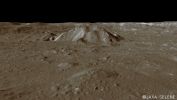
Kaguya-032-tc_012_e_l.jpgTycho: the Central Peak (perspective view - natural colors; credits: Lunexit)66 visitenessun commentoMareKromium
|
|

LRO-Craters-Tycho-Central_Peak-PCF-LXTT-0.jpgTycho's Peak (Absolute Natural Colors; credits for the additional process. and color.: Dr Paolo C. Fienga - Lunexit Team)244 visiteCaption NASA:"Tycho Crater's Central Peak Complex casts a long, dark shadow near Local Sunrise in this spectacular Lunarscape. The dramatic oblique view was recorded on June 10, 2011, by the Lunar Reconnaissance Orbiter. Shown in amazing detail, boulder strewn slopes and jagged shadows appear in the highest resolution version at 1,5 meters per pixel. The rugged Complex is about 15 Km wide, formed in uplift by the giant impact that created the well-known crater about 100 MYs ago. The Summit of its Central Peak reaches approx. 2 Km above the Floor".MareKromium
|
|

LRO-Craters-Tycho-Central_Peak-PCF-LXTT-1.jpgTycho's Peak (Extremely Saturated Absolute Natural Colors; credits for the additional process. and color.: Dr Paolo C. Fienga - Lunexit Team)282 visiteUn piccolo "Enigma Lunare": la "oversaturation" del frame che abbiamo operato, unita alla colorizzazione Assoluta, evidenzia un curioso, quanto palese, dettaglio ambiguo. C'è, infatti, una sorta di "linea di demarcazione" tra due zone della Superficie Lunare le quali giacciono entrambe nell'ombra del Picco Centrale di Tycho.
Di qualsiasi cosa si tratti, il dettaglio, se non altro, ci lascia perplessi: sarà un vizio di trasmissione o di montaggio del frame, oppure è (il solito) cover-up? Decidetelo Voi. L'immagine è lì: basta guardarla, studiarla e quindi avere il coraggio di dire (e scrivere!) quello che si pensa...MareKromium
|
|

Original_NASA-LO5-Tycho-5125_med.jpgOriginal Lunar Orbiter - Frame LO5-5125m - Tycho Crater108 visiteSpacecraft Position:
Altitude: 220.06 Km
Latitude: 42,21° South
Longitude: -11.60° East
Principal Point:
Latitude: 42,90° South
Longitude: -11.70° East
Illumination Data:
Sun Azimuth: 79,62°
Solar Incidence Angle: 81,10°
Emission Angle: 6,16°
Phase Angle (Sun-Spacecraft-Tycho): 79,44°MareKromium
|
|

Original_NASA-LO5-Tycho-5126_med.jpgOriginal Lunar Orbiter - Frame LO5-5126m - Tycho Crater112 visiteSpacecraft Position:
Altitude: 217,25 Km
Latitude: 41,70° South
Longitude: -11,53° East
Principal Point:
Latitude: 42,32° South
Longitude: -11,61° East
Illumination Data:
Sun Azimuth: 79,65°
Solar Incidence Angle: 80,93°
Emission Angle: 5,57°
Phase Angle (Sun-Spacecraft-Tycho): 79,44°MareKromium
|
|

Original_NASA-LO5-Tycho-5127_med.jpgOriginal Lunar Orbiter - Frame LO5-5127m - Tycho Crater103 visiteSpacecraft Position:
Altitude: 214,41 Km
Latitude: 41,18° South
Longitude: -11,46° East
Principal Point:
Latitude: 41,72° South
Longitude: -11,53° East
Illumination Data:
Sun Azimuth: 79,69°
Solar Incidence Angle: 80,76°
Emission Angle: 4,98°
Phase Angle (Sun-Spacecraft-Tycho): 79,44°MareKromium
|
|

Tycho-1.jpg201 - Tycho Crater71 visitenessun commento
|
|

Tycho-2.jpg202 - Tycho Crater75 visitenessun commento
|
|

Tycho-UVVis-2.gif203 - Tycho Crater86 visitenessun commento
|
|
| 13 immagini su 2 pagina(e) |
1 |
|








