| Risultati della ricerca nelle immagini - "To" |

15-U-Tobias.jpgTobias Mayer Crater, from Lunar Orbiter 5 (3D)93 visiteOriginal caption:"Stereoscopic view of an area sw of the Crater Tobias Mayer in Oceanus Procellarum. The highland ridge in the middle portion of the anaglyph is about 35 Km long and 2 Km high. A smooth mare dome abuts the western flank of the ridge. The dome is about 20 Km in diameter and exhibits an elongate summit crater, about 5 Km long.
A sinuous rille meanders across the lower part of the photograph, detouring around the base of the dome. Note the presence of several crater chains in the lower half and a large highland mass at upper left".
|
|

30-Doradus and Tarantula Region.jpg30-Doradus, R-136 Star Cluster and the "Tarantula Region"109 visite"...Per alcuni, la Cultura si fa sottovoce, con la semplicità e la condivisione critica delle informazioni.
Per altri si fa strillando, con rabbia, e cercando di imporre agli altri una visione acritica delle informazioni.
Molti pensano che la Cultura, comunque, si possa - o si debba - fare solo attraverso le azioni e le dimostrazioni "pratiche".
Io credo che la Verità sia nel concetto di Cultura che ognuno di noi possiede e ritiene di trasmettere. Io, ad esempio, penso che la Cultura possa farsi solo usando la Parola..."
P.C. Floegers - "Scritti di Cronaca e Sociale"
|
|

APOLLO 11 AS 11-37-5480.jpgAS 11-37-5480 - The Field (1)228 visiteLa "zona di lavoro" dove gli astronauti hanno operato per circa due ore continua ad essere fotografata. Non si vede nulla di particolare in queste immagini ripetitive (se non la "spazzatura spaziale" - come qualcuno ha definito le preziosissime attrezzature che abbiamo lasciato lassù ed il cui valore è, di fatto, "incalcolabile & gigantesco". Talmente elevato, si dice, che da solo giustificherebbe un "Back to the Moon"!).
|
|

APOLLO 11 AS 11-37-5481.jpgAS 11-37-5481 - The Field (2)191 visiteMa di quale "space trash" si stava parlando nel frame precedente? Semplice: cineprese, antenne, utensili vari, sismografi ed altri equipaggiamenti scientifici che, oggigiorno, avrebbero un valore (non solo intrinseco, ma anche - ed ovviamente - "storico") largamente superiore a qualche miliardo di dollari. Se qualcuno avesse intenzione di recuperare questi "gioielli" possiamo dire che si tratta, di "res derelictae" (cioè "cose abbandonate"). Ne diventa proprietario il primo che le trova e se le prende... Ma deve andare a passeggiare sulla Luna....
|
|

APOLLO 11 AS 11-37-5482.jpgAS 11-37-5482 - The Field (3)203 visiteA volte, guardando queste immagini, viene anche da domandarsi se gli astronauti non abbiano continuato a fotografare l'esterno alla ricerca di "movimenti". Ci sono dei frames, infatti, che lasciano supporre proprio questo tentativo e li vedremo in seguito. In questo caso, probabilmente, le fotografie sono state scattate in sequenza, cercando di migliorare "sul campo" la familiarità con la fotocamera (il cui uso era tuttaltro che semplice e comodo...).
|
|

APOLLO 11 AS 11-37-5483.jpgAS 11-37-5483 - The Field (4)183 visiteLa qualità dell'immagine sembra, effettivamente, leggermente migliorata. I bordi degli oggetti sono maggiormente definiti e la messa a fuoco appare, se non ottimale, quantomeno più che buona.
|
|

APOLLO 14 AS 14 64-9121 HR-1.jpgAS 14-64-9121 - Lunar Tools (HR)111 visiteOriginal caption:"133:23:40 MT. This frame from Al's Station C-Prime pan gives us good detail of the front of the MET, including the triangular handle brace, the 16-mm camera and the Gnomon. The dustbrush that the Astronauts use to dust themselves after each of the EVAs is hanging below the 16-mm camera on the right side of the MET. This brush is identical to the ones flown on the later missions. The white box attached to the side of the camera farthest from us is the battery pack (...)".
|
|

AS14-68-9455_HR.jpgAS 14-68-9455 - Triple Core55 visite134:26:27 MT - While Ed worked on the triple core, Al was digging a trench and, in the end, needed the extension handle to get it to full depth. In this photo, we can see that the extension handle has been removed prior to Ed's second attempt at getting the triple. Because of the length of the triple core, Ed can hammer the first section or two into the ground without the extension handle.
He will need it, however, to finish the job and, in fact, gets it back from Al at about 134:27:48 MT.MareKromium
|
|

ESP_013089_2040_RED_abrowse.jpgTooting Crater (Natural Colors; credits: Lunar Explorer Italia)58 visiteThis image is of the Ejecta Blanket of the Tooting Crater in the Northern Hemisphere of Mars.
Tooting is a "rampart" crater that is roughly 29 Km (about 18 miles) in diameter and appears to be one of the youngest craters of this size.
A "rampart crater" is one where the material ejected from the crater during impact forms lobes that end with a low ridge, or rampart. One indication of Tooting Crater's youth is its ratio of depth to width.
As a crater ages, the walls of the crater will tend to erode and debris will accumulate in the crater's floor making its apparent depth less, while also making its width larger.
One of the major features of Tooting Crater are its multiple ejecta layers that build a sequence of ramparts. The shapes of these ramparts suggest that the ejected material acted as a fluid (like mud) as it moved across the surface.
Most researchers think that such fluid ejecta indicates that there was ice in the ground when the crater formed.MareKromium
|
|
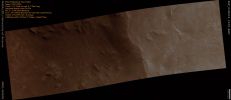
ESP_018474_1970_RED_abrowse.jpgFloor Deposits in Toro Crater (Natural Colors; credits for the additional process. and color.: Dr Paolo C. Fienga - Lunexit Team)87 visitenessun commentoMareKromium
|
|

ESP_022077_2000_RED_abrowse-PCF-LXTT.jpgPossible "Inverted-Topography" in the proximities of Mawrth Vallis (Absolute Natural Colors; credits for the additional process. and color.: Dr Paolo C. Fienga - Lunexit Team)236 visitenessun commentoMareKromium
|
|

Mars-013.jpgMars: Yesterday and Today246 visiteDoes Mars have canals? A hot debate topic of the late 1800s, several prominent astronomers including Percival Lowell not only claimed to see an extensive system of long straight canals on Mars, but used them to indicate that intelligent life exists there. The relatively close opposition of 1894 was used to make drawings like the one digitally re-scaled on the above left. The above map was originally prepared by Eugene Antoniadi and redrawn by Lowell Hess for the book Exploring Mars, by Roy A. Gallant. In more modern times, the latest Mars opposition has allowed the Hubble Space Telescope to capture a picture of similar orientation. Comparison of the two images shows that large features were impressively recorded, but that an extensive system of long and straight canals just does not exist. Satellites orbiting Mars have now shown conclusively that the red planet does indeed have surface features similar to canals, but that these are usually smaller, curved, and less extensive than that previously claimed. Real canyon systems like Noctis Labyrinthus are most likely cracks caused by surface stress.
|
|
| 33 immagini su 3 pagina(e) |
1 |
|





