| |
| Risultati della ricerca nelle immagini - "Titan" |

00-Titan.JPGTitan in possible True Colors (credits: NASA)81 visiteAttraverso l’oculare di un (anche) modesto telescopio, Titano, il più grande satellite naturale del pianeta Saturno, appare come un corpo puntiforme che splende debolmente di un delicato color giallo-pallido.
Si tratta di un oggetto celeste reso affascinante dalla sua posizione – apparentemente assai prossima – rispetto al Gigante Anellato (la sua distanza angolare da Saturno non supera mai i 20 raggi saturniani), ma certo non si può dire che Titano, in sé, riesca a suggerire particolari interessi e curiosità visive, anzi: nessun rilievo superficiale di questo Mondo, infatti, risulta discernibile nelle osservazioni effettuate da Terra (nemmeno usando le più sofisticate ed avanzate tecniche fotografiche) e, come abbiamo appreso grazie alle immagini ottenute dalle Sonde Voyager prima e dall’Orbiter Cassini poi, anche da distanza (relativamente) ravvicinata questo mondo risulta alquanto indecifrabile (anche se occorre dire che, già dalla metà degli Anni ’70, l’effettuazione di una serie di osservazioni ripetute di Titano – effettuate usando i più grandi telescopi terrestri al tempo disponibili – aveva, peraltro correttamente, suggerito agli Astronomi una sostanziale NON uniformità, in termini di albedo, della sua superficie la quale venne ben interpretata, sin d’allora, come indice della possibile presenza di aree superficiali sensibilmente disomogenee ed equiparabili a continenti).
MareKromium
|
|

060-vg1_p23076.jpgTitan, from Voyager 1 (natural colors)72 visitenessun commento
|
|

061-vg2_p23929.jpgTitan, from Voyager 2 (natural colors)63 visitenessun commento
|
|

Dione&Titan-PIA06607.jpgDione and Titan71 visiteCaption NASA originale:"As artful as it is informative, this captivating portrait captures Saturn's wispy moon Dione over the shoulder of smoggy Titan in a single inspiring scene. Dione is 1.118 Km (approx. 695 miles) across and Titan is 5.150 Km (such as approx. 3.200 miles) across.
The image was taken in visible green light with the Cassini spacecraft narrow-angle camera on Feb. 18, 2005, at a distance of approximately 1,3 MKM (808.000 miles) from Dione and 2,1 MKM (1,3 MMs) from Titan. The image scale is 8 Km (5 miles) per pixel on Dione and 13 Km (8 miles) per pixel on Titan".
|
|

Dione-N00028445.jpgDione and Titan66 visitenessun commento
|
|

Dione_and_Titan-EL.jpgFading in the Background... (credits: NASA/JPL/SSI; Color composite: Emily Lakdawalla)81 visiteEmily Lakdawalla è sicuramente bravissima, ma la nostra Elisabetta Bonora è meglio: nessuno ne dubita. Eppure, per l'ennesima volta, la prestigiosa Rubrica NASA "Astronomy, Picture of the Day", pubblica un lavoro che è stato palesemente scopiazzato dalle nostre pagine.
Non ci credete? Beh, questo non è un nostro problema. Andate a vedere la "Picture of the Day" del 20 Aprile 2010 e poi guardate l'immagine pubblicata da noi il giorno 12 Aprile 2010.
E se Vi va, alla fine provate a fare "2 + 2". E per quanti sforzi possiate inventarVi per dimostrare il contrario, credeteci, la somma sarà SEMPRE "4"...MareKromium
|
|

En route to Titan.jpgHuygens Probe: en route to Titan123 visiteThe Huygens Probe, after deploying from the Cassini Orbiter, en route into the murky atmosphere of Saturn's largest moon, Titan.
|
|

Enceladus and Titan-PIA07787-br500.jpgColors of the Saturnian System: Enceladus and Titan61 visiteMany denizens of the Saturn System wear a uniformly gray mantle of darkened ice, but not these 2 moons: the brightest body in the Solar System, Enceladus, is contrasted here against Titan's smoggy, golden murk. Ironically, what these 2 moons hold in common gives rise to their stark contrasting colors. Both bodies are, to varying degrees, geologically active. For Enceladus, its Southern Polar Vents emit a spray of icy particles that coats the small moon, giving it a clean, white veneer. On Titan, yet undefined processes are supplying the atmosphere with Methane and other chemicals that are broken down by sunlight. These chemicals are creating the thick yellow-orange haze that is spread through the atmosphere and, over geologic time, falls and coats the surface. The thin, bluish haze along Titan's limb is caused when sunlight is scattered by haze particles roughly the same size as the wavelength of blue light, or around 400 nnmts.
|
|

Enceladus&C-PIA08216.jpgJewels...77 visiteThe real jewels of Saturn are arguably its stunning collection of icy moons. Seen here with the unlit side of the Rings are Titan (Dx), Tethys (Sx) and Enceladus (Cn) with its fountain-like geysers.
The faint, vertical banding in the image is due to "noise" in the spacecraft electronics. This noise is difficult to remove from an image that has a very wide dynamic range - i.e.: a wide range of brightness levels - as in the difference between gleaming Titan and the faint plumes of Enceladus.
Additionally, a reflection of Titan's light within the camera optics is likely responsible for the faint secondary image of Titan's limb to the left of the giant moon.
The image was taken in visible green light with the Cassini spacecraft narrow-angle camera on June 10, 2006 at a distance of approx. 3,9 MKM (about 2,4 MMs) from Enceladus; 5,3 MKM (about 3,3 MMs) from Titan and 4,4 MKM (such as approx. 2,7 MMs) from Tethys.
The phase angle is 160° on Enceladus.
Image scale is 23 kilometers (14 miles) per pixel on Enceladus, 32 kilometers (20 miles) per pixel on Titan and 26 kilometers (16 miles) per pixel on Tethys.
|
|

Enceladus_and_Titan-PIA14617-PCF-LXTT-IPF.jpgSo close, and yet so far... (Absolute Natural Colors; credits for the additional process. and color.: Dr Paolo C. Fienga - Lunar Explorer Italia/Italian Planetary Foundation)102 visiteThe Saturnian moon Enceladus can be seen partially (as a matter of fact, we have to say almost completely) eclipsed by the shadow of its Gas-Giant Parent Planet, in this really fascinating view, taken by the the NASA - Cassini Spacecraft, which also features another Saturnian moon, such as Titan, in the distance. The Cassini Spacecraft flew by Enceladus, shown in the upper left of the picture, at a distance of about 16.000 miles (such as approx. 26.000 Km).
The Terminator - such as the Line separating the day from the night side - of Enceladus (whose dimension is approx. 313 miles, or about 504 Km across) can be barely seen on the very far left of the moon itself, while the shadow of Saturn runs all the way across from its Middle Northern, until the South Polar Regions. Titan (whose dimension is approx. 3200 miles, or about 5150 Km across), as we already mentioned hereabove, is well visible in the lower right of the frame, and, at the time that the picture was taken, it was about 684.000 miles (such as approx. 1,1 Million KiloMeters - MKM) away from the Spacecraft.
This view looks toward the Saturn-facing Sides of both Enceladus and Titan; North is up (obviously for both moons) and the image was taken in Visible Light, with the Cassini Spacecraft Wide-Angle Camera on October, 1st, 2011. The view was obtained at a Sun-Enceladus-CASSINI Spacecraft, or Phase, Angle of 29°. The Scale in the original image was approx. 2 miles (such as a little more than 3 Km) per pixel on Enceladus. The original image was also contrast enhanced and magnified by a factor of 1.5, so to enhance the visibility of a few Enceladian Surface Features (and in fact, if you look carefully, while Titan is - as usual, when observed from a great distance - completely featureless, a few Impact Craters and some Surface Striations, can actually be seen in the Northern Regions of the icy moon Enceladus).
This picture (which is an Original NASA - Cassini Spacecraft b/w frame published on the NASA - Planetary Photojournal with the ID n. PIA 14617) has been additionally processed and then colorized, according to an informed speculation carried out by Dr Paolo C. Fienga (LXTT-IPF), in Absolute Natural Colors (such as the colors that a human eye would actually perceive if someone were onboard the NASA - Cassini Spacecraft and then looked outside, towards the Saturnian moons Enceladus and Titan), by using an original technique created - and, in time, dramatically improved - by the Lunar Explorer Italia Team. Different colors, as well as different shades of the same color, mean, among others, the existence of different Elements present on the Surface of Enceladus and in the Atmosphere of Titan, respectively, each having a different Albedo (---> Reflectivity) and Chemical Composition.MareKromium
|
|
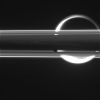
Janus&Titan-N00055796.jpgPassing-by... (1)75 visiteUna piccola serie di 3 frames (decisamente suggestivi) i quali ci mostrano alcuni istanti del transito della Sonda Cassini in una porzione dello spazio circum-saturniano capace di mostrarci lo spettacolo dell'incrocio (si tratta, come ovvio, di un semplice gioco prospettico) fra la piccola luna Giano (Janus), gli Anelli di Saturno e Titano.
Data:"N00055796.jpg was taken on March 21, 2006 and received on Earth March 22, 2006. The camera was pointing toward Janus that, at the time, was approximately 724.598 Km away.
The image was taken using the CL1 and CL2 filters".
|
|
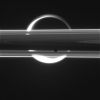
Janus&Titan-N00055798.jpgPassing-by... (2)65 visiteData:"N00055798.jpg was taken on March 21, 2006 and received on Earth March 22, 2006. The camera was pointing toward Janus that, at the time, was approximately 724.179 Km away.
The image was taken using the CL1 and CL2 filters".
Nota: la distanza fra Cassini e Titano, in questo frame - così come nel precedente e nel successivo - dovrebbe essere compresa fra i 2,2 ed i 2,4 MKM.
|
|
| 454 immagini su 38 pagina(e) |
1 |
 |
|
|
|
|
|
|
|
|
|
|
|





