| Risultati della ricerca nelle immagini - "Tethys" |

Dione&Co.-PIA07628.jpgDione, Tethys and Pandora67 visiteOriginal caption:"This excellent grouping of 3 moons - Dione, Tethys and Pandora - near the Rings, provides a sampling of the diversity of worlds that exists in Saturn's Realm. A 330-Km-wide (about 205 miles) impact basin can be seen near the bottom right on Dione (at left). Ithaca Chasma and the Region imaged during the Cassini spacecraft¿s Sept. 24, 2005, flyby can be seen on Tethys (middle). Little Pandora makes a good showing here as well, displaying a hint of surface detail. Tethys is on the far side of the Rings in this view; Dione and Pandora are much nearer to the Cassini spacecraft.
Rememeber that Dione is approx. 1.126 Km (about 700 miles) across. Tethys is approx. 1.071 Km (about 665 miles) across and Pandora is 84 Km (roughly 52 miles) across.
This image was taken in visible blue light with the Cassini spacecraft narrow-angle camera on Sept. 22, 2005, at a distance of approx. 1,2 MKM (about 800.000 miles) from Saturn. The image scale is about 5 Km (approx. 3 miles) per pixel on Dione and Pandora and 9 kilometers (6 miles) per pixel on Tethys".
|
|

Dione&Tethys-PIA06629.jpgDione and Tethys72 visiteCaption NASA originale:"Cassini offers this lovely comparison between two of Saturn's satellites, Dione and Tethys, which are similar in size but have very different surfaces.
Extensive systems of bright fractures carve the surface of Dione. The double-pronged feature Carthage Linea points toward the crater Turnus at the nine o'clock position near the terminator and Palatine Linea runs toward the moon's bottom limb near the five o'clock position.
In contrast, the surface of Tethys appears brighter and more heavily cratered. The large crater Penelope is near the eastern limb. The huge rift zone Ithaca Chasma, which is 3 to 5 Km deep and extends for about 2.000 Km from north to south across Tethys, is hidden in shadow just beyond the terminator. For comparison, the Grand Canyon in Arizona is about 1,5 Km deep and about 450 Km long.
The image was taken in visible light from a distance of approx. 1,5 MKM from Tethys and 1,6 MKM from Dione. The image scale is 9 Km/pixel on Tethys and 10 Km/pixel on Dione".
|
|

Dione&Tethys-PIA07630.jpgThe Eternal Companions63 visiteOriginal caption:"The moons Dione and Tethys face each other across the gulf of Saturn's Rings. Here, the Cassini spacecraft looks on the Saturn-facing Hemisphere of Tethys below and the anti-Saturn side of Dione above. The dark groove in the Rings is the Cassini Division.
This image was taken in visible light with the Cassini spacecraft narrow-angle camera on Sept. 22, 2005, at a distance of approximately 860.000 Km (about 530.000 miles) from Dione. Tethys was on the far side of the rings, 1,5 MKM (roughly 900.000 miles) from Cassini. The image scale is 5 Km (about 3 miles) per pixel on Dione and 9 Km (about 6 miles) per pixel on Tethys".
|
|

Dione_and_Tethys-MF-LXTT.jpgNightlights in the Sky of Saturn (Natural Colors; credits for the additonal process. and color.: Dr Marco Faccin - Lunexit Team)102 visitenessun commentoMareKromium
|
|

Enceladus&C-PIA08216.jpgJewels...77 visiteThe real jewels of Saturn are arguably its stunning collection of icy moons. Seen here with the unlit side of the Rings are Titan (Dx), Tethys (Sx) and Enceladus (Cn) with its fountain-like geysers.
The faint, vertical banding in the image is due to "noise" in the spacecraft electronics. This noise is difficult to remove from an image that has a very wide dynamic range - i.e.: a wide range of brightness levels - as in the difference between gleaming Titan and the faint plumes of Enceladus.
Additionally, a reflection of Titan's light within the camera optics is likely responsible for the faint secondary image of Titan's limb to the left of the giant moon.
The image was taken in visible green light with the Cassini spacecraft narrow-angle camera on June 10, 2006 at a distance of approx. 3,9 MKM (about 2,4 MMs) from Enceladus; 5,3 MKM (about 3,3 MMs) from Titan and 4,4 MKM (such as approx. 2,7 MMs) from Tethys.
The phase angle is 160° on Enceladus.
Image scale is 23 kilometers (14 miles) per pixel on Enceladus, 32 kilometers (20 miles) per pixel on Titan and 26 kilometers (16 miles) per pixel on Tethys.
|
|
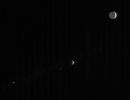
Enceladus&C.-PIA08182.jpgMoons...83 visiteCaption NASA proginale:"Four of Saturn's many and varied moons crowd this single frame from Cassini.
All of the moons are illuminated by the Sun, which is out of the frame to the right. "Saturnshine", or reflected light from the planet (out of frame to the lower left), partly illuminates three of the moons, such as Tethys (1.071 Km, or 665 miles across, at upper right), Janus (181 Km, or 113 miles across, at lower left) and Epimetheus (116 Km, or 72 miles across, below and left of center).
Enceladus (505 Km, or 314 miles across) is much farther in the distance in this view, and shows merely a slim crescent below center.
The image was taken in visible light with the Cassini spacecraft narrow-angle camera on April 17, 2006, at a distance of approx. 3,7 MKM (such as about 2,3 MMs) from Saturn. The image scale is approx. 27 Km (about 17 miles) per pixel on Tethys, 21 Km (13 miles) per pixel on Enceladus, and 22 Km (14 miles) per pixel on Janus and Epimetheus".
|
|

Enceladus&Tethys-PIA07664.jpgBrothers in the Night63 visiteThe Cassini spacecraft captures this dual portrait of an apparently dead moon and one that is very much alive. Tethys, in the foreground, shows no signs of recent geologic activity. Enceladus, instead, is covered in fractures and faults - near its South Pole in particular - and spews icy particles into space from active vents. Tethys' giant crater Odysseus lurks in the dark just west of the terminator. North on the moons is up.
The image was taken in visible light with the Cassini spacecraft narrow-angle camera on Nov. 29, 2005 at a distance of app.x 970.000 Km (roughly 600.000 miles) from Tethys and at a Sun-Tethys-spacecraft angle of 122°. Cassini was then 1,1 MKM (700.000 miles) from Enceladus. Image scale is about 6 Km per pixel on Tethys (at left) and 7 Km per pixel on Enceladus (at right).
|
|

Enceladus-N00086989.jpgSpace Encounter: Enceladus and Tethys (1)70 visitenessun commentoMareKromium
|
|

Enceladus-N00086992.jpgSpace Encounter: Enceladus and Tethys (2)63 visitenessun commentoMareKromium
|
|

Enceladus-N00086994.jpgSpace Encounter: Enceladus and Tethys (3)63 visitenessun commentoMareKromium
|
|

Enceladus-N00086995.jpgSpace Encounter: Enceladus and Tethys (4)63 visitenessun commentoMareKromium
|
|
Enceladus-N00086996.jpgSpace Encounter: Enceladus and Tethys (5)72 visitenessun commentoMareKromium
|
|
| 171 immagini su 15 pagina(e) |
1 |
 |
|
|
|
|
|
|
|
|
|





