| Risultati della ricerca nelle immagini - "Terby" |

Craters-Terby_Crater-01.jpgThe Sedimentary Layers of Terby Crater (1 - Original NASA/MGS/MSSS b/w Frame)70 visiteOriginal caption:"This MGS-MOC image shows some of the light-toned, layered, Sedimentary Rock Outcrops in Northern Terby Crater. Terby is located along the North edge of Hellas Planitia. The Sedimentary Rocks might have been deposited in a greater, Hellas-filling sea — or not. Today, the rocks are partly covered by dark-toned Sediment and Debris".
Location near: 27,2° South Lat. and 285,3° West Long.
Image width: ~3 km (~1,9 mi)
Illumination from: upper left
Season: Southern Summer
|
|

Craters-Terby_Crater-02.jpgThe Sedimentary Layers of Terby Crater (2 - Original NASA/MGS/MSSS b/w Frame)67 visitenessun commento
|
|

Craters-Terby_Crater-PIA14152-PCF-LXTT.jpgLayered Features inside Terby Crater (Absolute Natural Colors; credits for the additional process. and color.: Dr Paolo C. Fienga - Lunexit Team)291 visitenessun commentoMareKromium
|
|
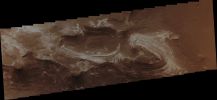
Craters-Terby_Crater-PIA14569-PCF-LXTT.jpgLayered Features inside Terby Crater (Absolute Natural Colors; credits for the additional process. and color.: Dr Paolo C. Fienga - Lunexit Team) 208 visiteOrbit Number: 42741
Latitude: 27,3491° South
Longitude: 74,2625° East
Instrument: VIS
Captured: August, 3rd, 2011
Mars Local Time (M.L.T.): 13:23 (Early Afternoon)
MareKromium
|
|
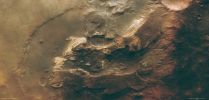
Craters-Terby_Crater.jpgTerby Crater (Natural Colors + MULTISPECTRUM; credits: ESA & Lunexit)87 visiteThe High Resolution Stereo Camera (HRSC) on board ESA’s Mars Express Orbiter imaged the Terby Crater on Mars on 13 April 2007 during orbit 4199.
The Region is of great scientific interest as sediments there hold information on the role of water in the history of the Planet. Eye-catching finger-shaped plateaux extend in the North-South direction. They rise up to 2000 mt above the surrounding terrain. The relatively old crater was filled with sediments in the past, which formed plateaux on erosion.
The flanks of the plateaux clearly exhibit layering of different-coloured material. Differences in colour usually indicate changes in the composition of the material and such layering is called ‘bedding’. Bedding structures are typical of sedimentary rock, which has been deposited either by wind or water. Different rock layers erode differently, forming terraces.
The valleys exhibit gullies, or channels cut in the ground by running liquid, mainly in the Northern part of the image.
These gullies and the rock-bedding structure indicate that the region has been affected by water.
MareKromium
|
|
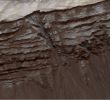
ESP_021942_1520_abrowse-PCF-LXTT.jpgGully-like Feature inside Terby Crater (Absolute Natural Colors; credits for the additional process. and color.: Dr Paolo C. Fienga - Lunexit Team)322 visitenessun commentoMareKromium
|
|

ESP_024421_1530-PCF-LXTT-00.jpgLayered Features inside Terby Crater (CTX Frame "A" - Absolute Natural Colors; credits for the additional process. and color.: Dr Paolo C. Fienga - Lunexit Team)225 visiteCoord. (centered): 27,1° South Lat. and 75,0° East Long.MareKromium
|
|

ESP_024421_1530-PCF-LXTT-01.jpgLayered Features inside Terby Crater (CTX Frame "B" - Absolute Natural Colors; credits for the additional process. and color.: Dr Paolo C. Fienga - Lunexit Team)234 visiteCoord. (centered): 27,1° South Lat. and 75,0° East Long.MareKromium
|
|
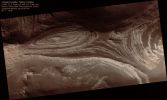
PSP_001596_1525_RED_browse-01-PCF-LXTT.jpgLayering inside Terby Crater (Absolute Natural Colors; credits: Dr Paolo C. Fienga - Lunexit Team)268 visiteImage PSP_001596_1525 shows a sequence of predominantly light-toned, layered, sedimentary rocks exposed by erosion on the floor of Terby Crater. Terby Crater is ~165 Km (~100 miles) in diameter. It's located on the northern rim of the Hellas impact basin in the Southern Hemisphere of Mars.
The layered sequence is ~2 Km (~1,2 miles) thick and consists of many repetitive, relatively horizontal beds. The beds appear to be laterally continuous, which means you can identify a given layer in many locations across the area.
Details in the layering seen in this HiRISE image reveal variations in the brightness of the layers and may indicate differing mineralogies. Based on the ease with which wind appears to erode these layers, they are believed to be composed mostly of fine-grained sediments.
However, one or more of the beds is weathering to form meter(yard)-scale boulders that have accumulated downslope in fans of debris.
These larger boulders indicate the material in the layers may be stronger than just fine-grained sediments.
It's not clear how these layers formed, but it may have involved deposition by wind or volcanic activity. Another theory involves all or part of the Hellas basin being filled with ice-covered lakes at one time in the past. The layers we see may have formed as material that was suspended in the water dropped down to the bottom of the lake. MareKromium
|
|
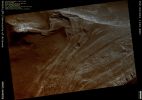
PSP_001662_1520_RED_abrowse.jpgLayered Deposits in Terby Crater (Natural - but enhanced - Colors; credits: Dr Paolo C. Fienga - Lunexit Team)108 visiteTerby Crater is a large (approximately 165 Km), Noachian-aged crater located on the Northern Rim of the Hellas Impact Basin.
Terby hosts a very impressive sequence of predominantly light-toned Layered Deposits, up to 2,5 Km thick that are banked along its Northern Rim and extend toward the center of the Crater.
The full image shows this stack of layered rocks as they are exposed Westward facing scarp. The layered sequence consists of many beds that are repetitive, relatively horizontal and laterally continuous on a kilometer scale. Many beds are strongly jointed and fractured and exhibit evidence of small-scale wind scour.
The light-toned layers are typically at least partially covered with dark mantling material that obscures the layers as well as debris and numerous, meter-scale boulders that have cascaded down slope. The processes responsible for formation of these layers remain a mystery, but could include deposition in water, by the wind, or even volcanic activity.
This HiRISE image is a proposed landing site for the Mars Science Laboratory (MSL) in Terby Crater.MareKromium
|
|
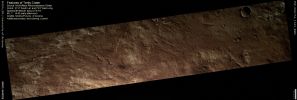
PSP_006752_1525_RED_abrowse-PCF-LXTT2.jpgFeatures of Terby Crater (Absolute Natural Colors; credits for the additional process. and color.: Dr Paolo C. Fienga - Lunexit Team)92 visitenessun commentoMareKromium
|
|

Psp_010259_1525_red.jpgBedrock inside Terby Crater (possible True Colors; credits: Lunar Explorer Italia)82 visiteMars Local Time: 15:40 (middle afternoon)
Coord. (centered): 27,3° South Lat. and 74,3° East Long.
Spacecraft altitude: 260,9 Km (such as about 163,1 miles)
Original image scale range: 52,2 cm/pixel (with 1 x 1 binning) so objects ~1,57 mt across are resolved
Map projected scale: 50 cm/pixel
Map projection: EQUIRECTANGULAR
Emission Angle: 6,4°
Phase Angle: 74,2°
Solar Incidence Angle: 69° (meaning that the Sun is about 21° above the Local Horizon)
Solar Longitude: 136,4° (Northern Summer)
Credits: NASA/JPL/University of Arizona
Additional process. and coloring: Lunar Explorer ItaliaMareKromium
|
|
| 12 immagini su 1 pagina(e) |
|








