| Risultati della ricerca nelle immagini - "Temperature" |

Japetus-temp.1-PIA07006_modest.jpgJapetus Temperature Variation Map64 visiteCaption NASA originale:"This plot shows how daytime temp.s at low latitudes on the Dark Material on Japetus vary with time of day from about 130 Kelvin (-226 F) at noon to about 70 Kelvin (-334 F) at sunset. The observations are compared to a "forecast" model (green line) which predicts temperatures based on an assumed value of a parameter called the "thermal inertia. Rock or solid ice has a high thermal inertia (approx. 2.000.000 as measured in the obscure units used for thermal inertia), meaning that it is good at storing heat and cools down or heats up relatively slowly. On Japetus, in contrast, temperatures drop precipitously in the afternoon as the Sun sinks towards the horizon and a very small value of the thermal inertia (30.000 units) is needed in the model to match the data. This means that Japetus's surface is extremely bad at storing heat and is thus extremely fluffy, probably due to the pulverizing effect of billions of years of meteorite impacts (...)".
|
|
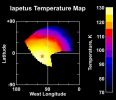
Japetus-temp.2-PIA07005_modest.jpgJapetus Temperature Map62 visiteCaption NASA originale:"Temperatures reach nearly 130 Kelvin (-226 F) at noon on the equator on the dark material that covers most of this side of Japetus, making high noon on Japetus's dark side probably the warmest place in the Saturn System. This is much warmer than temperatures on the moon Phoebe - as measured by the composite infrared spectrometer in June 2004 - which peaked near 112 Kelvin (-258 F). That's because, although Phoebe is almost as dark as Japetus's dark material and absorbs nearly as much sunlight, Phoebe rotates much more quickly (once every 9 hours, compared to 79 days for Japetus). That means the surface has less time to heat up during the day. Temperatures on Japetus' bright material are much colder, peaking near 100 Kelvin (-280 F), both because the bright material absorbs less sunlight and because it is further from the equator on this side of Japetus".
|
|
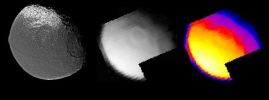
Japetus-temp.3-PIA07004_modest.jpgJapetus Thermal Radiation Image62 visiteCaption NASA originale:"This image of the infrared heat radiation from Saturn's moon Japetus was obtained by the Cassini composite infrared spectrometer instrument 16 hours before Cassini's closest approach to this mysterious moon, on December 31, 2004. The thermal radiation is shown as both a grayscale image, equivalent to what we would see if our eyes were sensitive to infrared wavelengths near 15 microns and as a color-coded temperature map. A previously-released mosaic obtained by Cassini's imaging camera shortly before the composite infrared spectrometer observation, with similar scale and orientation, is also shown for comparison. Temperatures in the large crater near the center of the disc are slightly different from those in surrounding areas, because sloping surfaces within the crater are warmer where they are tilted towards the Sun and cooler when tilted away from the Sun".
|
|

TEMPERATURA SU MARTE.jpgMars Temperatures276 visiteNel frame precedente: un'immagine ad ottima definizione di strisce di luce dal movimento incoerente (rispetto al movimento del Pianeta) nel Cielo di Marte (Raggi Cosmici?) ed in questo frame un grafico meritevole di studio sulle temperature del Pianeta a diverse ore ed altitudini.
Due frames - comunque - molto discutibili.
|
|

ZZ-Z-Temp at EndCrat-15-WC-04-miniTES-B127R1_br.jpgThe temperatures of Endurance Crater214 visitePer questo tipo di immagini ci sembra importante proporVi la caption NASA originale: "The colored dots in this image mosaic denote thermal data in features that make up the impact crater known as "Endurance." The data was taken by the miniature thermal emission spectrometer instrument on NASA's MER Opportunity. The information has been overlaid onto a view of the crater from the rover's NavCam. Blue denotes cooler temperatures of about 220 deg. Kelvin (-63.67 deg. Fahrenheit or -53.15° C) and red denotes warmer temperatures of about 280 deg. Kelvin (44.33 deg. Fahrenheit or 6.85° C)". Questi dati, a causa della loro intrinseca incoerenza e contraddittorietà, ci lasciano davvero senza parole. Ne parleremo ancora.
|
|
|
|
|
| 5 immagini su 1 pagina(e) |
|








