| Risultati della ricerca nelle immagini - "Tempe" |
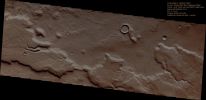
Channels-Tempe_Terra-PCF-LXTT.jpgFeatures of Tempe Terra (Absolute Natural Colors; credits for the additional process. and color.: Dr Paolo C. Fienga)69 visitenessun commentoMareKromium
|
|
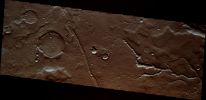
Channels-Unnamed_Channel_in_Tempe_Fossae-MO.jpgUnnamed Channel in Tempe Fossae (Natural Colors/Tri-Chromatic Version; credits: Dr Paolo C. Fienga - Lunexit Team)65 visiteCaption NASA:"The Channel in this VIS image is in the Tempe Fossae Region, just West of Sytinskaya Crater".MareKromium
|
|
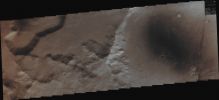
Dunes-Tempe_Terra-PIA15395-PCF-LXTT.jpgDunes in Tempe Terra (Absolute Natural Colors; credits for the additional process. and color.: Drr Gianluigi Barca and Paolo C. Fienga - Lunexit Team)138 visiteOrbit Number: 44792
Latitude: 34,494° North
Longitude: 306,000° East
Instrument: VIS
Captured: January, 19th, 2012
Mars Local Solar Time: 10:39 (Late Morning Hours)
MareKromium
|
|

Japetus-temp.1-PIA07006_modest.jpgJapetus Temperature Variation Map64 visiteCaption NASA originale:"This plot shows how daytime temp.s at low latitudes on the Dark Material on Japetus vary with time of day from about 130 Kelvin (-226 F) at noon to about 70 Kelvin (-334 F) at sunset. The observations are compared to a "forecast" model (green line) which predicts temperatures based on an assumed value of a parameter called the "thermal inertia. Rock or solid ice has a high thermal inertia (approx. 2.000.000 as measured in the obscure units used for thermal inertia), meaning that it is good at storing heat and cools down or heats up relatively slowly. On Japetus, in contrast, temperatures drop precipitously in the afternoon as the Sun sinks towards the horizon and a very small value of the thermal inertia (30.000 units) is needed in the model to match the data. This means that Japetus's surface is extremely bad at storing heat and is thus extremely fluffy, probably due to the pulverizing effect of billions of years of meteorite impacts (...)".
|
|
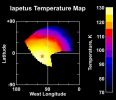
Japetus-temp.2-PIA07005_modest.jpgJapetus Temperature Map62 visiteCaption NASA originale:"Temperatures reach nearly 130 Kelvin (-226 F) at noon on the equator on the dark material that covers most of this side of Japetus, making high noon on Japetus's dark side probably the warmest place in the Saturn System. This is much warmer than temperatures on the moon Phoebe - as measured by the composite infrared spectrometer in June 2004 - which peaked near 112 Kelvin (-258 F). That's because, although Phoebe is almost as dark as Japetus's dark material and absorbs nearly as much sunlight, Phoebe rotates much more quickly (once every 9 hours, compared to 79 days for Japetus). That means the surface has less time to heat up during the day. Temperatures on Japetus' bright material are much colder, peaking near 100 Kelvin (-280 F), both because the bright material absorbs less sunlight and because it is further from the equator on this side of Japetus".
|
|
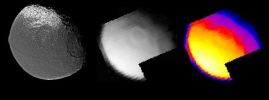
Japetus-temp.3-PIA07004_modest.jpgJapetus Thermal Radiation Image62 visiteCaption NASA originale:"This image of the infrared heat radiation from Saturn's moon Japetus was obtained by the Cassini composite infrared spectrometer instrument 16 hours before Cassini's closest approach to this mysterious moon, on December 31, 2004. The thermal radiation is shown as both a grayscale image, equivalent to what we would see if our eyes were sensitive to infrared wavelengths near 15 microns and as a color-coded temperature map. A previously-released mosaic obtained by Cassini's imaging camera shortly before the composite infrared spectrometer observation, with similar scale and orientation, is also shown for comparison. Temperatures in the large crater near the center of the disc are slightly different from those in surrounding areas, because sloping surfaces within the crater are warmer where they are tilted towards the Sun and cooler when tilted away from the Sun".
|
|

PSP_001390_2290_RED_abrowse.jpgLobate Debris Apron in Tempe Terra/Mareotis Fossae (Natural Colors; credits: Lunexit)117 visiteThis image shows a portion of a large Lobate Debris Apron along the bottom of a hill in the Tempe Terra/Mareotis Fossae Region of Mars.
Debris Aprons were first discovered in Regions of "Fretted Terrain" from analyses of images sent back by the Viking Orbiter Spacecrafts in the 1970s. Features in areas of Fretted Terrain appear "softened" as if some geologic process(es) had smoothed and rounded features that normally would be sharply defined, such the crest of a narrow, steep ridge.
Scientists inferred that the processes causing this degradation must have involved the incorporation and creep of ice in the surface materials. If so, these mixtures of ice and debris could have flowed away from topographically high areas leaving features much less sharply-defined.
The flow behavior described here is similar to slow-moving glacial or permafrost features on Earth. The Debris Apron in this image also has several subtle "ridge" features on its surface from low Sun illumination. The Ridges are roughly parallel to the base of the hill and their shapes mimic one another along their lengths.
Similar Ridges are seen on other Debris Aprons in this Region where the Aprons are located directly below large piles of debris accumulating along the bottom of hillslopes. These observations have led to the hypothesis that Ridges on Debris Aprons are accumulated piles of debris from a period of abnormally high erosion. If this was indeed the case, each Ridge may indicate a change in the climate or local environment that would have implications for our overall understanding of the Martian Climate.MareKromium
|
|

PSP_007930_2310_RED_abrowse-PCF-LXTT.jpgFeatures of Tempe Terra (Absolute Natural Colors; credits for the additional process. and color.: Dr Paolo C. Fienga - Lunexit Team)95 visitenessun commentoMareKromium
|
|
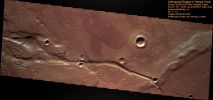
Ridges-Tempe_Terra-20080326a-PCF-LXTT.jpgRidges in Tempe Terra (Absolute Natural Colors; credits for the additional process. and color.: Dr Paolo C. Fienga - Lunexit Team)84 visitenessun commentoMareKromium
|
|

TEMPERATURA SU MARTE.jpgMars Temperatures275 visiteNel frame precedente: un'immagine ad ottima definizione di strisce di luce dal movimento incoerente (rispetto al movimento del Pianeta) nel Cielo di Marte (Raggi Cosmici?) ed in questo frame un grafico meritevole di studio sulle temperature del Pianeta a diverse ore ed altitudini.
Due frames - comunque - molto discutibili.
|
|

Tempel1-U-HST.jpgDeep-impact from HST78 visiteCaption NASA originale:"These 2 pictures of comet Tempel-1 were taken by NASA's HST. They show the comet before and after it ran over NASA's Deep Impact probe".
|
|

Tempel1-VV-nhvcaxf9000910-PIA02131.jpgImpact Time!67 visiteWhen NASA's Deep Impact probe collided with Tempel-1, a bright, small flash was created, which rapidly expanded above the surface of the comet. This flash lasted for more than a second and its overall brightness is close to that predicted by several models. After the initial flash, there was a pause before a bright plume quickly extended above the comet surface. The debris from the impact eventually cast a long shadow across the surface, indicating a narrow plume of ejected material, rather than a wide cone. The Deep Impact probe appears to have struck deep, before gases were heated and explosively released. The impact crater was observed to grow in size over time. A preliminary interpretation of these data indicate that the upper surface of the comet may be fluffy, or highly porous. The observed sequence of impact events is similar to laboratory experiments using highly porous targets, especially those that are rich in volatile substances. The duration of the hot, luminous gas phase, as well as the continued growth of the crater over time, all point to a model consistent with a large crater.
|
|
| 30 immagini su 3 pagina(e) |
1 |
|








