| Risultati della ricerca nelle immagini - "Telescopes" |

G_54-PIA12982_modest.jpgDusty and Dead97 visite"...Without Freedom of Choice, there is no Creativity. And without Creativity, there is no Life..."
dal telefilm"Star Trek" (Serie Classica "Old Timers" - Episodio "Il ritorno degli Arconti")
MareKromium
|
|

Galaxy Cluster 1-E-0657-556.jpg1-E 0657-556 Galaxy Cluster (HST)100 visite"...Le uniche Leggi che sono sucettibili di incutere timore e che quindi sono idonee a perseguire la funzione per cui esse furono create sono quelle che, in caso di una loro violazione, prevedono l'applicazione certa ed immediata di una sanzione.
Ed a tal riguardo mi permetto di sottolineare che non esistono Leggi Buone, né Leggi Cattive e che non fanno parte di questo Mondo né le Sanzioni Blande, né quelle Esemplari: esistono solo Leggi.
Leggi Umane, creati da Uomini e fatte per gli Uomini; Leggi che vanno rispettate...".
Paolo C. Fienga - "Scritti di Cronaca e Sociale"
|
|

IC-1396.jpgIC 1396 - Emission Nebula (full field)88 visite"...You will know the Truth, and the Truth will make you free..."
John - 8:32
|
|

M 42-PIA08653.jpgMoments of M-4274 visiteThis infrared image from NASA's Spitzer Space Telescope shows the Orion nebula, our closest massive star-making factory, 1,450 light-years from Earth. The nebula is close enough to appear to the naked eye as a fuzzy star in the sword of the popular hunter constellation.
The nebula itself is located on the lower half of the image, surrounded by a ring of dust. It formed in a cold cloud of gas and dust and contains about 1,000 young stars. These stars illuminate the cloud, creating the beautiful nebulosity, or swirls of material, seen here in infrared.
In the center of the nebula (bottom inset of figure 1) are four monstrously massive stars, up to 100,000 times as luminous as our sun, called the Trapezium (tiny yellow smudge to the lower left of green splotches. Radiation and winds from these stars are blasting gas and dust away, excavating a cavity walled in by the large ring of dust.
Behind the Trapezium, still buried deeply in the cloud, a second generation of massive stars is forming (in the area with green splotches). The speckled green fuzz in this bright region is created when bullets of gas shoot out from the juvenile stars and ram into the surrounding cloud.
Above this region of intense activity are networks of cold material that appear as dark veins against the pinkish nebulosity (upper inset pf figure 1). These dark veins contain embryonic stars. Some of the natal stars illuminate the cloud, creating small, aqua-colored wisps. In addition, jets of gas from the stars ram into the cloud, resulting in the green horseshoe-shaped globs.
Spitzer surveyed a significant swath of the Orion constellation, beyond what is highlighted in this image. Within that region, called the Orion cloud complex, the telescope found 2,300 stars circled by disks of planet-forming dust and 200 stellar embryos too young to have developed disks.
This image shows infrared light captured by Spitzer's infrared array camera. Light with wavelengths of 8 and 5.8 microns (red and orange) comes mainly from dust that has been heated by starlight. Light of 4.5 microns (green) shows hot gas and dust; and light of 3.6 microns (blue) is from starlight.
|
|

M 42-PIA08654-ed.jpgInfrared Orion66 visiteThis image composite compares infrared and visible views of the famous Orion nebula and its surrounding cloud, an industrious star-making region located near the hunter constellation's sword. The infrared picture is from NASA's Spitzer Space Telescope, and the visible image is from the National Optical Astronomy Observatory, headquartered in Tucson, Ariz.
In addition to Orion, two other nebulas can be seen in both pictures. The Orion nebula, or M42, is the largest and takes up the lower half of the images; the small nebula to the upper left of Orion is called M43; and the medium-sized nebula at the top is NGC 1977. Each nebula is marked by a ring of dust that stands out in the infrared view. These rings make up the walls of cavities that are being excavated by radiation and winds from massive stars. The visible view of the nebulas shows gas heated by ultraviolet radiation from the massive stars.
Above the Orion nebula, where the massive stars have not yet ejected much of the obscuring dust, the visible image appears dark with only a faint glow. In contrast, the infrared view penetrates the dark lanes of dust, revealing bright swirling clouds and numerous developing stars that have shot out jets of gas (green). This is because infrared light can travel through dust, whereas visible light is stopped short by it.
The infrared image shows light captured by Spitzer's infrared array camera. Light with wavelengths of 8 and 5.8 microns (red and orange) comes mainly from dust that has been heated by starlight. Light of 4.5 microns (green) shows hot gas and dust; and light of 3.6 microns (blue) is from starlight.
|
|

M 42-PIA08655-ed.jpgThe "Great Cloud" around Orion67 visiteThis image composite shows a part of the Orion constellation surveyed by NASA's Spitzer Space Telescope. The shape of the main image was designed by astronomers to roughly follow the shape of Orion cloud A, an enormous star-making factory containing about 1,800 young stars. This giant cloud includes the famous Orion nebula (bright circular area in "blade" part of hockey stick-shaped box at the bottom), which is visible to the naked eye on a clear, dark night as a fuzzy star in the hunter constellation's sword.
The region that makes up the shaft part of the hockey stick box stretches 70 light-years beyond the Orion nebula. This particular area does not contain massive young stars like those of the Orion nebula, but is filled with 800 stars about the same mass as the sun. These sun-like stars don't live in big "cities," or clusters, of stars like the one in the Orion nebula; instead, they can be found in small clusters (right inset), or in relative isolation (middle insert).
In the right inset, developing stars are illuminating the dusty cloud, creating small wisps that appear greenish. The stars also power speedy jets of gas (also green), which glow as the jets ram into the cloudy material.
Since infrared light can penetrate through dust, we see not only stars within the cloud, but thousands of stars many light-years behind it, which just happen to be in the picture like unwanted bystanders. Astronomers carefully separate the young stars in the Orion cloud complex from the bystanders by looking for their telltale infrared glow.
The infrared image shows light captured by Spitzer's infrared array camera. Light with wavelengths of 8 and 5.8 microns (red and orange) comes mainly from dust that has been heated by starlight. Light of 4.5 microns (green) shows hot gas and dust; and light of 3.6 microns (blue) is from starlight.
|
|

M 42-PIA08656.jpgOrion's "Sword"66 visiteThis image composite outlines the region near Orion's sword that was surveyed by NASA's Spitzer Space Telescope (white box). The view on the left (figure 1) is from a visible-light telescope, and the view on the right (figure 2) shows infrared light captured by a previous infrared mission, the Infrared Astronomical Satellite.
The Orion nebula, our closest massive star-making factory, is the brightest spot near the hunter's sword. On a dark night, it can appear to the naked eye as a fuzzy star, and it looks like a ghostly blob through a pair of binoculars. The Orion constellation is one of the most prominent winter constellations, and can be seen from all northern latitudes starting in the fall.
Spitzer used its infrared eyes to probe the dusty clouds of a region called Orion cloud A. outlined here in the hockey stick-shaped box (see PIA08655). This giant cloud stretches almost a quarter of the length of the constellation, an area equivalent to 18 full moons. The small box within the hockey stick shows the location of another image released by Spitzer (see PIA08653), which mainly features the Orion nebula itself.
The bright spot that shows up in the infrared view in the area of Orion's belt is known as Orion cloud B. Together, Orion clouds A and B make up the Orion cloud complex. In a survey of this entire complex, Spitzer unearthed 2,300 stars circled by disks of planet-forming dust and 200 stellar embryos too young to have developed disks.
The Infrared Astronomical Satellite was a joint effort between NASA, the Science and Engineering Research Council, United Kingdom and the Netherlands Agency for Aerospace Programmes, the Netherlands. Spitzer has extended the legacy of the satellite by providing much better resolution and sensitivity.
The visible-light image comes courtesy of Howard McCallon of the Infrared Processing and Analysis Center at the California Institute of Technology of Pasadena.
|
|
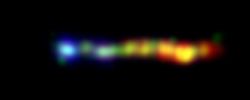
Quasar-3c273-PIA08617.jpgUniversal Rainbow: Quasar 3C27375 visite"...Parler et avoir de l'éloquence ne sont pas la même chose : parler et bien parler sont deux choses distinctes..."
(Original)
"...Talking and eloquence are not the same: to speak, and to speak well, are two things..."
Blaise Pascal - "Pensées"
|
|

Tenth_Planet-00.jpgThe 10th Planet? (1)70 visiteDa "NASA - Picture of the Day", del 31 Luglio 2005:"Is that a Tenth Planet? A faint, slowly moving dot discovered by computer shows clear signs of being a deep Solar System object at least as large as Pluto. The object, designated 2003 UB313, is currently situated nearly 100 times the Earth-Sun distance - over twice the average Pluto-Sun distance. That far out, the only way a single round object could be as bright as 2003 UB313 would be if it is at least as large as Pluto and completely reflective.
Since 2003 UB313 is surely not completely reflective, it could be substantially larger. One of the discovery frames is shown above digitally expanded and artificially brightened. 2003 UB313 was identified initially on frames taken by the automated 1.2-meter Samuel Oschin Telescope at Palomar Observatory in California, USA".
|
|

Tenth_Planet-01.jpgThe 10th Planet? (2)67 visitePerchè escludere a priori, come fa la NASA, che il Decimo Pianeta abbia una superficie TOTALMENTE RIFLETTENTE?
Scusateci la provocazione, ma sarebbe sufficiente ipotizzare - per assurdo, se volete - che questo ipotetico Decimo Pianeta sia:
1) una sfera costituita prevalentemente di ghiaccio (un'eventualità tutt'altro che remota);
2) un corpo capace di emanare luce propria (una piccola stella?);
3) una sfera metallica (ossìa, per esempio, una gigantesca astronave che si trova "parcheggiata" ai confini del Sistema Solare).
Stupidaggini "Cosmiche"? Fantascienza di basso livello? Forse.
Ma se ci pensate (e se conoscete almeno un poco la storia del Sistema Solare e delle meccaniche - per lo più teoriche - che ci hanno permesso di stimarne le dimensioni complessive), l'ipotesi più improbabile (molto in voga negli anni '60/'70 ma poi ritenuta inverosimile ed abbandonata) è proprio quella che immagina il Decimo Pianeta come un corpo roccioso di dimensioni medio-grandi!
|
|
|
|
| 10 immagini su 1 pagina(e) |
|








