| Risultati della ricerca nelle immagini - "Sunspots" |
A-The Sun - sunspot_newton_big.jpgSunspots228 visitenessun commento
|
|

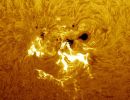
Sunspot-10982.jpgSunspot 1098269 visiteDa "NASA - Picture of the Day", del giorno 6 Febbraio 2008:"A new Solar Cycle has begun on our Sun. Over the past year, the Sun's Magnetic Field has reset and now a new 11 year period is beginning.
Pictured above in a specific color of light emitted by Hydrogen is Sunspot 10982, one of the first sunspots of the new Solar Cycle. The two dark lines visible just above and to either side of the bright sunspot are cool filaments held aloft by the Sun's Magnetic Field. Hot and cold regions are shown as regions of relative light and dark, respectively.
A Solar Cycle is caused by the changing Magnetic Field, and varies from Solar Maximum (when sunspots, coronal mass ejections and flare phenomena are most frequent), to Solar Minimum (meaning when such activity is relatively infrequent).
Solar Minima occurred in 1996 and 2007, while the last Solar Maximum occurred in 2001 (...)".MareKromium
|
|
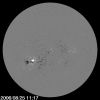
Sunspot-reversed-0.jpgSunspot-905: a sign of an incoming new "Solar Cycle"? (1)70 visiteDa "NASA - Picture of the Day" del 30 Agosto 2006:"Why is sunspot-905 backwards? Perhaps it is a key marker for the beginning of a new Magnetic Cycle on our Sun.
Every 11 years, our Sun goes through a Magnetic Cycle, at the end of which its overall magnetic orientation is reversed. An 11-year Solar Cycle has been observed for hundreds of years by noting peaks and valleys in the average number of sunspots.
Just now, the Sun is near Solar Minimum, and likely to start a long progression toward the most active time, called Solar Maximum, in about 5,5 years".
|
|

Sunspot-reversed-1.jpgSunspot-905: a sign of an incoming new "Solar Cycle"? (2)67 visiteDa "NASA - Picture of the Day" del 30 Agosto 2006:"An indicator that the Sun's magnetic field is reversing is the appearance of sunspots with the reverse magnetic polarity.
A few weeks ago, one small candidate "reverse sunspot" was sited but faded quickly. Now, however, a larger sunspot with negative polarity is being tracked. This sunspot, numbered 905, appears as the unusual white spot in the above magnetic image of the Sun taken with the SOHO spacecraft a few days ago. In the past few days, Sunspot-905 has actually begun to break apart and might also become the source of coronal mass ejections and explosive solar flares.
Solar astronomers predict that the coming Solar Maximum will be unusually active".
|
|

Sunspots - SST.jpgSunspots76 visiteCaption NASA originale:"This stunning image shows remarkable and mysterious details near the dark central region of a planet-sized sunspot in one of the sharpest views ever of the surface of the Sun. Just released, the picture was made using the Swedish Solar Telescope now in its first year of operation on the Canary Island of La Palma. Along with features described as hairs and canals are dark cores visible within the bright filaments that extend into the sunspot, representing previously unknown and unexplored solar phenomena".
|
|

ZA-Sunspot.jpgSunspot and Solar "granules" (detail mgnf)99 visiteCaption NASA originale:"Sometimes, small regions of the Sun appear unusually dark. Visible above is a close-up picture of a sunspot, a depression on the Sun's face that is slightly cooler and less luminous than the rest of the Sun. Sunspots can be larger than the Earth and usually last for only a few days. As you can see, the Sun's face is a bubbling sea of separate cells of hot gas. These cells are known as "granules" and a solar "granule" is about 1000 Km across and "lives" for + or - 10 minutes, then explodes".
|
|
|
|
| 6 immagini su 1 pagina(e) |
|








