| Risultati della ricerca nelle immagini - "Summit" |

ESP_016173_2005_RED_abrowse-1.jpgSmall Shield Volcano with "Summit Caldera" (CTX Frame - Saturated and Enhanced Natural Colors; credits: Dr Paolo C. Fienga - Lunexit Team) 78 visitenessun commentoMareKromium
|
|

ESP_016173_2005_RED_abrowse-3.jpgSmall Shield Volcano with "Summit Caldera" (Saturated and Enhanced Natural Colors; credits: Dr M. Faccin - Lunexit Team)70 visiteAlthough there are a few truly giant Shield Volcanoes on Mars, there are also many smaller ones.
There's a strong interest in imaging the Volcanic Vent Regions of Mars, in order to understand not only the Volcanic Processes themselves, but also to search for any signs of recent activity.
In fact, it has been suggested that active volcanism is one possible explanation for the Methane gas that has been detected in the Atmosphere of Mars.
This HiRISE image shows that the Summit Caldera of a small Shield Volcano is mantled by Dust and covered by tiny Impact Craters. And it is just this last element (such as the existence of Impact Craters all over the Caldera) the one that allows us to believe that there are basically no chances that the imaged Volcano was active recently enough to affect the Atmosphere of Mars through the release of any gas whatsoever.MareKromium
|
|

SOL0488-2N169692705EFFAAE0P0617R0M1.jpgPanorama of rocks, distant horizons and outcrops - Sol 488 (1 - Enhanced Absolute Natural Colors; credits for the additional process. and color.: Dr Paolo C. Fienga - Lunexit Team)157 visitenessun commentoMareKromium
|
|

SOL0488-2N169692806EFFAAE0P0617R0M1.jpgPanorama of rocks, distant horizons and outcrops - Sol 488 (3 - Extremely Enhanced Absolute Natural Colors; credits for the additional process. and color.: Dr Paolo C. Fienga - Lunexit Team)131 visitenessun commentoMareKromium
|
|
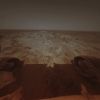
SOL583-PIA04190-PCF-LXTT.jpgWindy Summit - Sol 583 (Absolute Natural Colors; credits for the additional process. and color.: Dr Paolo C. Fienga - Lunexit Team)143 visitenessun commentoMareKromium
|
|

SOL586-Summit_360_L2456atc-A586R1_br2-1.jpgSummit Panorama (1) - Sol 583-58662 visiteThe PanCam on NASA's MER Spirit took the hundreds of images combined into this 360° view, the "Husband Hill Summit" panorama. The images were acquired on Spirit's sols 583 to 586 (Aug. 24 to 27, 2005), shortly after the Rover reached the crest of "Husband Hill" inside Mars' Gusev Crater. This is the largest panorama yet acquired from either Spirit or Opportunity. The PanCam shot 653 separate images in 6 different filters, encompassing the Rover's deck and the full 360° of surface rocks and soils visible to the camera from this position. This is the first time the camera has been used to image the entire Rover deck and visible surface from the same position.
Stitching together of all the images took significant effort because of the large changes in resolution and parallax across the scene.
|
|

SOL586-Summit_360_L2456atc-A586R1_br2-2.jpgSummit Panorama (2) - Sol 583-58662 visiteThis panorama provided the team's first view of the Inner Basin Region, including the enigmatic Home Plate feature seen from orbital data. After investigating the Summit, Spirit drove downhill to get to the Inner Basin Region. Spirit arrived at the Summit from the west, along the direction of the Rover tracks seen in the middle right of the panorama. The peaks of "McCool Hill" and "Ramon Hill" can be seen on the horizon near the center of the panorama. The Summit Region itself is a broad, windswept plateau. Spirit spent more than a month exploring the Summit Region, measuring the chemistry and mineralogy of soils and rocky outcrops at the peak of Husband Hill for comparison with similar measurements obtained during the ascent.
Nota: questo panorama è in approx. true colors. Provate a confrontarlo con un altro panorama, sempre in approx. true colors (sic!) e relativo alla Regione di Erebus Crater (cfr. "Olympia Panorama") e poi provate a chiederVi dove sia la verità...
|
|
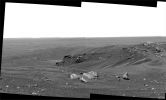
SOL603-A-P2374_R1-A603R1.jpgThe "Sand-Strewn" Summit of Husband Hill (1) - Sol 60370 visiteOriginal caption:"Undulating bands of dark and light sand, sloping dunes, and scattered cobbles form an apron around a ridge of light-colored rock that stands in bold relief against distant plains, as viewed by NASA's Spirit Rover from the top of Husband Hill on Mars. "The view of the summit is spectacular where we are right now", said geologist Larry Crumpler, with the New Mexico Museum of Natural History and Science, Albuquerque.
From here, Spirit is looking North-North/East en route to examining more of the local geology of the Columbia Hills in Gusev Crater. A few days after taking this picture, Spirit investigated the small, sinuous drifts on the left, located north-northeast of the rover's position in this image. The last previous time Spirit examined a drift was on the rim of Bonneville Crater almost 500 Soles ago, in March 2004".
|
|
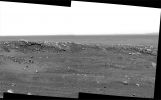
SOL603-B-P2374_R1-A603R1.jpgThe "Sand-Strewn" Summit of Husband Hill (2) - Sol 60364 visiteOriginal caption:"The largest light-colored rock in the foreground is nicknamed Whittaker while the cliff beyond it and slightly to the left is Tenzing. The highest rock on the ridge ahead has been dubbed Hillary. Science team members selected the nicknames in honor of the earliest climbers to scale Mount Everest on Earth.
This view covers approximately 50° of the compass from left to right. It is a mosaic assembled from frames Spirit took with the PanCam on Sol 603 (Sept. 13, 2005). It was taken through a blue (430-nanometer) filter and is presented as a cylindrical projection".
|
|

SOL608-A_P2582_3_L257-A625R1.jpg"Hillary" and "Tenzing" outcrops - Sol 60868 visiteNASA's MER Spirit will not plant a flag, as did Sir Edmund Hillary when he scaled Mount Everest on Earth, when the Rover reaches the hilltop outcrop shown here, which scientists have nicknamed in honor of Hillary. But Spirit will send images and other scientific data across the millions of miles that separate Earth from the distant planet where no human has yet set foot. This false-color view combines images that Spirit took with its PanCam during the Rover's 608th Sol (Sept. 18, 2005). The site is on top of 'Husband Hill' inside Gusev Crater. The component images were taken through the camera's 750-, 530- and 430-nnmt filters.
The slightly lower outcrop to the left of 'Hillary' is nicknamed 'Tenzing.' The names recall the first humans - Hillary of New Zealand and Tenzing Norgay of Nepal - to reach the highest point on Earth, in 1953.
Husband Hill rises 106 meters (348 feet) above the surrounding plains.
|
|
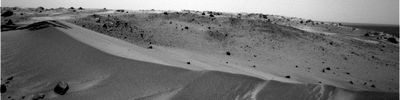
SOL613-2N180781428ESFAENLP1560L0M1.jpgSandy area, on top of the Hill - Sol 61367 visiteC'è poco da offrire per il Sol 613 di Spirit, ma questo frame - a nostro avviso - è comunque piuttosto bello (a dispetto di una definizione, tutto sommato, abbastanza povera) e ci offre, come ormai è d'abitudine, un angolo visuale diverso della sommità di questa piccola collina che, nei mesi, è diventata famosa quasi quanto l'Everest...
|
|
SOL617-2P181138657EFFAEOTP2291L7M1.jpgSandy Panorama (1) - Sol 61765 visiteLa NASA, oggi, 30 Settembre 2005, ha ripreso a fornire alcune (le solite) informazioni contingenti sui frames pubblicati nel Sito Ufficiale MER. Forse qualcuno gli ha ricordato che sono pagati anche per dare informazioni al Pubblico. Che poi queste "informazioni" sìano tutte vere, beh...Questo è un altro discorso.
Comunque, meglio poco che nulla! Ecco i dati "ufficiali" relativi a questo frame:"Left PanCam Non-linearized Full frame EDR acquired on Sol 617 of Spirit's mission to Gusev Crater at approximately 11:55:45 MLT, camera commanded to use Filter 7 (432 nm)".
|
|
| 27 immagini su 3 pagina(e) |
1 |
|








