| Risultati della ricerca nelle immagini - "Strike" |
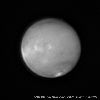
1010_Mars-Possible_Volcanic_Phenomenon-20-March-2012-03.gifPowerful Meteor Strike or Massive Volcanic Event on Mars? 1 - GIF Movie; Credits: Wayne Jaeschke165 visiteThe event captured by Astro photographer Wayne Jaeschke on the night of March 20, 2012, is certainly epochal, whatever its cause might be.
But let's try to understand something and, at the same time, try to make some informed speculation.
So: these are definitely not "normal" cloud formations. Their altitude (note that their tops are already visible while they are still behind the visible portion of Mars, as to Earth), configuration and direction, in fact, rule out this possibility.
Clouds, as such, follow the motion of the planet to which they refer (that is, they generally follow longitudinal movements), and therefore position themselves, relative to an observer, as parallel or semi-parallel to the observed horizon plane and all this applies even if one observes clouds driven by jet streams (these are the so-called "super-rotating clouds", such as clouds traveling faster than the orbital velocity of the reference planet).MareKromium
|
|
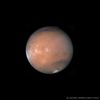
1011_Mars-Possible_Volcanic_Phenomenon-20-March-2012-01.jpgPowerful Meteor Strike or Massive Volcanic Event on Mars? (2) Credits: Wayne Jaeschke108 visiteThe formations observed in this instance are actually "pillars" that appear to extend in a radius from a surface point not visible there. Pillar-like clouds, however, besides being a unique and rare event, have never been observed on Mars, as far as we know. Instead, we have some Dust & Smoke Pillars recorded by the now defunct Mars Global Surveyor probe, which our Lunexit Research Group, as well as other highly regarded researchers and scientists, interpreted as evidence of residual volcanic activity (because they were, after all, small columns).MareKromium
|
|
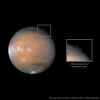
1012_Mars-Possible_Volcanic_Phenomenon-20-March-2012-02.jpgPowerful Meteor Strike or Massive Volcanic Event on Mars? (3) Credits: Wayne Jaeschke202 visiteIn this case, one must first note the extraordinary similarity between the Martian Event and the famous Anomalous Lunar Event photographed by my friend (professional photographer) from Milan, Alessandro della Torre.
In that case, NASA, after having outlined various responses, concluded that, essentially, "since it couldn't have been any known phenomenon, it was evidently a phenomenon that never happened," thereby ruling out any exotic hypothesis or one capable of causing dangerous oscillations in currently consolidated scientific knowledge (we quote: "...it can't be a volcanic event because the Moon is geologically dead...") or dangerous emotional/catastrophic tendencies (we quote again: "...it can't be a meteor impact because otherwise, given the scale of the event, we would have noticed it on our own...").
I believe that NASA's reasoning style (but in this case, "reasoning" is a strong word) is unacceptable and is also, if you'll pardon my comment, quite arrogant and obscurantist. So I put it aside.MareKromium
|
|
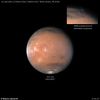
1013_Mars-Possible_Volcanic_Phenomenon-20-March-2012-04.jpgPowerful Meteor Strike or Massive Volcanic Event on Mars? (4) Credits: Wayne Jaeschke197 visiteGiven that it will be difficult to discover the Absolute Truth (if we ever discover it), let's say this: the configuration of the Anomaly makes us more than reasonably think of a meteoric phenomenon of vast proportions.
If this were the case, given that the approximate coordinates of the Event are estimable (in fact, we have them, and the Event occurred on Acidalia Planitia), we would simply have to point the eyes of at least one of the Automatic Probes orbiting Mars at Acidalia and search for a new (or more...), very fresh, impact crater(s).
If, however, it had been a volcanic event (but NOT a residual one, judging by its size!), it would not have been difficult for us to take a look again, always using one of the Probes orbiting Mars, at the Acidalia Region (and also Tharsis, just to be safe), and then verify the status of the volcanoes present there.MareKromium
|
|
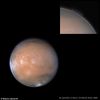
1014_Mars-Possible_Volcanic_Phenomenon-20-March-2012-05.jpgPowerful Meteor Strike or Massive Volcanic Event on Mars? (5) Credits: Wayne Jaeschke197 visiteNot to be overlooked, however, is the fact that the extremely strong winds constantly sweeping the Martian atmosphere would have dissipated the smoke and vapors rather quickly, had it indeed been an explosive volcanic event (even if it were a large-scale one).
It would have taken longer, however, to dissipate the dust raised by a possible meteor impact (or a multiple one, judging by the shape and direction of the Pillars).
In any case, to see the phenomenon still in progress, the electronic eyes of the probes we have on site would have had to operate rapidly; let's say within 24-36 hours of discovery. Which — alas! — was not done (for reasons I simply cannot fathom).
I have no further evidence, so I stop here.
My favorite hypothesis? A multiple meteor impact (a medium-sized comet or a cluster of small-sized meteorites). However, I decided to name this event as "MTP" (Martian Transient Phenomenon). And to Posterity the Arduous Sentence!
p.s.: now let's go see another MTP over Arsia Mons...MareKromium
|
|
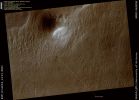
ESP_014264_2235_RED_abrowse-00.jpgSigns of a possible (and recent) "Mid-Air Meteor Strike" (CTX Frame - Natural Colors; credits: Lunexit)73 visitenessun commentoMareKromium
|
|
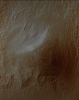
ESP_014264_2235_RED_abrowse-01.jpgSigns of a possible (and recent) "Mid-Air Meteor Strike" (EDM - Natural Colors; credits: Dr G. Barca & Lunexit)81 visiteIn questo EDM, ottimamente curato - come sempre - dal nostro Dr Barca, si può vedere l'evidente "scurimento" (che qualcuno potrebbe anche chiamare "bruciatura") del suolo, senza che però sia possibile scorgere un (anche di modestissime dimensioni) cratere da impatto.
Questa situazione (bruciatura del suolo, presenza di veri detriti di origine indeterminabile e mancanza di cratere) abbiamo deciso di battezzarla come "Mid-Air Meteor Strike", ossìa effetto di collisione meteorica avvenuta a mezz'aria (ergo, SENZA impatto - se non altro nel senso più tecnico della parola).
Una curiosità: la NASA ha classificato/titolato questo frame come "New Crater with Ice". Curioso: poichè noi non riusciamo a vedere nè il cratere in questione (tantomeno un cratere che sia "new"...), nè il ghiaccio (il quale, vista la Latitudine di cui si parla, comunque risulterebbe difficilmente visibile in superficie - se non altro in assenza di nevicate recenti).
Cosa ne pensiamo? Che anche alla NASA sbagliano...MareKromium
|
|
|
| 7 immagini su 1 pagina(e) |
|








