| Risultati della ricerca nelle immagini - "Streak" |
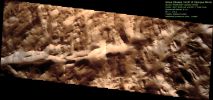
Chaotic_Terrain-Slope_Streaks-PCF-LXTT.jpgSlope Streaks (Enhanced and Saturated Natural Colors; credits for the additional process. and color.: Dr Paolo C. Fienga - Lunexit Team)70 visitenessun commentoMareKromium
|
|

Craters-Unnamed_Crater-PIA06699-PCF-LXTT.jpgDark Slope Streaks (Natural Colors; credits for the additional process. and color.: Dr Paolo C. Fienga - Lunexit Team)147 visiteCaption NASA:"Dark Slope Streaks are a common feature on the Slopes thickly-mantled by Dust in the Tharsis, Arabia, and Western Amazonis Planitia egions of Mars. Less common are light-toned Slope Streaks, which often occur in the same area as Dark Streaks. They are most common in Arabia Terra, and some are shown in this MGS image. Slope Streaks are probably the result of sudden Avalanches of extremely dry Dust. The behavior of the avalanching dust is somewhat fluid-like and it is a phenomenon often observed during the Martian year.
MareKromium
|
|
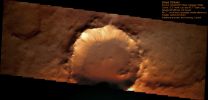
Craters-Unnamed_Crater_in_Terra_Sabaea-20071122a-PCF-LXTT.jpgUnnamed Crater in Terra Sabaea (Absolute Natural Colors; credits for the additional process. and color.: Dr Paolo C. Fienga - Lunar Explorer Italia)79 visiteCaption NASA:"The Dark Slope Streaks on the Interior Rim of this Unnamed Crater located in Terra Sabaea mark those places where the upper layer of Dust has been removed, exposing the darker rock beneath". MareKromium
|
|

Craters-Unnamed_Crater_with_Dark_Slope_Streaks-HC-MO-PCF-LXTT.jpgDark Slope Streaks (Saturated Natural Colors; credits for the additional process. and color.: Dr Paolo C. Fienga - Lunexit Team)66 visiteSource: NASA/2001 Mars Odyssey Orbiter
Coord.: 13,6° North Lat. and 21,2° East Long. (center of the frame)
Credits: NASA/JPL/Arizona State University (ASU)
Additional process. and color.: Lunar Explorer ItaliaMareKromium
|
|
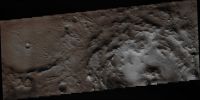
Craters-Unnamed_Crater_with_Dark_Slope_Streaks-PIA14997-PCF-LXTT.jpgOld and Highly Degraded Unnamed Northern Crater (Enhanced and Sharpened Absolute Natural Colors; credits for the additional process. and color.: Dr Paolo C. Fienga - Lunexit Team)224 visiteOrbit Number: 43578
Latitude: 21,5399° North
Longitude: 31,9211° East
Instrument: VIS
Captured: October, 11th, 2011
Mars Local Time (M.L.T.): 12:39 (Early Afternoon)
MareKromium
|
|

Craters-Unnamed_Crater_with_Dunefield_and_Windstreak-PIA07508-PCF-LXTT.jpgImpact Crater and Windstreak (Saturated Natural Colors; credits for the additional process. and color.: Dr Paolo C. Fienga - Lunar Explorer Italia)70 visiteCaption NASA:"This MGS-MOC image shows a 1,2-Km-diameter North mid-latitude crater with a bright wind streak".
Location near: 30,8° North Lat. and 131,8° West Long.
Image width: ~3 Km (~1,9 mi)
Illumination from: lower left
Season: Northern SummerMareKromium
|
|
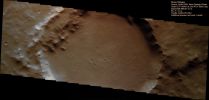
Craters-Unnamed_Crater_with_Slope_Streaks-TS-20080611a-PCF-LXTT.jpgUnnamed Crater with Slope Streaks (Natural Colors; credits for the additional process. and color.: Dr Paolo C. Fienga - Lunexit Team)100 visitenessun commentoMareKromium
|
|

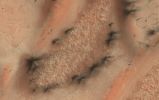
ESP_016032_2600_RED_abrowse-00.jpgNorthern Spring (CTX Frame - Natural Colors; credits: Dr Paolo C. Fienga - Lunexit Team)65 visiteIn the Winter a layer of Carbon Dioxide (CO2) ice (such as Dry Ice) covers the North Polar Sand Dunes.
In the Spring the sublimation of the ice causes a host of uniquely Martian Phenomena.MareKromium
|
|
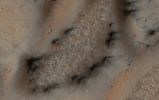
ESP_016032_2600_RED_abrowse-01.jpgNorthern Spring (EDM - Natural Colors; credits: Dr Paolo C. Fienga - Lunexit Team)65 visiteIn this EDM, Streaks of dark Basaltic Sand have been carried from below the ice layer to form Fan-shaped Deposits on top of the seasonal ice.
The similarity in the directions of the fans suggests that they formed at the same time, when the wind direction and speed was the same. They often form along the boundary between the dune and the Surface below the Dunes.MareKromium
|
|
ESP_016032_2600_RED_abrowse-02.jpgNorthern Spring (EDM - Natural Colors; credits: NASA/JPL/Univ. of Arizona)66 visitenessun commentoMareKromium
|
|
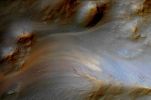
ESP_016136_1525_RED_abrowse-01.jpgColourful Streaks (EDM - possible True Colors; credits: NASA/JPL/Univ. of Arizona and Dr Paolo C. Fienga - Lunexit Team)88 visiteIn this enhanced True Color EDM, we see colorful Streaks, where the bedrock is eroding, moving downhill a bit, then getting swept by the wind.MareKromium
|
|
ESP_022255_1095_RED_abrowse-PCF-LXTT.jpgSouthern Dunefield (Enhanced Natural Colors; credits for the additional process. and color.: Dr Paolo C. Fienga - Lunexit Team)109 visitenessun commentoMareKromium
|
|
| 31 immagini su 3 pagina(e) |
1 |
|








