| Risultati della ricerca nelle immagini - "St." |

OPP-SOL1167-PIA10210-1.jpgCape St. Vincent (natural - but sligthly darkened - colors; MULTISPECTRUM processing; credits: Lunexit)69 visiteCaption NASA:"The cliff in this image from Opportunity's PanCam is informally named Cape St. Vincent. It is a promontory approx. 12 mt (39 feet) tall on the Northern Rim of Victoria Crater, near the farthest point along the Rover's traverse around the rim. Layers seen in Cape St. Vincent have proven to be among the best examples of meter scale cross-bedding observed on Mars to date. Cross-bedding is a geologic term for rock layers which are inclined relative to the horizontal and which are indicative of ancient sand dune deposits. In order to get a better look at these outcrops, Pancam Super-Resolution (SR) imaging techniques were utilized.
SR is a type of imaging mode which acquires many pictures of the same target to reconstruct a digital image at a higher resolution than is native to the camera.
These SR images have allowed scientists to discern that the rocks at Victoria Crater once represented a large Dunefield, not unlike the Sahara desert on Earth, and that this Dunefield migrated with an ancient wind flowing from the North to the South across the Region. Other Rover chemical and mineral measurements have shown that many of the ancient sand dunes studied in Meridiani Planum were modified by surface and subsurface liquid water long ago.
This is a Mars Exploration Rover Opportunity PanCam image acquired on Sol 1167 (May 7, 2007), and was constructed from a mathematical combination of 16 different blue filter (480 nm) images".MareKromium
|
|
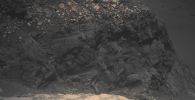
OPP-SOL1213-PIA10211-1.jpgCape St. Mary (natural - but highly darkened - colors; MULTISPECTRUM processing; credits: Lunexit)64 visiteCaption NASA:"Another of the best examples of spectacular cross-bedding in Victoria Crater are the outcrops at Cape St. Mary, which is an approx. 15 mt (45 foot) high promontory located along the Western Rim of Victoria Crater and near the beginning of the Rover's traverse around the rim. Like the Cape St. Vincent images, these Pancam Super-Resolution images have allowed scientists to discern that the rocks at Victoria Crater once represented a large dune field that migrated across this region.
This is a Mars Exploration Rover Opportunity PanCam image mosaic acquired on Sol 1213 (June 23, 2007), and was constructed from a mathematical combination of 32 different blue filter (480 nm) images".
Nota Lunexit: attraverso il darkening del frame originale e l'esaltazione dei contrasti, riteniamo di poter dire - con un ragionevole margine di certezza - che il "Paving" (di Victoria come di Endurance) ed il "Boulders Carpet" (tappeto di macigni) che paiono caratterizzare l'outer rim di questi Crateri, posseggono un'albedo molto più alta delle pareti dei Crateri stessi ed un colore molto più vicino all'argento/arancio, piuttosto che al giallo/cenere. Questi indizi, a nostro parere, sono il possibile indice di una matrice cristallina dei rilievi in questione (vetrificazione?); una matrice che potrebbe essere "responsabile" dei curiosi giochi di colore che i Crateri Victoria ed Endurance sembrano generare allorchè viene tentata la colorizzazione di frames ottenuti in particolari ore del giorno (e cioè con luci radenti e/o con luci perpendicolari al rim dei Crateri).MareKromium
|
|
|
|
| 2 immagini su 1 pagina(e) |
|








