| |
| Risultati della ricerca nelle immagini - "St" |

00230-StarSurface.jpgThe "Star" (High-Def-3D; credits: Dr M. Faccin & Lunar Explorer Italia)178 visitenessun commentoMareKromium
|
|

0050.jpgSteps... (ctx frame - High-Def-3D; credits: Dr M. Faccin & Lunar Explorer Italia)200 visiteOsservate attentamente i due rilievi che sembrano formare un "8", alla Vostra Dx...Si tratta di due crateri (probabilmente secondari), decisamente rotondeggianti e, si direbbe, non molto profondi.
Nulla di strano, quindi?
Guardate meglio: guardate, soprattutto, il cratere che si trova più in basso rispetto al punto di osservazione e quindi, se non notate ancora nulla, andate a vedere il prossimo frame...MareKromium
|
|

0051.jpgSteps... (edm - High-Def-3D; credits: Dr M. Faccin & Lunar Explorer Italia)293 visiteDifficile spiegare rilievi come questo conservando intatte Razionalità e Pragmatismo...La nostra opinione? Ci sono dei "gradoni" (una sorta di "gradoni"...), effettivamente, sul margine inferiore del cratere più prossimo al punto di osservazione i quali ci lasciano perplessi.
Ci lasciano perplessi a causa della loro linearità e regolarità; ci lasciano perplessi a causa delle loro fattezze; ci lasciano perplessi - infine - anche in sede di contestualizzazione (non siamo lontani, infatti, dal rilievo a "V" di cui si è già detto).
Sarà stata, questa, una Regione Mineraria (in un remoto passato)?
O forse questi rilievi sono le evidenze di processi biomagnetici ancora in atto (come suggerisce il Dr Feltri)?
Oppure si tratta solo di illusioni ottiche e sviste?
Secondo noi la realtà è solo una: in questo frame ci sono (e si vedono - BENE) dei rilievi a forma di gradoni.
Essi esistono.
Ma quale sia il loro significato, la loro natura ed il loro scopo...nessuno, ad oggi, lo può dire.
Nessuno.MareKromium
|
|
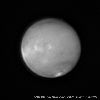
1010_Mars-Possible_Volcanic_Phenomenon-20-March-2012-03.gifPowerful Meteor Strike or Massive Volcanic Event on Mars? 1 - GIF Movie; Credits: Wayne Jaeschke165 visiteThe event captured by Astro photographer Wayne Jaeschke on the night of March 20, 2012, is certainly epochal, whatever its cause might be.
But let's try to understand something and, at the same time, try to make some informed speculation.
So: these are definitely not "normal" cloud formations. Their altitude (note that their tops are already visible while they are still behind the visible portion of Mars, as to Earth), configuration and direction, in fact, rule out this possibility.
Clouds, as such, follow the motion of the planet to which they refer (that is, they generally follow longitudinal movements), and therefore position themselves, relative to an observer, as parallel or semi-parallel to the observed horizon plane and all this applies even if one observes clouds driven by jet streams (these are the so-called "super-rotating clouds", such as clouds traveling faster than the orbital velocity of the reference planet).MareKromium
|
|
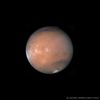
1011_Mars-Possible_Volcanic_Phenomenon-20-March-2012-01.jpgPowerful Meteor Strike or Massive Volcanic Event on Mars? (2) Credits: Wayne Jaeschke108 visiteThe formations observed in this instance are actually "pillars" that appear to extend in a radius from a surface point not visible there. Pillar-like clouds, however, besides being a unique and rare event, have never been observed on Mars, as far as we know. Instead, we have some Dust & Smoke Pillars recorded by the now defunct Mars Global Surveyor probe, which our Lunexit Research Group, as well as other highly regarded researchers and scientists, interpreted as evidence of residual volcanic activity (because they were, after all, small columns).MareKromium
|
|
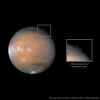
1012_Mars-Possible_Volcanic_Phenomenon-20-March-2012-02.jpgPowerful Meteor Strike or Massive Volcanic Event on Mars? (3) Credits: Wayne Jaeschke202 visiteIn this case, one must first note the extraordinary similarity between the Martian Event and the famous Anomalous Lunar Event photographed by my friend (professional photographer) from Milan, Alessandro della Torre.
In that case, NASA, after having outlined various responses, concluded that, essentially, "since it couldn't have been any known phenomenon, it was evidently a phenomenon that never happened," thereby ruling out any exotic hypothesis or one capable of causing dangerous oscillations in currently consolidated scientific knowledge (we quote: "...it can't be a volcanic event because the Moon is geologically dead...") or dangerous emotional/catastrophic tendencies (we quote again: "...it can't be a meteor impact because otherwise, given the scale of the event, we would have noticed it on our own...").
I believe that NASA's reasoning style (but in this case, "reasoning" is a strong word) is unacceptable and is also, if you'll pardon my comment, quite arrogant and obscurantist. So I put it aside.MareKromium
|
|
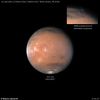
1013_Mars-Possible_Volcanic_Phenomenon-20-March-2012-04.jpgPowerful Meteor Strike or Massive Volcanic Event on Mars? (4) Credits: Wayne Jaeschke197 visiteGiven that it will be difficult to discover the Absolute Truth (if we ever discover it), let's say this: the configuration of the Anomaly makes us more than reasonably think of a meteoric phenomenon of vast proportions.
If this were the case, given that the approximate coordinates of the Event are estimable (in fact, we have them, and the Event occurred on Acidalia Planitia), we would simply have to point the eyes of at least one of the Automatic Probes orbiting Mars at Acidalia and search for a new (or more...), very fresh, impact crater(s).
If, however, it had been a volcanic event (but NOT a residual one, judging by its size!), it would not have been difficult for us to take a look again, always using one of the Probes orbiting Mars, at the Acidalia Region (and also Tharsis, just to be safe), and then verify the status of the volcanoes present there.MareKromium
|
|
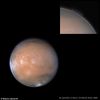
1014_Mars-Possible_Volcanic_Phenomenon-20-March-2012-05.jpgPowerful Meteor Strike or Massive Volcanic Event on Mars? (5) Credits: Wayne Jaeschke196 visiteNot to be overlooked, however, is the fact that the extremely strong winds constantly sweeping the Martian atmosphere would have dissipated the smoke and vapors rather quickly, had it indeed been an explosive volcanic event (even if it were a large-scale one).
It would have taken longer, however, to dissipate the dust raised by a possible meteor impact (or a multiple one, judging by the shape and direction of the Pillars).
In any case, to see the phenomenon still in progress, the electronic eyes of the probes we have on site would have had to operate rapidly; let's say within 24-36 hours of discovery. Which — alas! — was not done (for reasons I simply cannot fathom).
I have no further evidence, so I stop here.
My favorite hypothesis? A multiple meteor impact (a medium-sized comet or a cluster of small-sized meteorites). However, I decided to name this event as "MTP" (Martian Transient Phenomenon). And to Posterity the Arduous Sentence!
p.s.: now let's go see another MTP over Arsia Mons...MareKromium
|
|

ALPHA CENTAURI.jpgAlpha Centauri - European Southern Obs.194 visite"...Ho visto una Stella sorgere, dalle profondità del Mare, ed ergersi, luminosa, sino alla sommità del Cielo.
Una Nuova Stella che splende su di noi, che ci guarda, ci osserva, ci scruta. Una Nuova Stella che illuminerà nuovi Percorsi, Pensieri, Passioni, Opere ed Omissioni.
Ho visto una Stella sorgere, dalle profondità del Mare, e perdersi, nei crepacci dell'Infinito. Grande la Luce emessa e l'Energia, breve il Tempo concessole.
Povera Stella..."
Paolo Catello Fienga - "Usque Ad Sidera"
|
|

APOLLO 12 AS 12-46-6793.jpgAS 12-46-6793 - A very strange mound (1)205 visiteUna prima immagine di una possibile struttura superficiale "anomala". Perché "anomala"?
Per la (quantomeno apparente) esistenza di simmetrie bilaterali, decisamente chiare in questa immagine scattata da una distanza di circa 20/25 metri (forse anche qualcosa di più...) dal target.
Un lato della "collinetta" appare leggermente più liscio dell'altro. Ma siamo ancora troppo lontani per avanzare ipotesi. Avviciniamoci ancora un poco...
|
|

APOLLO 12 AS 12-46-6794.jpgAS 12-46-6794 - A very strange mound (2)206 visite...adesso siamo a circa 7 metri dal target. Da questo angolo visuale, la struttura che ci troviamo davanti non sembra davvero un'opera della Natura: la simmetria esistente fra i due lati corti di questa sorta di tumulo di pietra sembra evidente e tale configurazione non deve essere sfuggita neppure ai due astronauti (Bean e Conrad) i quali, dopo essersi ulteriormente avvicinati, scatteranno - da svariati angoli visuali e da diverse distanze - un numero davvero elevato di fotografie di questo particolare "dettaglio" della superficie della Luna.
|
|

APOLLO 12 AS 12-46-6795.jpgAS 12-46-6795 - A very strange mound (3)191 visiteDa questa ulteriore immagine (l'astronauta si è spostato leggermente sulla sua Dx, presumiamo proprio per verificare - otticamente - l'esistenza di una simmetria bilaterale) la "struttura" ci appare in tutta la sua curiosa apparenza.
Alcuni Ricercatori hanno subito ipotizzato l'artificialità dell'Anomalia superficiale e, in effetti, l'immagine che abbiamo davanti sembra davvero confermare questa impressione.
E' evidente che si tratta di una stranissima configurazione del suolo (che ha colpito ed interessato anche gli astronauti), ma che questo "tumulo" possa effettivamente essere opera delle "mani" di qualcuno, in tutta onestà, ci pare davvero azzardato asserirlo (almeno in questo momento ed in difetto di ulteriori e più chiari indizi).
|
|
| 208 immagini su 18 pagina(e) |
1 |
 |
|
|
|
|
|
|
|
|
|
|
|








