| Risultati della ricerca nelle immagini - "Spiders" |

ESP_011711_0930_RED_abrowse.jpgSouth Polar Spiders (Natural Colors; credits: Lunar Explorer Italia)82 visitenessun commentoMareKromium
|
|

ESP_013049_0950_RED_abrowse.jpgSouth Polar Spiders (Natural Colors; credits: Lunar Explorer Italia)80 visiteThis image is part of an ongoing seasonal monitoring effort in this location in the Southern Polar Region of Mars.
Mars’ South Polar Region changes significantly during the Martian Year. During the Southern Hemisphere’s Winter, the Polar Cap increases dramatically as the lowered temperatures make a large portion of the Atmosphere freeze out into ice.
As Spring approaches and the Polar Region begins to warm once again, the Cap recedes revealing terrains like those visible in this image. The polygonal features in this image are termed “Spiders” and their origin is still unknown (although there are several hypotheses).
One possible hypothesis for the black fan-shaped features is that they may be formed by a geyser-like process. As the Sun heats the ground layer below the Carbon Dioxide ice, the ice on the bottom begins to sublimate, or turn directly from a solid to a gas.
This gas then builds up in pressure as more of it sublimates, until a critical pressure is achieved and it erupts through the ice layer much as a geyser would, spewing the debris that is thought to make up the dark fan shaped features.MareKromium
|
|
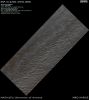
ESP_014282_0930_RED_abrowse-00.jpgSpiders (CTX Frame - Natural Colors; credits: Lunexit)75 visitenessun commentoMareKromium
|
|
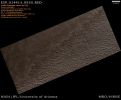
ESP_014413_0930_RED_abrowse-00.jpgRadial Channels carved by CO2 - a.k.a.: The "Spiders" (CTX Frame - Natural Colors; credits: Lunexit)75 visiteMars’ Carbon Dioxide-based Atmosphere partially condenses every Winter to form Polar Caps of Dry Ice (CO2). In the Spring, the evaporation/sublimation of the ice is a dynamic process and carves Channels into the ground as it escapes back into the Atmosphere.
Often these Channels are radial in nature and are colloquially refered to as “Spiders” although the prefered term for these radially-organized channels is “Araneiform” (which means spider-like).MareKromium
|
|
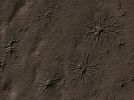
ESP_014413_0930_RED_abrowse-01.jpgRadial Channels carved by CO2 - a.k.a.: The "Spiders" (EDM - Natural Colors; credits: Lunexit)76 visiteIn this EDM we can see, now that all the seasonal frost is gone, the actual appearence of the "Spiders" and we can both use stereo images (when available) or shadows (if any) to measure the depth of the Channels carved into the ground (which, by the way, are usually 1 or 2 meters deep).MareKromium
|
|

ESP_020954_0935_RED_abrowse-PCF-LXTT.jpgSouth Polar "Spiders" (Absolute Natural Colors; credits: Dr Paolo C. Fienga - Lunexit Team)445 visitenessun commentoMareKromium
|
|
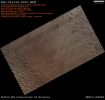
ESP_022259_0935_RED_abrowse.jpgCracks near Spider-like Features in Ice-free "Manhattan Zone" (Absolute Natural Colors; credits for the additional process. and color.: Dr Paolo C. Fienga - Lunexit Team)312 visitenessun commentoMareKromium
|
|
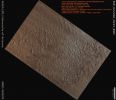
ESP_022260_0935_RED_abrowse.jpgCracks near Spider-like Features in Ice-free "Manhattan Zone" (Absolute Natural Colors; credits for the additional process. and color.: Dr Paolo C. Fienga - Lunexit Team)323 visitenessun commentoMareKromium
|
|

ESP_022998_0980_RED_abrowse-PCF-LXTT.jpgErosional South Polar Features (Natural Colors; credits for the additional process. and color.: Dr Paolo C. Fienga - Lunexit Team)149 visitenessun commentoMareKromium
|
|
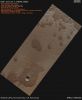
ESP_023117_0980_RED_abrowse-PCF-LXTT.jpgErosional South Polar Features (Natural Colors; credits for the additional process. and color.: Dr Paolo C. Fienga - Lunexit Team)164 visitenessun commentoMareKromium
|
|

PIA10145-CrypticTerrain~0.jpgCryptic Terrain (MULTISPECTRUM; credits: Lunexit)91 visiteThere is an enigmatic Region near the South Pole of Mars known as the "cryptic" terrain. It stays cold in the Spring, even as its albedo darkens and the Sun rises in the sky.
This Region is covered by a layer of translucent seasonal CO2 ice that warms and evaporates from below. As CO2 gas escapes from below the slab of seasonal ice it scours dust from the surface. The gas vents to the surface, where the dust is carried downwind by the prevailing wind.
The channels carved by the escaping gas are often radially organized and are known informally as "spiders". MareKromium
|
|
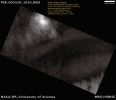
PSP_003520_1010_RED_abrowse-00.jpgSouth Polar Spiders (ctx frame - MULTISPECTRUM-2; credits: Lunexit)65 visiteThis image is located in the South Polar Region of Mars and we can see “spiders” likely caused by the sublimation of Carbon Dioxide ice.
As this happens, the gas moves through channels until it reaches the surface and vents out. These vents show up as the dark streaks because they carry dust and dirt up to the surface.MareKromium
|
|
| 23 immagini su 2 pagina(e) |
1 |
|








