| Risultati della ricerca nelle immagini - "Spallanzani" |

Craters-Spallanzani_Crater-MGS-00.JPGLayered "Mesa" inside Spallanzani Crater (Original NASA/MGS/MSSS b/w Frame)70 visiteCaption NASA originale:"This MGS-MOC image shows a layered, light-toned Mesa among other Layered Materials exposed in a mound that covers much of the Floor of Spallanzani Crater".
Location near: 58,3° South Lat. and 273,9° West Long.
Image width: ~3 Km (~1,9 mi)
Illumination from: upper left
Season: Southern Summer
|
|

Craters-Spallanzani_Crater-MGS-01.jpgLayered "Mesa" inside Spallanzani Crater (Natural Colors; credits for the additional process. and color.: Dr Paolo C. Fienga - Lunexit Team)206 visiteCaption NASA originale:"This MGS-MOC image shows a layered, light-toned Mesa among other Layered Materials exposed in a mound that covers much of the Floor of Spallanzani Crater".
Location near: 58,3° South Lat. and 273,9° West Long.
Image width: ~3 Km (~1,9 mi)
Illumination from: upper left
Season: Southern Summer MareKromium
|
|
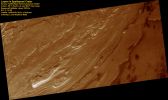
PSP_003442_1215_RED_browse-00.jpgLayers in Spallanzani Crater (context image)67 visiteThis image shows light-toned layered deposits along the floor of Spallanzani crater, a 72 Km (about 45 mile) diameter crater located just South-East of Hellas Planitia.
These layered deposits may be remnant sediments once deposited within the crater. Mechanisms for sediment deposition include windblown debris, airfall volcanic ash, or sediments that accumulated in a lake on the crater floor.
The slopes are covered in debris, and not fallen plates or blocks from the plateau edge.
This suggests that the layers are composed of weak materials that are protected by a stronger, more coherent surface.
The crater is named after the 18th Century Italian biologist, Lazzaro Spallanzani (1729-1799).
MareKromium
|
|
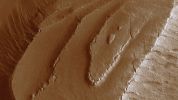
PSP_003442_1215_RED_browse-01.jpgLayers in Spallanzani Crater (extra-detail mgnf)110 visiteThe layers within Spallanzani Crater are eroding in a stair-stepped pattern.
Each layer appears as a sequence of a broad flat area or plateau, which drops off abruptly down to the next flat surface (see this extra-detail mgnf).
This stair-stepped pattern suggests that the layers have discreet boundaries that may be the result of differing compositions, time of deposition, or both. Near, but not at the edge of each plateau, the material is fracturing into polygonal plates or blocks that tilt downward away from the plateau center. MareKromium
|
|
| 4 immagini su 1 pagina(e) |
|








