| Risultati della ricerca nelle immagini - "Spacecraft" |
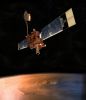
00-A-Mars_Global_Surveyor.jpgMars Global Surveyor72 visiteMars Global Surveyor was launched in 1996 on a mission designed to study Mars from orbit for two years. It accomplished many important discoveries during nine years in orbit. On Nov. 2, 2006, the spacecraft transmitted information that one of its arrays (---> pannelli) was not pivoting (--> ruotando) as commanded.
Loss of signal from the MGS Orbiter began on the following orbit.
Mars Global Surveyor has operated longer at Mars than any other spacecraft in history and for more than four times as long as the prime mission originally planned.
NASA has recently formed an internal review board to look more in-depth into why NASA's Mars Global Surveyor went silent in November 2006 and recommend any processes or procedures that could increase safety for other spacecraft.
|
|
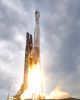
00-LRO-0001.jpgLiftoff...To the Moon!67 visitenessun commentoMareKromium
|
|

00-LRO-0002.jpgLiftoff...To the Moon!69 visitenessun commentoMareKromium
|
|
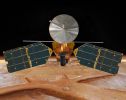
00-MRO-front-view_br~0.jpgHere is the "Mars Reconnaisance Orbiter"119 visiteThis artist's concept of the Mars Reconnaissance Orbiter features the spacecraft's main bus facing down, toward the red planet. The large silver circular feature above the spacecraft bus is the high-gain antenna, the spacecraft's main means of communicating with both Earth and other spacecraft. The long, thin pole behind the bus is the SHARAD antenna. Seeking liquid or frozen water, SHARAD will probe the subsurface using radar waves at a 15-25 MHz frequency band, "seeing" in the first few hundreds of feet (up to 1 kilometer) of Mars' crust. The large instrument (covered in black thermal blanketing) in the center is the HiRISE camera. This powerful camera will provide the highest-resolution images from orbit to date.
The other easily visible instruments are: the Electra telecommunications package which is the gold-colored instrument directly left of the HiRISE camera. It will act as a communications relay and navigation aid for Mars spacecraft. To the right of the HiRISE camera is the Context Imager (CTX).
|
|

00-PhoenixLiftoff.jpgThe beginning...94 visiteCaption NASA:"Can Mars sustain life? To help answer this question, last week NASA launched the Phoenix Mission to Mars. In May 2008, Phoenix is expected to land in an unexplored North Polar Region of Mars that is rich in water-ice. Although Phoenix cannot move, it can deploy its cameras, robotic arm, and a small chemistry laboratory to inspect, dig, and chemically analyze its landing area. One hope is that Phoenix will be able to discern telling clues to the history of ice and water on Mars. Phoenix is also poised to explore the boundary between ice and soil in hopes of finding clues of a habitable zone there that could support microbial life.
Phoenix has a planned lifetime of 3 months on the Martian surface".MareKromium
|
|
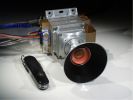
0008-Phoenix-Mike.jpgOne, Two, Three...TESTING!66 visiteThe unmistakable presence of a microphone, next to one of the cameras equipped with the Phoenix Probe, suggests even more interesting scenarios: the Friends of Pasadena don't just want photographs and "cooking" experiments (assuming they can be done, sooner or later...): they also want "sounds" from Mars!
What kind? Perhaps the wind... Maybe other things too.
The Lunexit STAFF's intuition when, years ago, we thought the idea of an "Audio-File" from Mars might even be a good idea.
And if it is, then Phoenix does NOT have exclusive rights to the sound... Believe me!MareKromium
|
|

001-Kaguya-20071009_kaguya_02l.jpgRstar Separation from Kaguya (1) - before separation109 visiteKAGUYA consists of the Main Orbiter and two small satellites (Relay Satellite and VRAD Satellite). The Main Orbiter will reach the vicinity of the Moon. Once it has reached the Moon, it will be placed into a peripolar orbit at an altitude of 100 Km. The Relay Satellite will be placed in an elliptic orbit at an apogee of 2400 Km, and will relay communications between the Main Orbiter and the ground station.
The VRAD Satellite will play a significant role in measuring the gravitational field around the Moon.
The Main Orbiter will be employed for about one year and will observe the entire Moon.
(in this picture: on the left is the Rstar, and on the right is the VRAD Satellite).MareKromium
|
|

002-Kaguya-20071009_kaguya_03l.jpgRstar Separation from Kaguya (2) - after separation68 visiteCaption JAXA:"The Rstar has been released and moving toward the upper left of the image.
The right one, the VRAD satellite, was scheduled to be released on Oct. 12th, 2007).MareKromium
|
|

0210-TheSpacecraft.jpgThe "Triangular Spacecraft" (High-Def-3D; credits: Dr M. Faccin & Lunar Explorer Italia)133 visitenessun commentoMareKromium
|
|

A-IN-SIGHT_00.jpgHere is the Lander!130 visiteInSight (acronym for "Interior Exploration using Seismic Investigations, Geodesy and Heat Transport"), is a Mars Lander designed to give the Red Planet its first thorough checkup. It is the first Outer Space Robotic Explorer to study in-depth the "inner space" of Mars: its crust, mantle, and core.
The "InSight" Lander uses cutting edge instruments, to delve deep beneath the Surface and seek the fingerprints of the processes that formed the terrestrial planets.
It does so by measuring the Planet's "vital signs": its "pulse" (seismology), "temperature" (heat flow), and "reflexes" (such as: precision tracking).
This Project is part of NASA's Discovery Program for highly focused science missions that ask critical questions related to the Solar System.MareKromium
|
|

A-Phoenix-000.jpgThe (fully assembled) Phoenix Mars Lander68 visitenessun commentoMareKromium
|
|
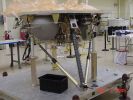
A-Phoenix-001.jpgThe Phoenix Lander: Hot-Fire Test Mock-Up65 visitenessun commentoMareKromium
|
|
| 367 immagini su 31 pagina(e) |
1 |
 |
|
|
|
|
|
|
|
|
|








