| Risultati della ricerca nelle immagini - "Soft" |
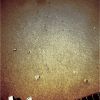
OPP-SOL1668-1N276264911EFF90__P1983L0M1.jpgMeridiani's Surface - Sol 1668 (possible True Colors; credits: Lunexit)65 visitenessun commentoMareKromium
|
|

OPP-SOL819-1M200889076EFF70VMP2936M2M1.jpgThe texture of the surface (1) - Sol 81963 visiteCaption NASA originale:"Microscopic Imager Non-linearized Full frame EDR acquired on Sol 819 of Opportunity's mission to Meridiani Planum at approximately 11:53:14 MLT. Microscopic Imager dust cover commanded to be OPEN".
|
|

OPP-SOL819-1M200889346EFF70VMP2936M2M1.jpgThe texture of the surface (2) - Sol 81963 visiteCaption NASA originale:"Microscopic Imager Non-linearized Full frame EDR acquired on Sol 819 of Opportunity's mission to Meridiani Planum at approximately 11:57:37 MLT. Microscopic Imager dust cover commanded to be OPEN".
|
|

OPP-SOL819-1M200889616EFF70VMP2936M2M1.jpgThe texture of the surface (3) - Sol 81963 visiteCaption NASA originale:"Microscopic Imager Non-linearized Full frame EDR acquired on Sol 819 of Opportunity's mission to Meridiani Planum at approximately 12:02:00 MLT. Microscopic Imager dust cover commanded to be OPEN".
|
|

OPP-SOL819-1M200889911EFF70VMP2936M2M1.jpgThe texture of the surface (4) - Sol 81965 visiteCaption NASA originale:"Microscopic Imager Non-linearized Full frame EDR acquired on Sol 819 of Opportunity's mission to Meridiani Planum at approximately 12:06:47 MLT. Microscopic Imager dust cover commanded to be OPEN".
|
|
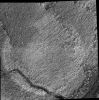
OPP-SOL819-PIA08499.jpgCheyenne - Sol 81977 visiteCaption originale:"As NASA's MER Opportunity is traversing southward toward Victoria Crater, it is periodically stopping to characterize exposed bedrock, using the contact instrument suite on the RA.
Between Soles 818 and 821 of the mission (such as from May 13 up to May 16), one such characterization was carried out on a rock target called Cheyenne. The target was brushed by the RAT, analyzed by the Alpha Particle X-ray Spectrometer and Moessbauer Spectrometer and photographed by the MI.
This image is a mosaic of 4 frames taken by the MI after the brush had removed dust and sand grains from most of the area shown, exposing the underlying bedrock. The resolution is 30 microns per pixel and the entire mosaic is 6 cm (about 2,4") square. Opportunity acquired the images on Sol 819 (May 14, 2006) while the target was fully shadowed.
This rock surface exhibits relatively small spherical concretions compared to those observed in the vicinity of "Eagle Crater" and "Endurance Crater." Such small concretions, and in places apparent absence of concretions, have characterized the outcrops south of "Vostok Crater." Also visible in this image are small pits and grooves in the rock surface, including narrow, elongated void spaces different from any previously observed by Opportunity. Crystal-shaped and elongated void spaces that were seen in the vicinity of Eagle and Endurance Craters are interpreted as spaces left by dissolving of soluble salts. However, these features at Cheyenne have a significantly different appearance and the science team is considering a number of alternative hypotheses for their origin.
|
|
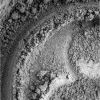
SOL830-2M200051480EFFAR00P2956M2M1.jpgThe "Mark" (1) - Sol 83063 visiteCaption NASA originale:"Microscopic Imager Non-linearized Full frame EDR acquired on Sol 830 of Spirit's mission to Gusev Crater at approximately 13:27:05 MLT; Microscopic Imager Dust Cover commanded to be OPEN".
Nota: si tratta di sabbia Marziana (e dunque arida e polverosa - per definizione) oppure questa è sabbia raccolta in prossimità del mare, magari nei pressi di qualche splendida spiaggia tropicale (una sabbia dunque umida e del tutto priva di polvere)? Che cosa stiamo guardando?
|
|
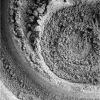
SOL830-2M200052049EFFAR00P2956M2M1.jpgThe "Mark" (2) - Sol 83064 visiteCaption NASA originale:"Microscopic Imager Non-linearized Full frame EDR acquired on Sol 830 of Spirit's mission to Gusev Crater at approximately 13:36:19 MLT; Microscopic Imager dust cover commanded to be OPEN".
|
|
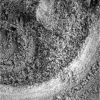
SOL830-2M200052766EFFAR00P2936M2M1.jpgThe "Mark" (3) - Sol 83089 visiteCaption NASA originale:"Microscopic Imager Non-linearized Full frame EDR acquired on Sol 830 of Spirit's mission to Gusev Crater at approximately 13:47:56 MLT; Microscopic Imager dust cover commanded to be OPEN.
|
|
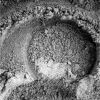
SOL830-2M200053418EFFAR00P2956M2M1.jpgThe "Mark" (4) - Sol 83066 visiteCaption NASA originale:"Microscopic Imager Non-linearized Full frame EDR acquired on Sol 830 of Spirit's mission to Gusev Crater at approximately 13:56:52 MLT; Microscopic Imager dust cover commanded to be OPEN".
|
|

SOL830-2M200053513EFFAR00P2956M2M1.jpgThe "Mark" (5) - Sol 83072 visiteCaption NASA originale:"Microscopic Imager Non-linearized Full frame EDR acquired on Sol 830 of Spirit's mission to Gusev Crater at approximately 14:00:04 MLT; Microscopic Imager dust cover commanded to be OPEN".
|
|
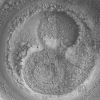
SOL830-PIA08455.jpgThe "Mark" (full mosaic) - Sol 83077 visiteThe grinding teeth have worn away on the rock abrasion tool of NASA's MER Spirit (after exposing interiors of five time more rock targets than its design goal of three rocks) but the tool still has useful wire bristles for brushing targets. In this image, a figure-eight-like imprint in the Martian soil marks the spot where Spirit has begun examining subsurface deposits layer by layer. The circular indentations resulted from brushing by the RAT, one of several instruments on the Rover's RA. As an effective brushing tool it is now fulfilling a soil profiling experiment on a target called "Progress". The experiment is a multi-step process of carefully brushing away fine layers of soil and then using the Moessbauer and Alpha particle X-ray Spectrometers, MI, and PanCam to examine the exposed surfaces during the long Martian Winter.
This view is a mosaic of exposures taken by Spirit's MI during the Rover's 830th Sol (such as (May 4, 2006). The total area shown here is about 6 cm (such as 2,4") square.
|
|
| 19 immagini su 2 pagina(e) |
1 |
|








