| Risultati della ricerca nelle immagini - "Side" |
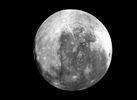
000-The Moon from Clem.JPG014 - Light-up the Moon!81 visiteMosaic of the near side of the Moon lit by Earthshine, as imaged by a Startracker camera on March 15, 1994.
The Southern Hemisphere is up.
The bright crater toward the top of the image is Tycho.
|
|

015-The Moon from Clem-FarSide-PIA00304.jpg002 - The Far-Side of the Moon97 visiteClementine Project Information
--------------------------------------------------------------------------------
Clementine was a joint project between the Strategic Defense Initiative Organization and NASA. The objective of the mission was to test sensors and spacecraft components under extended exposure to the space environment and to make scientific observations of the Moon and the near-Earth asteroid 1620 Geographos. The observations included imaging at various wavelengths including ultraviolet and infrared, laser ranging altimetry, and charged particle measurements. These observations were originally for the purposes of assessing the surface mineralogy of the Moon and Geographos, obtaining lunar altimetry from 60N to 60S latitude, and determining the size, shape, rotational characteristics, surface properties, and cratering statistics of Geographos.
Clementine was launched on 25 January 1994 at 16:34 UTC (12:34 PM EDT) from Vandenberg AFB aboard a Titan IIG rocket. After two Earth flybys, lunar insertion was achieved on February 21. Lunar mapping took place over approximately two months, in two parts. The first part consisted of a 5 hour elliptical polar orbit with a perilune of about 400 km at 28 degrees S latitude. After one month of mapping the orbit was rotated to a perilune of 29 degrees N latitude, where it remained for one more month. This allowed global imaging as well as altimetry coverage from 60 degrees S to 60 degrees N.
After leaving lunar orbit, a malfunction in one of the on-board computers on May 7 at 14:39 UTC (9:39 AM EST) caused a thruster to fire until it had used up all of its fuel, leaving the spacecraft spinning at about 80 RPM with no spin control. This made the planned continuation of the mission, a flyby of the near-Earth asteroid Geographos, impossible. The spacecraft remained in geocentric orbit and continued testing the spacecraft components until the end of mission.
More information on the Clementine mission, instruments, and early results can also be found in the Clementine special issue of Science magazine, Vol. 266, No. 5192, December 1994.
|
|

017-The Moon from Clem-NearSide-PIA00302.jpg003 - The Near-Side of the Moon85 visiteAbout 50.000 Clem images were processed to produce the 4 orthographic views of the Moon. Images PIA00302, PIA00303, PIA00304 and PIA00305 show albedo variations (normalized brightness or reflectivity) of the surface at a wavelength of 750 nm (just longward of visible red). The Lunar Near-Side is a contrast between dark and light albedo surfaces that has been fancied as the "Man in the Moon". Lunar terrain types are still designated by their 17th century name and that is:
1. Maria (dark albedo features also known as basins) and
2. Terra (brighter albedo features also known as uplands or highlands).
The Maria constitutes about 16% while the Terra 84% of the Lunar Surface. The nearside is composed of about 30 percent maria. Extensive bright ray systems surround craters Copernicus (upper left center) and Tycho (near bottom).
Studies have shown that two major processes, impact and basaltic volcanism have shaped the major physical features of the Lunar Surface.
|
|

APOLLO 16 AS 16-131-20163 HR-2.jpgAS 16-131-20163 - The Moon (HR)107 visitenessun commento
|
|
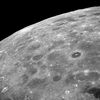
APOLLO 8 AS 08-12-2192.jpgAS 08-12-2192 - The "Far-Side" of the Moon...is not "too far"! (1)117 visitenessun commento
|
|

APOLLO 8 AS 08-13-2225 HR.jpgAS 08-13-2225 - The "Far-Side" of the Moon...is not "too far"! (2)136 visitePer gli Anomaly Hunters: in questo frame HR Apollo 8, fra i dettagli dei grandi crateri ripresi ed i più modesti "crater-clusters" che si vedono un pò ovunque, lo spazio per le "curiosità" (non chiamiamole - almeno per adesso - "Singolarità" e/o "Anomalìe") è abbondante...
|
|
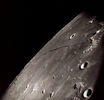
APOLLO 8 AS 08-13-2344.jpgAS 08-13-2344 - The "Far-Side" of the Moon...is not "too far"! (3)126 visitenessun commento
|
|

Eartshine.JPG024 - Earthshine78 visiteThe Clementine Startracker acquired this image of the Moon glowing from the reflected light of the Earth.
|
|

FarSideAlbedo.jpg006 - Farside Albedo71 visiteGlobal map of the albedo from the 750-nanometer filter of the Clementine UV-VIS camera and this is the FarSide of the Moon, shown in Lambert equal-area projection.
Note the lack of maria on the FarSide, as compared to the NearSide.
The relatively dark area at center-bottom outlines the extent of the South Pole-Aitken Basin. This view has been subsampled to a resolution of about 1 Km per pixel, about 5 times lower than the full-resolution data.
|
|

Luna-01.jpgLunar Far Side115 visiteUnder the Surface fine-grained Regolith, superpositions among these Crater Materials and mare Basalt Units establish shallow Regolith Stratigraphic sequences. The low-frequency data (CH-1, 60 MHz) show a deep Stratigraphic Structure to the depth of approx. 360 mt that indicates the previous Geological evolution history of the Von Kármán Crater.
The LPR results (will) provide an important scientific basis for understanding the Geological History of the Far Side of the Moon.MareKromium
|
|

Moon_Full-STB.jpg026 - Earthshine83 visitenessun commento
|
|

NearsideAlbedo.JPG007 - Nearside Albedo74 visiteGlobal map of the albedo from the 750-nanometer filter of the Clementine UV-VIS camera. This is the NearSide of the Moon, shown in Lambert equal-area projection.
Note the familiar appearance of the maria; the fresh, rayed crater near bottom center is Tycho.
This view has been subsampled to a resolution of about 1 Km per pixel, about 5 times lower than the full-resolution data.
|
|
| 113 immagini su 10 pagina(e) |
1 |
 |
|
|
|
|
|
|
|








