| Risultati della ricerca nelle immagini - "Scarp" |
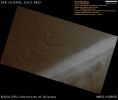
ESP_014306_1015_RED_abrowse.jpgBounding Scarp (Natural Colors; credits: Lunexit)69 visitenessun commentoMareKromium
|
|
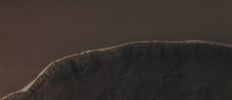
ESP_024559_2640-PCF-LXTT-00.jpgNorth Polar Scarp (CTX Frame "A" - Absolute Natural Colors; credits for the additional process. and color.: Dr Paolo C. Fienga - Lunexit Team)244 visiteMars Local Time: 13:00 (early afternoon)
Coord. (centered): 83,9° North Lat. and 234,9° East Long.
Spacecraft altitude: 319,0 Km (such as about 199,4 miles)
Original image scale range: 31,9 cm/pixel (with 1 x 1 binning) so objects ~ 96 cm across are resolved
Map projected scale: 25 cm/pixel
Map projection: POLAR STEREOGRAPHIC
Emission Angle: 4,9°
Phase Angle: 73,2°
Solar Incidence Angle: 76° (meaning that the Sun is about 14° above the Local Horizon)
Solar Longitude: 19,2° (Northern Spring)
Credits: NASA/JPL/University of Arizona
Additional process. and coloring: Lunar Explorer ItaliaMareKromium
|
|
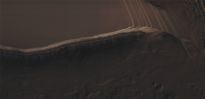
ESP_024559_2640-PCF-LXTT-01.jpgNorth Polar Scarp (CTX Frame "B" - Absolute Natural Colors; credits for the additional process. and color.: Dr Paolo C. Fienga - Lunexit Team)240 visiteMars Local Time: 13:00 (early afternoon)
Coord. (centered): 83,9° North Lat. and 234,9° East Long.
Spacecraft altitude: 319,0 Km (such as about 199,4 miles)
Original image scale range: 31,9 cm/pixel (with 1 x 1 binning) so objects ~ 96 cm across are resolved
Map projected scale: 25 cm/pixel
Map projection: POLAR STEREOGRAPHIC
Emission Angle: 4,9°
Phase Angle: 73,2°
Solar Incidence Angle: 76° (meaning that the Sun is about 14° above the Local Horizon)
Solar Longitude: 19,2° (Northern Spring)
Credits: NASA/JPL/University of Arizona
Additional process. and coloring: Lunar Explorer ItaliaMareKromium
|
|

ESP_024560_2650-PCF-LXTT.jpgNorth Polar Scarp (Absolute Natural Colors; credits for the additional process. and color.: Dr Paolo C. Fienga - Lunexit Team)264 visiteMars Local Time: 12:19 (early afternoon)
Coord. (centered): 85,0° North Lat. and 197,2° East Long.
Spacecraft altitude: 317,3 Km (such as about 198,3 miles)
Original image scale range: 63,5 cm/pixel (with 2 x 2 binning) so objects ~ 1 mt and 90 cm across are resolved
Map projected scale: 50 cm/pixel
Map projection: POLAR STEREOGRAPHIC
Emission Angle: 0,1°
Phase Angle: 77,0°
Solar Incidence Angle: 77° (meaning that the Sun is about 13° above the Local Horizon)
Solar Longitude: 19,2° (Northern Spring)
Credits: NASA/JPL/University of Arizona
Additional process. and coloring: Lunar Explorer ItaliaMareKromium
|
|

ESP_024563_2640-PCF-LXTT.jpgNorth Polar Scarp (Absolute Natural Colors; credits for the additional process. and color.: Dr Paolo C. Fienga - Lunexit Team)254 visiteMars Local Time: 12:49 (early afternoon)
Coord. (centered): 83,9° North Lat. and 122,8° East Long.
Spacecraft altitude: 320,5 Km (such as about 200,3 miles)
Original image scale range: 64,1 cm/pixel (with 2 x 2 binning) so objects ~ 1 mt and 92 cm across are resolved
Map projected scale: 50 cm/pixel
Map projection: POLAR STEREOGRAPHIC
Emission Angle: 0,2°
Phase Angle: 75,9°
Solar Incidence Angle: 76° (meaning that the Sun is about 14° above the Local Horizon)
Solar Longitude: 19,3° (Northern Spring)
Credits: NASA/JPL/University of Arizona
Additional process. and coloring: Lunar Explorer ItaliaMareKromium
|
|
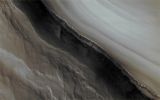
ESP_025010_2650-PCF-LXTT-IPF.jpgOn the North Polar Scarp (EDM - Absolute Natural Colors; credits for the additional process. and color. Dr Paolo C. Fienga/Lunar Explorer Italia/Italian Planetary Foundation)89 visiteThis image, taken by the NASA - Mars Reconnaissance Orbiter in the late November of the AD 2011, was acquired in order to monitor the effects on the North Polar Scarp of the so-called "Frost Avalanches" that occurred the year prior. HiRISE often re-images certain areas of Mars so to track those changes which, over time, might have occurred in some particularly interesting Regions and, in this case, the NASA People wanted to photograph the North Polar Scarp near the onset of the Martian Springtime, so to get a better understanding, among other things, of the number, extent and frequency of these Frost Avalanches; their possible causes (beside the thawing ---> the fact that Ice, Snow, or other frozen substances, start to become liquid, or just soft, as a result of warming) and the role that they have in the evolution of the North Poalr Scarp itself.
It is a fact that, even though the HiRISE has captured the occurrence of many other Frost Avalanches in the past, their view never ceases to amaze, since it demonstrates (but we, as IPF, just like many other Researchers and Scientists all over the World, had no doubts about it) that there still are, even at present time, several Active Geologic and Atmospheric Processes which keep happening (or regular bases) on the Red Planet. And this one, in other words, is just "one of the many"...
Mars Local Time: 12:33 (Early Afternoon)
Coord. (centered): 84,995° North Lat. and 151,528° East Long.
Spacecraft altitude: 320,4 Km (such as about 200,2 miles)
Original image scale range: 32,1 cm/pixel (with 1 x 1 binning) so objects ~ 96 cm across are resolved
Map projected scale: 25 cm/pixel
Map projection: POLAR STEREOGRAPHIC
Emission Angle: 0,5°
Phase Angle: 71,1°
Solar Incidence Angle: 71° (meaning that the Sun was about 19° above the Local Horizon at the time the picture was taken)
Solar Longitude: 35,4° (Northern Spring - Southern Fall)
Credits: NASA/JPL/University of Arizona
Additional process. and coloring: Lunar Explorer Italia
This picture (which is a cropped and NON-Map Projected NASA - Original Mars Reconnaissance Orbiter CTX b/w frame, identified by the serial n. ESP_025010_2650) has been additionally processed and then colorized in Absolute Natural Colors (such as the colors that a human eye would actually perceive if someone were onboard the NASA - Mars Reconnaissance Orbiter and then looked down, towards the Surface of Mars), by using an original technique created - and, in time, dramatically improved - by the Lunar Explorer Italia Team.MareKromium
|
|

ESP_027451_2635_RED-PCF-LXTT-IPF.jpgFeatures of the North Polar Regions (Absolute Natural Colors; credits for the additional process. and color.: Dr Paolo C. Fienga/Lunexit Team)111 visiteThere is an Ice-Sheet at the North Pole of Mars that is a few miles thick at its center. At some places (like in this image) it ends in steep Cliffs that can be about 800 meters (2600 feet) high.
The Slopes of these Cliffs are almost vertical, which causes "Slab-like Blocks" of Ice to periodically (and, actually, quite often) break off and crash down onto the Surrounding Plains.
A dense Network of Cracks covers these Icy Cliff faces, thus making it easier for these Blocks to break free. New piles of Debris (located at the base of many of these Cliffs) have appeared in successive HiRISE images, and so the MRO Team shall regularly monitor sites like this in order to check for new Blocks that might have fallen. Understanding how these Cliffs are formed can help Scientists to better understand the "Climatic Record" which are stored in the Ice-Sheet itself.
Mars Local Time: 13:44 (Early Afternoon)
Coord. (centered): 83,618° North Lat. and 119,827° East Long.
Spacecraft altitude: 320,5 Km (such as about 200,3 miles)
Original image scale range: 32,1 cm/pixel (with 1 x 1 binning) so objects ~ 96 cm across are resolved
Map projected scale: 25 cm/pixel
Map projection: POLAR STEREOGRAPHIC
Emission Angle: 0,1°
Sun - Mars - MRO (or "Phase") Angle: 62,8°
Solar Incidence Angle: 63° (meaning that the Sun is about 27° above the Local Horizon)
Solar Longitude: 120,0° (Northern Summer - Southern Winter)
Credits: NASA/JPL/University of Arizona
Additional process. and coloring: Lunar Explorer ItaliaMareKromium
|
|

North_Polar_Features-North_Polar_Margin-Chasma_Boreale-PIA07052-PCF-LXTT.jpgNorth Polar "Scarp" (Absolute Natural Colors; credits for the additional process. and color.: Dr Paolo C. Fienga - Lunexit Team)254 visiteCaption NASA:"This 1,6 meters (~5 feet) per pixel Mars Global Surveyor (MGS) Mars Orbiter Camera (MOC) image shows a typical North Polar Scarp and associated dark windblown Sand Dunes. Layers of material -- possibly Dust and Ice -- are exposed by the Scarp. The small white patches in the image are remnants of seasonal Frost. When this North Polar image was acquired in late September 2004, most of the Polar Frost had sublimed away. This image is located near 85,1° North Lat. and 210,8°West Longitude. The scene covers an area of approximately 3 Km (about 1,9 mi) across, and is illuminated by sunlight from the lower left.MareKromium
|
|

North_Polar_Scarp-Psp_001341_2650_red.jpgNorth Polar Scarp80 visitenessun commentoMareKromium
|
|
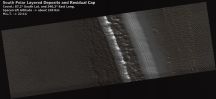
PSP_002856_0875_red-PCF-LXTT.jpgSouth Polar Layered Deposits and Scarp (Absolute Natural Colors; credits: Dr Paolo C. Fienga - Lunexit Team)131 visitenessun commentoMareKromium
|
|
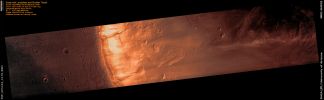
PSP_005343_2170_RED_abrowse-00~0.jpgScarp with Landslides and Boulder Tracks (context frame; natural colors - elab. Lunexit)72 visiteThis observation shows an equatorial scarp (cliff) with possible landslides and boulder tracks.
The cliff has several distinct layers visible near its top. There is a smoother, possibly fine-grained layer on top, underlain by a relatively bright and a dark layer. It is possible that the entire cliff face consists of layers but that erosion has not exposed others yet.
There are two main landslide scars, locations where a landslide has carved into the slope. Both of the scars have boulder tracks, several of which have boulders at their ends as they progress down the slope or reach the end of the slope.MareKromium
|
|
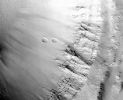
PSP_005343_2170_RED_abrowse-01.jpgScarp with Landslides and Boulder Tracks (extra-detail mgnf)65 visiteThis subimage - or extra-detail mgnf - (approx. 480 meters across) shows boulder tracks from the landslide scar on the left side of the image.
Some boulders can be seen forming trails along the slope at the top part of the subimage, while others can be seen at the end of their trails (...).MareKromium
|
|
| 20 immagini su 2 pagina(e) |
1 |
|








