| Risultati della ricerca nelle immagini - "SPL" |

Clouds-M0904025-PCF-LXTT-2.jpgLow-altitude Clouds over Chasma Australe (Absolute Natural Colors; credits for the additional process. and color.: Dr Paolo C. Fienga - Lunexit Team)130 visitenessun commentoMareKromium
|
|
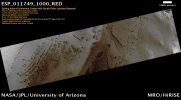
ESP_011749_1000_RED_abrowse.jpgSpring View of Unnamed Crater with South Polar Layered Material (Natural Colors; credits: Lunar Explorer Italia)90 visitenessun commentoMareKromium
|
|

ESP_012934_1070_RED_abrowse.jpgTroughs and Scarps in Planum Australe (Natural Colors; credits: Lunar Explorer Italia)79 visiteThis image shows an outcrop of the South Polar Layered Deposits (SPLD). The SPLD consist of layers of ice and admixed dust and make up the bulk of the dome-shaped Planum Australe.
Planum Australe is, in some ways, analogous to the Antarctic ice sheet. Troughs and scarps carved into Planum Australe by erosional processes have exposed SPLD layers within it.
In this image, the darkest area at the bottom of the image is the bottom of the Scarp. Except for the dark material at the bottom of the slope, much of the changes in brightness in this image are due to the lighting angle, such as the direction from which the Sun is illuminating the slope.
Much like ice cores from Greenland and Antarctica and deep sea sediment cores, the icy-dusty layers of the SPLD may have preserved a record of recent Mars Climate History. Understanding that record is a complex process and involves, among many other types of analyses, examining the differences and similarities in appearance between each layer and attempting to classify layer types. This image shows nice examples of different layer textures. But what is especially interesting about this image are the Faults cutting through the Layers. These Faults appear as diagonal lines, on either side of which, the layering is offset.
Note that the Faults are not clean, single lines, but appear in long groups of short lines. What caused these Faults is still under investigation, but, among other possibilities, they could be related to an earlier time when temperatures were higher and the ice was flowing at a much faster rate than it is today.MareKromium
|
|
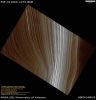
ESP_013066_1070_RED_abrowse.jpgFault in the South Polar Layered Deposits (Natural Colors; credits: Lunar Explorer Italia)83 visitenessun commentoMareKromium
|
|

ESP_013329_1070_RED_abrowse.jpgSouth Polar Layered Deposits (Natural Colors; credits: Lunar Explorer Italia)78 visiteThe Ice Caps on Mars are surrounded by a thick stack of Layered Deposits. HiRISE and other instruments have shown that these layers are composed of dusty ice. Now imagine this stack of layers as a cake with alternating layers.
What happens if someone comes and takes a big scoop out of the middle of the cake? Well, while our first reaction might be to get mad at them for ruining the cake, take a moment to think what the pattern would look like: it would have rings going round and round the hole. This is what we are seeing in this image of Mars.
The same pattern that you can see HERE!
Therefore, what you see in this frame is just the consequence of some erosional process which has scooped a big hole into the Layered Deposits.MareKromium
|
|
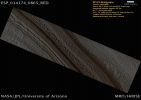
ESP_014174_0865_RED_abrowse.jpgSouth Polar Layered Deposits' (SPLD) Stratigraphy (Natural Colors; credits: Lunexit)67 visitenessun commentoMareKromium
|
|

ESP_014334_0945_RED_abrowse.jpgPolar Layered Deposits Stratigraphy near Chasma Australe (Natural Colors; credits: Lunexit)74 visitenessun commentoMareKromium
|
|

ESP_014342_0930-01.jpgSouth Polar Residual Cap Intraseasonal Change Monitoring (EDM n.1 - Natural Colors; credits: Lunexit)74 visitenessun commentoMareKromium
|
|

ESP_014416_0950_RED_abrowse.jpgSouth Polar Layered Deposits (Natural Colors; credits: Lunexit)79 visitenessun commentoMareKromium
|
|
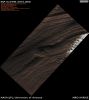
ESP_021996_0935_RED_abrowse-PCF-LXTT.jpgSouth Polar Layered Deposits near Chasma Austale (Absolute Natural Colors; credits for the additional process. and color.: Dr Paolo C. Fienga - Lunexit Team)234 visitenessun commentoMareKromium
|
|
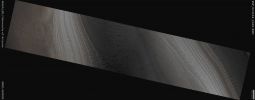
ESP_023164_1020_RED_abrowse-PCF-LXTT-00.jpgFeatures of the SPLD (CTX Frame - Absolute Natural Colors; credits for the additional process. and color: Dr Paolo C. Fienga - Lunexit Team)205 visiteMars Local Time: 14:46 (Early Afternoon)
Coord. (centered): 77,9° South Lat. and 203,8° East Long.
Spacecraft altitude: 250,1 Km (such as about 156,3 miles)
Original image scale range: 50 cm/pixel (with 2 x 2 binning) so objects ~1 mt and 50 cm across are resolved
Map projected scale: 50 cm/pixel
Map projection: POLAR STEREOGRAPHIC
Emission Angle: 7,5°
Sun-Mars-Spacecraft (or "Phase") Angle: 70,8°
Solar Incidence Angle: 66° (meaning that the Sun is about 24° above the Local Horizon)
Solar Longitude: 323,4° (Northern Winter)
Credits: NASA/JPL/University of Arizona
Additional process. and coloring: Dr Paolo C. Fienga - Lunar Explorer ItaliaMareKromium
|
|
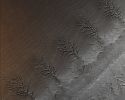
ESP_023164_1020_RED_abrowse-PCF-LXTT-01.jpgFeatures of the SPLD (EDM - Absolute Natural Colors; credits for the additional process. and color: Dr Paolo C. Fienga - Lunexit Team)198 visitenessun commentoMareKromium
|
|
| 32 immagini su 3 pagina(e) |
1 |
|








