| Risultati della ricerca nelle immagini - "SOHO" |
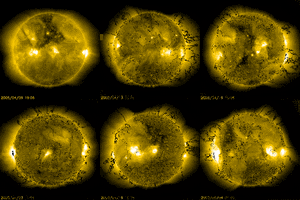
00-The Sun.gifThe Sun259 visite"It is in the Human Nature", qualcuno ha scritto, "to take everything for granted...Until you loose it".
Anche il Sole fa parte di quello che "diamo per scontato", come ovvio, ed è per questo che Vi offriamo questo piccolo filmato GIF - opera del Dr A. Feltri: per ricordare e ricordarVi grazie a 'che cosa', oggi, sin dal momento della nostra nascita e sino all'istante della nostra morte, possiamo dire di essere vivi e, quindi, possiamo vedere, respirare, avere esperienze, fare delle scelte, evolvere o regredire, ridere o piangere etc.
E' il Sole: la nostra Stella, ma solo una delle tante...
|
|

Solar Eclipse 2006.jpgFrom Space, from Earth...68 visiteDa "NASA - Picture of the Day" del 31 Marzo 2006:"Neither rain, nor snow, nor dark of night can keep the space-based SOlar Heliospheric Observatory (SOHO) from watching the Sun. In fact, from its vantage point 150 MKM sunward of planet Earth, SOHO's cameras can always monitor the Sun's Outer Atmosphere, or Corona.
But only during a total solar eclipse can earth-based observers see the lovely coronal streamers and structures - such as when the Moon briefly blocks the overwhelmingly bright solar surface.
In this composite view, SOHO's uninterrupted view of the Solar Corona above the Solar Photosphere (center) and Corona far beyond the Sun's disk, are shown in orange hues. The middle, donut-shaped region is the Corona as recorded by the Williams College Eclipse Expedition to Kastelorizo Island, Greece during the March 29th, 2006 total solar eclipse.
Merging ground and space-based views allows astronomers to trace features in the Corona that reach from just above the Sun's surface into the Solar Wind".
|
|

Solar Flare.jpgLoops over the Sun69 visiteCaption originale:"How can gas float above the Sun? Twisted magnetic fields arching from the Solar Surface can trap ionized gas, suspending it in huge looping structures. These majestic plasma arches are seen as prominences above the Solar Limb. In September 1999, this dramatic and detailed image was recorded by the EIT experiment on board the space-based SOHO observatory in the light emitted by ionized Helium. It shows hot plasma escaping into space as a fiery prominence breaks free from magnetic confinement a hundred thousand kilometers above the Sun. These awesome events bear watching as they can affect communications and power systems over 100 MKM away on Planet Earth".
|
|

Solar Prominence.jpgSolar "Blow"...76 visiteDa "NASA - Picture of the Day" del 7 Agosto 2006:"Our Sun is still very active. In the year 2000, our Sun went though Solar Maximum, the time in its 11-year cycle where the most sunspots and explosive activities occur. Sunspots, the Solar Cycle, and Solar Prominences are all caused by the Sun's changing magnetic field.
Pictured above is a solar prominence that erupted in 2002, July, throwing electrons and ions out into the Solar System.
The above image was taken in the ultraviolet light emitted by a specific type of Ionized Helium, a common element on the Sun. Particularly hot areas appear in white, while relatively cool areas appear in red. Our Sun should gradually quiet down until Solar Minimum occurs, and the Sun is most quiet. No one can precisely predict when Solar Minimum will occur, although some signs indicate that it has started already".
|
|
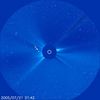
Sun-Saturn-IMG001612-br500.jpgSaturn's "superior conjunction"67 visiteIn this SOHO image taken July 21, 2005, the Sun is represented by the white circle in the center. Saturn is the bright object to the left of the Sun. Interestingly, the streak accompanying Saturn is not the rings but a distortion caused by Saturn's brightness. Saturn is approaching "superior conjunction," that is, it will be almost directly behind the Sun from Earth - thus the Cassini spacecraft, in orbit around Saturn, will not be able to send or receive transmissions normally. Regular science data collection has been temporarily suspended.
As Cassini passes closest by the limb of the Sun on July 24 PDT, all the communications will be impossible because of the Sun's radio noise. The spacecraft will regain full communication with Earth on July 27, once again returning Saturn science data. In the meantime, controllers are sending approximately 100 commands per day to test communication status. Cassini radio scientists are taking advantage of this opportunity to study the Sun's corona from its effects on the radio signals that reach Earth.
SOHO (Solar and Heliospheric Observatory Satellite) orbits the Sun parked in one of the five gravitational-neutral spots, called Lagrange Points. This specific spot, called L1, stays in the same place relative to the Sun and the Earth, offering a continuously uninterrupted view of the Sun.
|
|

The Sun from SOHO.jpgAnagliph of the Sun83 visitenessun commento
|
|
|
|
| 6 immagini su 1 pagina(e) |
|








