| Risultati della ricerca nelle immagini - "Rupes" |
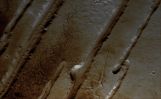
Channels-Panchaia_Rupes-PIA08622-1.jpg"Linear Fractures" or "Through Segments"? - Panchaia Rupes Region (Natural Colors; credits for the additional process. and color.: Dr Paolo C. Fienga - Lunexit Team)64 visiteImage information: VIS instrument;
Latitude: 29,9° North;
Longitude: 138,5° East;
Resolution: 19 meter/pixel.MareKromium
|
|
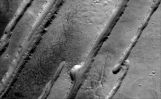
Fractures-Panchaia_Rupes-PIA08622-1.jpg"Linear Fractures" or "Through Segments" in Panchaia Rupes Region (Original NASA/JPL/ASU b/w Frame)74 visiteImage information: VIS instrument;
Latitude: 29,9° North;
Longitude: 138,5° East;
Resolution: 19 meter/pixel.
|
|

Miranda-vg2_2684617-A.jpgThe beautiful "Verona Rupes" from a different angle (context image)106 visitenessun commento
|
|

Miranda-vg2_2684617-B.jpgThe beautiful "Verona Rupes" from a different angle (detail mgnf)122 visiteUn detail mgnf dedicato ad un frame raro e stupendo che ci rammenta (ancora una volta) una delle Meraviglie del Sistema Solare: le Verona Rupes.
|
|

Psp_008222_1640_red.jpgCollpse Pits along Claritas Rupes (Saturated and Enhaced Natural Colors; credits for the additional process. and color.: Dr Paolo C. Fienga - Lunexit Team)89 visitenessun commentoMareKromium
|
|

Q-S-BosporusRupes-PIA08047_modest.jpgBosporos Rupes78 visiteThis image was taken in the mid-latitudes of Mars' Southern Hemisphere near the giant Argyre Impact Basin. It is located just to the West of a prominent scarp known as Bosporos Rupes. The left side of the image shows cratered plains. Some of the craters are heavily mantled and indistinct, whereas others exhibit sharp rims and dramatic topography. The largest crater in this half of the image is about 2,5 Km wide. Mounds and ridges, which may be remnants of an ice-rich deposit, are visible on its floor. Three sinuous valleys occupy the center of the image. Valleys such as these were first observed in data returned by the NASA Mariner 9 spacecraft, which reached Mars in 1971. The right side of the image shows part of an impact crater that is approx. 20 Km in diameter. The furrowed appearance of the crater's inner wall suggests that it has been extensively modified, perhaps by landslides and flowing water. Like other craters in the area, the floor of this crater has a rough and dissected texture that is often attributed to the loss of ice-rich material.
This image was taken by the High Resolution Imaging Science Experiment (HiRISE) camera onboard NASA's Mars Reconnaissance Orbiter spacecraft on March 24, 2006. The image is centered at 40,64° South Latitude, 303,49° East Longitude. The image is oriented such that North is 7° to the left of up. The range to the target was 2.044 Km (about 1.270 miles). At this distance the image scale is 2,04 mt (6,69 feet) per pixel, so objects as small as 6,1 mt (20 feet) are resolved. In total this image is 40,90 Km (about 25,41 miles) or 20.081 pixels wide and 11,22 Km (such as 6,97 miles) or 5.523 pixels high. The image was taken at a Local Mars Time of 07:30 and the scene is illuminated from the upper right with a solar incidence angle of 81,4° (this meaning that the Sun was about 8,6° above the horizon).
|
|
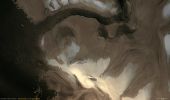
RupesTenuis-428-20081205-5872-6-co-01-RupesTenuis_H1.jpgNorth Polar Features: Rupes Tenuis (Natural Colors; credits: Lunar Explorer Italia)78 visiteCaption ESA:"ESA’s Mars Express Orbiter imaged the snow-laden region of Rupes Tenuis on the Martian North Pole on July, 29th, 2008.
Rupes Tenuis is located at the southern edge of the Martian North Polar Cap, approx. 5500 Km North-East of the Tharsis Province.
The image shows an area located at about 81° North Lat. and 297° East Long. and has a ground resolution of approx. 41 mt/pixel. It covers an area of about 44.000 Km2 (such as almost as large as the Netherlands)".
Nota Lunexit: secondo noi, questa "immagine" (che in realtà dovrebbe essere un fotomosaico) NON E' reale. L'immagine...NON E' un'immagine reale di Marte (è solo una ricostruzione virtuale, nello stile tipico della - sempre più ambigua e sopravvalutata - ESA). MareKromium
|
|

South_Polar_Regions-Rupes_Tenuis-ESA-PF.jpgRupes Tenuis (possible Natural Colors; credits ESA - additional color. and process. Dr Paolo C. Fienga)93 visiteESA’s Mars Express orbiter imaged the snow-laden Region of Rupes Tenuis on the Martian North Pole on 29 July 2008.
Rupes Tenuis is located at the Southern Edge of the Martian North Polar Cap, approx. 5500 Km northeast of the Tharsis Volcanic Region.
The images are at about 81° north and 297° east and have a ground resolution of approx. 41 mt/pixel. They cover an area of about 44.000 square/Km, almost as large as the Netherlands.
Nota Lunexit: a nostro avviso questa "immagine" NON E' VERA! E' un disegno. Al limite, è la trasposizione digitale di un frame RAW originale unprocessed (ma ne dubitiamo).MareKromium
|
|

ZZ-Mercury-Rupes-Terror_Rupes-PIA17881-PCF-LXTT-IPF-00.jpgTerror Rupes (CTX Frame - Absolute Natural Colors; credits for the additional process. and color.: Dr Paolo C. Fienga/Lunar Explorer Italia/Italian Planetary Foundation)80 visiteThis is certainly not the first time that we can take a look at the Limb of Mercury and, just as usual, we have to underline that these kind of images never fail to showcase the Geological Diversities of the Innermost Planet of the Solar System. This time, something fills the scene with "terror" and that is, to be clear and precise, the "Terror Rupes", such as the long, Cliff-like Landform visible almost at (better yet to say "near"...) the center of the scene. Terror Rupes is one of Mercury's most prominent Lobate Scarps, and it was so named after the HMS (---> Her Majesty's Ship) Terror: an eighteenth-century warship that, later, participated in Scientific Polar Explorations.
Date acquired: February, 4th, 2012
Image Mission Elapsed Time (MET): 236853865
Image ID: 1353252
Instrument: Wide Angle Camera (WAC) of the Mercury Dual Imaging System (MDIS)
Center Latitude: 69,30° South
Center Longitude: 96,00° East
Solar Incidence Angle: 80,3° (meaning that the Sun, at the time that the picture was taken, was about 9,7° above the imaged Local Mercurian Horizon)
Emission Angle: 50,9°
Sun-Mercury-Messenger (or "Phase") Angle: 114,5°
This picture (which is an Original NASA - MESSENGER Spacecraft's b/w and NON-Map-Projected image published on the NASA - Planetary Photojournal with the ID n. PIA 17881) has been additionally processed, contrast enhanced, Gamma corrected, magnified to aid the visibility of the details and then colorized in Absolute Natural Colors (such as the colors that a human eye would actually perceive if someone were onboard the NASA - MESSENGER Spacecraft and then looked outside, towards the Southern Limb of Mercury), by using an original technique created - and, in time, dramatically improved - by the Lunar Explorer Italia Team. Different colors, as well as different shades of the same color, mean, among other things, the existence of different Elements (Minerals) present on the Surface of Mercury, each having a different Albedo (---> Reflectivity) and Chemical Composition.MareKromium
|
|

ZZ-Mercury-Rupes-Terror_Rupes-PIA17881-PCF-LXTT-IPF-01.jpgTerror Rupes (EDM - Absolute Natural Colors; credits for the additional process. and color.: Dr Paolo C. Fienga/Lunar Explorer Italia/Italian Planetary Foundation)82 visiteIn this picture, we can better see the Southern Mercurian Relief known as "Terror Rupes": it is the long, Cliff-like Landform visible right in the middle of the frame. Terror Rupes is one of Mercury's most prominent Lobate Scarps, and it was so named after the HMS (---> Her Majesty's Ship) Terror: an eighteenth-century warship that, later, participated in Scientific Polar Explorations.
Date acquired: February, 4th, 2012
Image Mission Elapsed Time (MET): 236853865
Image ID: 1353252
Instrument: Wide Angle Camera (WAC) of the Mercury Dual Imaging System (MDIS)
Center Latitude: 69,30° South
Center Longitude: 96,00° East
Solar Incidence Angle: 80,3° (meaning that the Sun, at the time that the picture was taken, was about 9,7° above the imaged Local Mercurian Horizon)
Emission Angle: 50,9°
Sun-Mercury-Messenger (or "Phase") Angle: 114,5°
This picture (which is a crop taken from an Original NASA - MESSENGER Spacecraft's b/w and NON-Map-Projected image published on the NASA - Planetary Photojournal with the ID n. PIA 17881) has been additionally processed, contrast enhanced, Gamma corrected, magnified to aid the visibility of the details and then colorized in Absolute Natural Colors (such as the colors that a human eye would actually perceive if someone were onboard the NASA - MESSENGER Spacecraft and then looked outside, towards the Surface of Mercury), by using an original technique created - and, in time, dramatically improved - by the Lunar Explorer Italia Team. Different colors, as well as different shades of the same color, mean, among other things, the existence of different Elements (Minerals) present on the Surface of Mercury, each having a different Albedo (---> Reflectivity) and Chemical Composition.MareKromium
|
|

m10_aom_11_27.jpgDiscovery Rupes' Scarp (HR)63 visiteA limping Mariner 10 spacecraft was coaxed into a third and final encounter with Mercury in March of 1975.
Due to several problems with the aging spacecraft, only ~450 useful images of the Planet were acquired, though many are at significantly higher resolution than previous encounters.
In this HR image (FDS 528884) the Sun is low to the horizon thus enhancing topographic features with prominent shadows.
As can be seen here, the surface of Mercury is heavily cratered similar to the Moon.
|
|
|
| 11 immagini su 1 pagina(e) |
|








