| Risultati della ricerca nelle immagini - "Rocknest" |

SOL0052-PIA16204-PCF-LXTT-IPF.jpg"Rocknest" Site - Sol 52 (Absolute Natural Colors; credits for the additional process. and color.: Dr Paolo C. Fienga - Lunar Explorer Italia/Italian Planetary Foundation)110 visiteCaption NASA:"This patch of windblown Sand and Dust downhill from a cluster of Dark Rocks is the so-called "Rocknest" Site, which has been selected as the likely location for first use of the scoop on the Robotic Arm of NASA's Mars Exploration Rover Curiosity. This view is a mosaic of images taken by the telephoto right-eye camera of the Mast Camera (Mastcam) during the 52nd Martian Day, or Sol, of the mission (such as September, 28, 2012). Just 4 (four) Soles before, the Rover arrived at Rocknest. The "Rocknest" patch is about 8 by 16 feet (such as approx. 1,5 by 5 meters)".MareKromium
|
|

SOL0059-PIA16452-PCF-LXTT-IPF.jpgRocknest 3 - Sol 59 (Absolute Natural Colors; credits for the additional process. and color.: Dr Paolo C. Fienga/Lunar Explorer Italia/Italian Planetary Foundation)97 visiteThis view of a Martian Rock nicknamed "Rocknest 3" combines 4 (four) images taken by the right-eye camera of the Mast Camera (MastCam) Instrument located onboard the NASA - Mars Exploration Rover - Mars Laboratory "Curiosity", which has a telephoto, 100-millimeter-focal-length lens. The component images were taken a few minutes after Martian noon (---> 12:00 Mars Local Solar Time) on the 59th Martian Day, or Sol, of Curiosity's operations at Gale Crater, Mars.
Rocknest 3 is a Sedimentary Rock approximately 15" (such as about 40 centimeters) long and about 4" (approx. 10 centimeters) tall; next to "Rocknest 3" there is a patch of windblown Dust and Sand where Curiosity scooped and analyzed several Soil Samples. The MastCam was about 13 feet (approx. 4 meters) from Rocknest 3 when the component images were taken, thus providing an image scale of about 0,01" (approx. 0,3 millimeter) per pixel.
This picture (which is an Original NASA - Mars Exploration Rover - Mars Laboratory "Curiosity" white-balanced color frame published on the NASA - Planetary Photojournal with the ID n. PIA 16452) has been additionally processed and then re-colorized in Absolute Natural Colors (such as the colors that a human eye would actually perceive if someone were near the NASA - Mars Exploration Rover (MER) - Mars Laboratory "Curiosity" and then looked down, towards the Rock known as Rocknest 3), by using an original technique created - and, in time, dramatically improved - by the Lunar Explorer Italia Team. Different colors, as well as different shades of the same color, mean, among other things, the existence of different Elements (Minerals) present on the Surface of Gale Crater, each having a different Albedo (---> Reflectivity) and Chemical Composition.MareKromium
|
|

SOL0066-EB-MF-LXTT-IPF.jpgDigging at Rocknest - Sol 66 (Natural Colors; credits for the additional process. and color.: Elisabetta Bonora and Marco Faccin/Lunar Explorer Italia/Italian Planetary Foundation)124 visitenessun commentoMareKromium
|
|
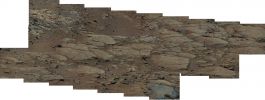
SOL0104-MF-LXTT-IPF.jpgThe Surface of Gale Crater - Sol 104 (An Image-Mosaic in RAW Natural Colors; credits for the additional process. and color.: Elisabetta Bonora and Marco Faccin/Lunar Explorer Italia/Italian Planetary Foundation) 104 visitenessun commentoMareKromium
|
|
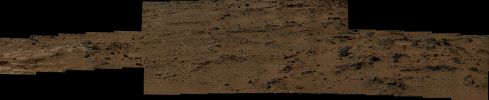
SOL0110-GB-LXTT-IPF-00.jpgThe Surface of Gale Crater - Sol 110 (An Image-Mosaic in Calibrated Natural Colors; credits for the additional process. and color.: Dr Gianluigi Barca/Lunar Explorer Italia/Italian Planetary Foundation) 100 visitenessun commentoMareKromium
|
|
|
|
|
| 5 immagini su 1 pagina(e) |
|








