| Risultati della ricerca nelle immagini - "Ring" |

001-vg1_p22990c.jpgThe "texture" of the Rings66 visitenessun commento
|
|

005-vg1_3469906.jpgClosing-up on the Rings63 visitenessun commento
|
|

006-vg2_4381849.jpgThe Rings and - maybe - Mimas66 visitenessun commento
|
|

011-vg2_p23927.jpgThe texture of the Rings (false colors - detail mgnf)66 visitenessun commento
|
|

013-vg2_p23953.jpgThe Rings (HR - false colors)67 visitenessun commento
|
|

AI-Saturn-Streak in the Sky-N00018041.jpgA new "Bright Streak" in the Sky of Saturn97 visiteUna nuova "striscia luminosa" (bright streak) nel Cielo di Saturno, ripresa il giorno 14 Settembre 2004. Che dire? Secondo noi - anche se accettassimo acriticamente la teoria che spiega alcune (comunque brevi e piuttosto deboli) striature di luce che, spesso, appaiono nelle immagini scattate guardando verso lo spazio come "raggi cosmici" - questa specifica "striscia" sembra qualcosa di molto particolare. Qualcosa che non può essere semplicemente ricondotto all'emissione luminosa di una micro-particella che schizza nello spazio a velocità presso-relativistica.
Secondo noi, questa striscia (come anche altre, riprese dalla superficie di Marte) è causata da qualcosa di diverso.
Cosa?
E se lo sapessimo...Ve lo diremmo!
|
|

AL-Streak Again-N00018570.jpgStreak again!88 visiteUna nuova "Striscia nel Cielo" - del 17/9/2004 - da guardare con estrema cura. Il motivo è questo: abbiamo svolto una semplice analisi sul frame scoprendo che la Striscia, stavolta, è costituita - ed è la 1ma volta che lo si vede con estrema chiarezza - da una sequenza di punti luminosi ravvicinatissimi i quali, per altro, non hanno tutti la stessa intensità luminosa. Un effetto similare (se non identico) lo si può ottenere, sulla Terra, riprendendo - con obbiettivo grandangolare o simile - una porzione di cielo notturno (con esposizione fra i 10 ed i 18/20") mentre un qualsiasi velivolo convenzionale si trovi in transito attraverso tale porzione di cielo. Effettuato lo sviluppo dell'immagine, noterete che il corpo del velivolo risulterà costituito da una serie ravvicinatissima di punti luminosi i quali diventeranno "più luminosi" in corrispondenza dei flash emessi dalle sue luci di posizione. Cosa implichiamo con questo discorso?
Che la Streak in the Sky di oggi NON E' CERTAMENTE un raggio cosmico!
|
|
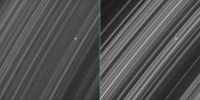
Aldebaran-PIA08300.jpgThrough the B-Ring104 visiteThese side-by-side views of a star (Aldebaran?) seen through Saturn's densely populated B-Ring show marked contrast between the region where spokes - the ghostly radial features periodically seen in it - are produced and regions where no spokes are seen.
In the view at left, the B-Ring displays an uneven grainy texture, with a great deal of variability in brightness along the direction of the particle motion. In the view at right, the B-Ring is far smoother and more uniform along the same longitudinal direction.
Ring scientists on the Cassini Imaging Team are studying images such as these to understand the processes by which spokes are created. This difference in appearance from one location to another on the Ring could provide the researchers with helpful insights into the features' formation.
These views were acquired about half an hour apart as the Cassini spacecraft looked toward the unlit side of the Rings from about 33° above the Ring-Plane.
|
|

Daphnis-PIA08924.jpgDaphnis is there...somewhere!70 visiteCaption NASA:"The presence of the tiny ring moon Daphnis is betrayed by the edge waves it creates in the Keeler Gap.
The Gap is a narrow lane, about 42 Km (26 miles) wide, in Saturn's outer A-Ring. Daphnis (7 Km, or 4,3 miles across) was discovered in Cassini spacecraft images at the same time that scientists spotted the edge waves. Researchers had suspected the presence of a moon in this gap after Pan was discovered in Voyager spacecraft images taken 25 years earlier.
This view looks toward the unilluminated side of the Rings from about 54° above the Ring-Plane.
The image was taken in visible light with the Cassini spacecraft narrow-angle camera on March 17, 2007 at a distance of approx.y 1,8 MKM (1,1 MMs) from Saturn.
Image scale is roughly 10 Km (about 6 miles) per pixel".MareKromium
|
|

Daphnis-PIA11637.jpgHeavy Disturbances82 visiteCaption NASA:"This Cassini image, which at first appears to show a serene scene, in fact reveals dramatic disturbances created in Saturn's A-Ring by its moon Daphnis.
Near the center of the image, tiny Daphnis (about 8 Km across) appears as a bright dot in the Keeler Gap near the edge waves it has created in the A-Ring. The moon has an inclined orbit and its gravitational pull both perturbs the orbits of the particles of the A-Ring forming the Keeler Gap's edge and sculpts the edge into waves having both horizontal (radial) and out-of-plane components. Material on the inner edge of the gap orbits faster than the moon so that the waves there lead the moon in its orbit. Material on the outer edge moves slower than the moon, so waves there trail the moon.
Epimetheus (approx. 113 Km, or about 70 miles across) orbits beyond the F-Ring at the bottom of the image. Bright specks in the image are background stars.
This view looks toward the Northern, sunlit side of the Rings, from about 11° above the Ring-Plane.
The image was taken in Visible Light with the Cassini Spacecraft narrow-angle camera on Sept. 24, 2009. The view was obtained at a distance of approx. 1,8 MKM (about 1,1 MMs) from Daphnis.
Image scale is roughly 11 Km (a little less than 7 miles) per pixel".MareKromium
|
|

Daphnis_and_Rings-PIA11656-1.jpgWavy Shadows (ctx frame)81 visiteCaption NASA:"This image of shadows on the Rings and others like it (see also PIA11653 and PIA11655) are only possible around the time of Saturn's equinox which occurs every half-Saturn-year, equivalent to about 15 Earth years. The illumination geometry that accompanies equinox lowers the Sun's angle to the Ring-Plane and causes out-of-plane structures to cast long shadows across the Rings.
This view looks toward the unilluminated side of the Rings from about 49° above the Ring-Plane. The image was taken in visible light with the Cassini Spacecraft narrow-angle camera on April 13, 2009.
The view was obtained at a distance of approx. 1,2 MKM (about 746.000 miles) from Daphnis and at a Sun-Daphnis-Spacecraft, or phase, angle of 56°.
Image scale is roughly 7 Km (about 5 miles) per pixel".MareKromium
|
|

Daphnis_and_Rings-PIA11656-2.JPGWavy Shadows (edm)80 visiteCaption NASA:"Never-before-seen tall vertical structures created by Saturn's moon Daphnis rise above the Planet's otherwise flat, thin disk of Rings to cast long shadows in this Cassini image.
Daphnis, approx. 8 Km (about 5 miles) across, occupies an inclined orbit within the about 42-Km (approx. 26-mile) wide Keeler Gap in Saturn's outer A-Ring. Recent analyses by imaging scientists published in the Astronomical Journal illustrate how the moon's gravitational pull perturbs the orbits of the particles forming the Gap's edge and sculpts the edge into waves having both vertical and horizontal components.
Measurements of the shadows in this and other images indicate that the vertical structures range between one-half to 1,5 Km tall (about 1/3rd to one mile), making them as much as 150 times as high as the Ring is thick. The main A, B and C-Rings are only about 10 meters (about 30 feet) thick. Daphnis itself can be seen casting a shadow onto the nearby Ring".MareKromium
|
|
| 287 immagini su 24 pagina(e) |
1 |
 |
|
|
|
|
|
|
|
|
|








