| Risultati della ricerca nelle immagini - "Ridge" |

Craters-Unnamed_Crater-ESP_017975_1705-PCF-LXTT-IPF.jpgUnnamed Crater with Ridges (Absolute Natural Colors; credits for the additional process. and color.: Dr Paolo C. Fienga/Lunar Explorer Italia/Italian Planetary Foundation)88 visiteMars Local Time: 15:20 (Early Afternoon)
Coord. (centered): 9,515° South Lat. and 16,433° East Long.
Spacecraft altitude: 261,3 Km (such as about 162,267 miles)
Original image scale range: 52,3 cm/pixel (with 2 x 2 binning) so objects ~ 1 mt and 57 cm across are resolved
Map projected scale: 50 cm/pixel
Map projection: EQUIRECTANGULAR
Emission Angle: 0,7°
Phase Angle: 60,4°
Solar Incidence Angle: 60° (meaning that the Sun was about 30° above the Local Horizon at the time the picture was taken)
Solar Longitude: 96,6° (Northern Summer - Southern Winter)
Credits: NASA/JPL/University of Arizona
Additional process. and coloring: Lunar Explorer Italia
This picture (which is a NASA - Original Mars Reconnaissance Orbiter NON-Map Projected CTX b/w frame identified by the serial n. ESP_025557_1705) has been additionally processed and then colorized in Absolute Natural Colors (such as the colors that a human eye would actually perceive if someone were onboard the NASA - Mars Reconnaissance Orbiter and then looked down, towards the Surface of Mars), by using an original technique created - and, in time, dramatically improved - by the Lunar Explorer Italia Team.MareKromium
|
|
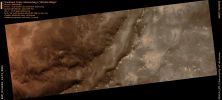
ESP_014260_1675_RED_abrowse.jpgUnnamed Crater intersecting a "Wrinkle Ridge" (Natural Colors; credits: Lunexit)106 visiteWrinkle Ridges are topographic structures produced by Subsurface faulting; they are commonly found on both the Moon and Mars.
This image shows a site where a Wrinkle Ridge intersects a Crater; the Ridge is a large feature and extends well outside this observation. The spur just inside the Crater Rim is roughly in line with the Wrinkle Ridge structure and probably represents enhanced crater collapse along the fault line.
An alternative possibility is that this spur was created by movement of the Wrinkle Ridge fault after the Crater formed, but this is unlikely because the Outer Rim of the Crater is not cut. Observations like this help constrain the relative timing of events on Mars.MareKromium
|
|
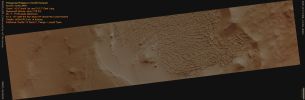
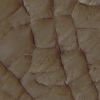
ESP_017348_1910_RED_abrowse-00.jpgPolygonal Ridges in Gordii Dorsum (CTX Frame - Natural Colors; credits for the additional process. and color.: Dr Paolo C. Fienga - Lunexit Team)98 visiteThis image from the Gordii Dorsum Region of Mars shows a large area covered with Polygonal Ridges in an almost geometric pattern.
The Ridges may have originally been Dunes which hardened (indurated) through the action of an unknown process.
Groundwater might have been involved.MareKromium
|
|
ESP_017348_1910_RED_abrowse-01.jpgPolygonal Ridges in Gordii Dorsum (EDM - Natural Colors; credits for the additional process. and color.: Dr Paolo C. Fienga - Lunexit Team)143 visitenessun commentoMareKromium
|
|

ESP_023328_1325_RED_abrowse-PCF-LXTT.jpgUnnamed Impact Crater wth Gullies and curved Ridges (Absolute Natural Colors; credits for the additional process. and color.: Dr Paolo C. Fienga - Lunexit Team)286 visiteMars Local Time: 14:18 (Early Afternoon)
Coord. (centered): 47,4° South Lat. and 37,6° East Long.
Spacecraft altitude: 251,1 Km (such as about 156,9 miles)
Original image scale range: 25,1 cm/pixel (with 1 x 1 binning) so objects ~ 75 cm across are resolved
Map projected scale: 25 cm/pixel
Map projection: EQUIRECTANGULAR
Emission Angle: 0,5°
Sun-Mars-Spacecraft (or "Phase") Angle: 46,1°
Solar Incidence Angle: 46° (meaning that the Sun is about 44° above the Local Horizon)
Solar Longitude: 330,5° (Northern Winter)
Credits: NASA/JPL/University of Arizona
Additional process. and coloring: Dr Paolo C. Fienga - Lunar Explorer ItaliaMareKromium
|
|
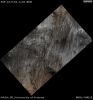
ESP_023578_1130_RED_abrowse-PCF-LXTT.jpgFeatures of Malea Planum (Absolute Natural Colors; credits for the additional process. and color.: Dr Paolo C. Fienga - Lunexit Team) 244 visiteMars Local Time: 14:37 (Early Afternoon)
Coord. (centered): 66,7° South Lat. and 57,7° East Long.
Spacecraft altitude: 250,1 Km (such as about 156,3 miles)
Original image scale range: 25,0 cm/pixel (with 1 x 1 binning) so objects ~ 75 cm across are resolved
Map projected scale: 25 cm/pixel
Map projection: POLAR STEREOGRAPHIC
Emission Angle: 5,5°
Sun-Mars-Spacecraft (or "Phase") Angle: 61,7°
Solar Incidence Angle: 65° (meaning that the Sun is about 25° above the Local Horizon)
Solar Longitude: 341,0° (Northern Winter)
Credits: NASA/JPL/University of Arizona
Additional process. and coloring: Drr Gianluigi Barca and Paolo C. Fienga - Lunar Explorer ItaliaMareKromium
|
|
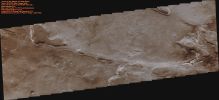
Layers-PIA14365-PCF-LXTT.jpgLayered Ridge (Natural Colors; credits for the additional process. and color.: Dr Paolo C. Fienga - Lunexit Team)148 visiteCaption NASA:The Layered Ridge and Mesas visible in this VIS image are located on the Northern Margin of the Hellas Basin".
MareKromium
|
|

Linear_Ridges-PCF-LXTT-1.jpgLinear Ridges (Enhanced Natural Colors; credits for the additional process. and color.: Dr Paolo C. Fienga - Lunexit Team)75 visitenessun commentoMareKromium
|
|
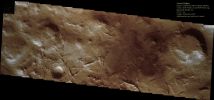
Linear_Ridges-PCF-LXTT.jpgLinear Ridges (Enhanced Natural Colors; credits for the additional process. and color.: Dr Paolo C. Fienga - Lunexit Team)78 visitenessun commentoMareKromium
|
|

Oenotria_Scapuli-PIA14567-PCF-LXTT.jpgFeatures of Oenotria Scapuli (Absolute Natural Colors; credits for the additional process. and color: Dr Paolo C. Fienga - Lunexit Team)205 visiteOrbit Number: 42604
Latitude: 5,8920° South
Longitude: 68,8747° East
Instrument: VIS
Captured: July, 23rd, 2011
Mars Local Time (M.L.T.): 06:03 (Early Morning Hours)
MareKromium
|
|
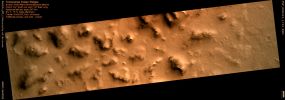
PSP_008323_1735_RED_abrowse-00.jpgTARs and Unusual "Star Ripples" (MULTISPECTRUM; credits: Lunexit)77 visiteThis blocky terrain is southwest of Schiaparelli Crater and is surrounded by a field of Transverse Aeolian Ridges (TARs) and unusual "Star Ripples" (dunes).
TARs are linear ripples with crest-ridge morphologies that can vary in shape; these morphologies include forked, sinuous, barchanoid, networked or feathered characteristics. The ridges also appear to transition into star dunes.
Star Dunes are complex features and are not yet fully understood on Earth. They form by multidirectional wind regimes with a dominant Primary Wind. Chains of Star Dunes often appear to have a massive linear appearance, or can be modified linear or Barchan Dunes with the formation of secondary slipfaces (on the steeper slope). On Earth, there are incipient Star Dunes, such as in the Dumont Dune field in the Mojave Desert, that display similar characteristics. The Dumont embryonic Star Dunes may result from dunes merging as they overrun one another, or are modified preexisting dunes, which could also be the case in this image.
Martian weather models predict that the dominate wind comes from a South-Westerly direction. This direction aligns nicely with the Transverse Ripples and the main arms of the Star Ripples.
This suggests that the Star Ripples were also affected by a different wind pattern or "Secondary Winds" or "Secondary Airflow". (Secondary Airflow is the airflow and sediment transport around the slopes of the dune).
Formation of incipient Star Dunes depends on the nature (strength, direction, and duration) of the Primary Wind and the volume of the sand to create the dune. Secondary airflow maintains the dune arms. The last factor is the deposition or removal of the sand by grainfall or grainflow avalanching. Grainfall and grainflow transports material from the main crestline slipface and along-slope or down-slope which maintains the secondary arm crest.MareKromium
|
|

PSP_010057_2040_RED.JPGUnnamed Crater with Ridges and DD Tracks (natural colors; credits: Lunexit)69 visiteThis image shows two features of interest on the floor of a large impact crater. The first is the set of roughly parallel ridges on the crater floor that point towards the crater center north of the image. These may be Inverted Stream Channels, where old streambeds became resistant to erosion due to cementation or simply deposition of large rocks. This is consistent with the slightly wavy, sinuous shape of the ridges, but these examples are not particularly well-preserved.
More recently, this site has become blanketed by dust, settling out after Global Dust Storms. This obscures much of the fine-scale geology, but allows HiRISE to see the effects of a recent process: Dust Devils. These have left the dark stripes across the surface by disturbing the dust cover. Most followed straight paths, but a few loops or turns are visible. Dust Devils may be an important factor in the Martian climate system because they lift dust into the atmosphere, helping to trigger larger Dust Storms.MareKromium
|
|
| 21 immagini su 2 pagina(e) |
1 |
|








