| Risultati della ricerca nelle immagini - "Radio" |
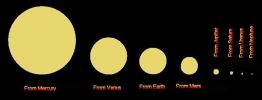
000-The_Sun_from_Space.JPGThe Sun from all the Planets of the Solar System181 visiteCome appare (o meglio: "Quanto grande" dovrebbe apparire) il Disco Solare allorchè osservato da un Mondo diverso dalla Terra?
Senza pretesa di assolutezza matematica, questa Tavola dovrebbe fornirVi un'idea più precisa della questione su cui tanto ci siamo arrovellati sino ad ora.
Nota: i diversi diametri sono stati ipotizzati ragionando in termini di UA (Unità Astronomiche), laddove 1 UA = distanza Sole / Terra = 149.597.970 Km
ergo la distanza fra il Sole e Mercurio viene fatta mediamente pari a (circa *) 0,4 UA
fra il Sole e Venere è mediamente pari a (circa) 0,7 UA
fra il Sole e Marte è mediamente pari a (circa) 1,5 UA
fra il Sole e Giove è mediamente pari a (circa) 5,2 UA
fra il Sole e Saturno è mediamente pari a (circa) 9,5 UA
fra il Sole ed Urano è mediamente pari a (circa) 19,6 UA
fra il Sole e Nettuno è mediamente pari a (circa) 30 UA
fra il Sole ed il Sistema Binario Plutone-Caronte è mediamente pari a (circa) 39 UA
* diciamo circa perchè le orbite dei diversi Pianeti attorno al Sole NON descrivono cerchi perfetti (e quindi con raggio - distanza dal Sole - fisso), bensì delle ellissi più o meno allungate (le quali implicano l'esistenza di un "perielio" - o punto di massima vicinanza del Corpo Celeste considerato rispetto al Sole - ed un "afelio" - o punto di massima lontananza del Corpo Celeste considerato rispetto al Sole.MareKromium
|
|

034-Methane_of_Mars.jpgMap of the "Martian Methane"82 visiteCaption NASA:"Why is there Methane on Mars? No one is sure.
An important confirmation that Methane exists in the Atmosphere of Mars occurred last week, bolstering previous controversial claims made as early as 2003. The confirmation was made spectroscopically using large ground-based telescopes by finding precise colors absorbed on Mars that match those absorbed by Methane on Earth.
Given that Methane is destroyed in the open martian air in a matter of years, the present existence of the fragile gas indicates that it is currently being released, somehow, from the Surface of Mars.
One prospect is that microbes living underground are creating it, or created in the past. If true, this opens the exciting possibility that life might be present under the Surface of Mars even today. Given the present data, however, it is also possible that a purely geologic process, potentially involving volcanism or rust and not involving any life forms, is the Methane creator.
Pictured above is an image of Mars superposed with a map of the recent Methane detection".
Nota Lunexit: se la Mappa NASA è realmente accurata ed il quantitativo di Metano presente in Atmosfera è quello "suggerito" dalla Mappa stessa, allora - sempre seguendo la "Logica NASA" - ci troveremmo davanti a due possibili scenari:
1) Scenario Geologico (Metano come prodotto di processi geologici): Marte è ancora soggetto attivo di fenomeni vulcanici tutt'altro che minori e residuali, visti i quantitativi e la distribuzione del Metano nell'Atmosfera del Pianeta Rosso, oppure
2) Scenario Biologico (Metano come sottoprodotto di attività biologiche attuali): Marte è, letteralmente, "brulicante di Vita" - altro che batteri e micro-organismi - visti, come sopra, i quantitativi e la distribuzione del Metano nell'Atmosfera del Pianeta Rosso.
SOTTOLINEIAMO che queste nostre congetture DERIVANO LOGICAMENTE DALL'ANALISI DEI DATI NASA e NON da nostre speculazioni!
Vi suggeriamo, inoltre, di notare la posizione dei maggiori quantitativi di Metano nell'Atmosfera Marziana...MareKromium
|
|

HD-80606b.jpgA Dangerous Summer on HD 80606b84 visiteOn the distant planet HD 80606b, Summers might be dangerous.
Hypothetic life forms floating in HD 080606b's Atmosphere or lurking on one of its (presently hypothetical) moons might fear the 1500 Kelvin Summer heat, which is hot enough not only to melt Lead but also Nickel. Although Summers are defined for Earth by the daily amount of Sunlight, Summers on HD 80606b are more greatly influenced by how close the Planet gets to its Parent Star.
HD 80606b, about 200 LY distant, has the most elliptical orbit of any planet yet discovered. In comparison to the Solar System, the distance to its Parent Star would range from outside the orbit of Venus to well inside the orbit of Mercury.
In this sequence, the night side of HD 80606b is computer simulated as it might glow in infrared light in nearly daily intervals as it passed the closest point in its 111-day orbit around its Parent Star.
The simulation is based on infrared data taken in late 2007 by the Spitzer Space Telescope.
Nota Lunexit (a chi interessa): la Formula di Conversione per le Temperature espresse in Kelvin in Temperature espresse in Celsius è la seguente: T° Celsius = T Kelvin - 273,15
Nel nostro caso di specie, quindi, la temperatura diurna media Estiva di HD 80606b dovrebbe essere pari a circa 1227° C.
Un bel "tepore", davvero...MareKromium
|
|

Sagittarius_A.jpgThe Galactic Center Radio Arc78 visite"...Catilinam quocumque in populo videas, quocumque sub axe..."
(Giovenale)
"...Di gente come Catilina ne puoi vedere in ogni popolo e sotto ogni cielo..." (trad. libera)MareKromium
|
|

Spectra.jpgBreaking Distant Light78 visite"...Non si può conoscere un evento futuro ed incerto senza esserne, almeno in parte, la causa..."
P.C. Floegers - "In the Paradox"MareKromium
|
|

Titan-Cryovolcanism_Map-PIA11701.jpgIR Map of Titan's Active (Cryovolcanic) Regions67 visiteThis infrared projection map of Titan was composed from images taken by NASA's Cassini Spacecraft, Visual and Infrared Mapping Spectrometer. The location of two regions that changed in brightness are labeled. These regions are hypothesized by some to be areas of cryovolcanic activity on Titan.
Rather than erupting molten rock, it is theorized that the cryovolcanoes of Titan would erupt volatiles such as Water, Ammonia and Methane. Scientists have suspected cryovolcanoes might be on Titan, and the Cassini mission has collected data on several previous passes of the moon that suggest their existence. Imagery of the moon has included a suspect haze hovering over flow-like surface formations, which are plausibly the result of icy volcanism.
Some Cassini scientists indicate that such volcanism could release Methane from the interior, which explains Titan's seemingly continuous supply of fresh Methane. Without replenishment, scientists say, Titan's original Atmospheric Methane should have been exhausted long ago.
This image is an overlay of all the high-resolution images from the first 45 flybys, up through last February 2007. The map was created using what 2,1 micron wavelength. Image scale is about 25 Km (approx. 16 miles) per pixel or 1,8 pixels per degree".MareKromium
|
|
|
|
| 6 immagini su 1 pagina(e) |
|





